While South Africa’s major cities battle crumbling infrastructure, dry taps and decaying road networks, the civil servants running them earn more than the President of the Republic.
As the municipal elections draw near, some 20 days away, public attention must turn from political campaign slogans to the accounting officers holding real administrative power and the multi-billion-rand municipal purse strings.
Across the country’s eight metropolitan municipalities, election posters showcase mayoral candidates and party leaders, yet the individuals exercising direct executive and statutory authority remain largely invisible.
They are municipal managers or better known as City Managers. Their total annual compensation packages command up to R4.8 million, which is substantially higher than President Cyril Ramaphosa’s salary of roughly R3.5 million.
Across South Africa’s eight metros, the officials responsible for running city administrations command substantial remuneration packages, even as several municipalities continue to struggle with audit findings.
Cape Town city manager Lungelo Mbandazayo and Ekurhuleni’s Kagiso Lerutla sit at the top of the list, each with a total annual package of about R4.8 million. eThekwini city manager Musa Mbhele earns more than R4.3 million, followed by Johannesburg’s Floyd Brink and Tshwane’s Johann Mettler at about R3.3 million each.
Buffalo City’s Mxolisi Yawa receives around R2.5 million, while Mangaung’s Sello More earns more than R2.45 million. Nelson Mandela Bay is the exception, with Lonwabo Ngoqo serving in an acting capacity and therefore subject to the municipality’s acting-remuneration provisions. That is about R3.3 million.
The salaries are particularly striking when compared with President Cyril Ramaphosa’s remuneration of roughly R3.4 million to R3.5 million a year.
Here is why you must care: these are far from ceremonial posts. Municipal managers act as chief executive officers, leading the administrative machinery responsible for delivering water, electricity, roads, and sanitation. Yet nationwide, urban delivery is buckling, water networks are collapsing, and municipal financial governance is in severe distress.
SALARY VS AUDIT PERFORMANCE: SOUTH AFRICA’S METRO MANAGERS
Cape Town [R4.8m] —————————— Unqualified
Ekurhuleni [R4.8m] —————————— Unqualified
eThekwini [R4.3m] ————————– Qualified / Adverse
Johannesburg [R3.3m] —————————— Qualified
Tshwane [R3.3m] —————————— Qualified
Buffalo City [R2.5m] —————————— Unqualified
Mangaung [R2.45m] —————————– Qualified
Nelson Mandela [Acting] —————————– Qualified
What Does a City Manager Actually Do?
Diagnosing local government failure requires distinguishing political leadership from administrative execution. In an executive mayoral system, voters elect councillors who form the municipal council and elect an executive mayor. The mayor provides political direction, while council determines broad policies, priorities, and budgets.
Translating those decisions into a functioning city falls entirely to the municipal manager. Governed by the Local Government: Municipal Finance Management Act (MFMA) and the Municipal Systems Act, the city manager serves as chief executive and statutory accounting officer. This means the legal buck stops directly with them regarding municipal finances, multi-billion-rand asset registers and regulatory compliance.
When a water pipe bursts or a power grid fails, the city manager does not physically carry out the repair. However, the administration they lead must maintain the skilled personnel, heavy equipment, supply-chain procurement systems and operational plans to address infrastructure failures promptly.
When service delivery fails, an entrenched institutional blame game takes over: politicians routinely blame bureaucrats, bureaucrats point to political interference and ratepayers are left without essential services.
The framework governing municipal manager compensation is issued by the Department of Cooperative Governance and Traditional Affairs (COGTA). Municipalities are graded on population size, economic output, and generated revenue. Metros occupy Grade 6, which is the highest band, unlocking salary structures modelled after corporate executive suites.
The justification for multi-million-rand salaries rests on private-sector comparability. Metros manage massive balance sheets; the City of Johannesburg alone oversees an annual budget of approximately R90 billion. Proponents argue high remuneration attracts top executive talent and disincentivizes corruption.
However, attempting to professionalize municipalities by pegging executive salaries to corporate rates fails when tested against public reality. Paying corporate-level salaries has not eliminated systemic corruption, nor has it guaranteed executive competence. Instead, corporate benchmarks collide with partisan patronage, leaving ratepayers to fund executive-level packages for dysfunctional public administration.
“So that big salary is not drawing the best talent; it is getting the most compliant person to deliver political patronage. So we need to think differently about it,” analyst Tessa Dooms told The Debrief.
Municipal managers are appointed by municipal councils on fixed-term contracts, typically for five years, following interview and screening processes designed to enforce minimum statutory competencies.
In practice, appointments frequently diverge from statutory principles. A prime example is the ongoing controversy surrounding the appointment of Dr. Floyd Brink in Johannesburg. Candidates overseeing a R90-billion budget are legally expected to possess extensive financial management and operational experience in large urban centres.
Brink’s appointment faced intense legal challenges and public scrutiny because much of his prior municipal background was spent in rural municipal settings and within traffic management divisions, rather than leading major municipal financial or supply-chain departments.
This disconnect highlights a systemic vulnerability: the conflation of administrative capability with political patronage.
Commenting on the structural root of municipal appointments, governance expert Prof. Dumisani Jantjies notes:
“Many of the municipality managers’ appointments are a lot political-linked as opposed to competence-linked. So I feel we need to have a different way of thinking of getting municipality managers. There shouldn’t be the perception—I’m using the word perception—that they’re there mainly to get money to use it for political reasons and so on, hence the appointments become aligned a lot with political principles in particular. So there isn’t evidence that they’re capable, because if they’re capable, you’ll want to see municipalities being able to perform.”
Data from the Auditor-General tracking executive stability across metros reflects acute administrative turnover:
Nelson Mandela cycled through 18 acting city managers in 10 years (16 since 2020), severely crippling institutional continuity and financial oversight, The Daily Maverick reported.
Mangaung and Buffalo City metros cycled through 4 accounting officers across a single four-year evaluation cycle, diluting executive accountability.
Then you had repeated court challenges and council interdicts regarding city manager appointments in Johannesburg and Tshwane following coalition floor shifts.
Experts warned that when appointments are contested, the fallout paralyzes municipal operations. In fragile coalition environments, disputes over the city manager post freeze departmental budgets and halt procurement, even as revenue collection and payroll must continue.
Dooms stresses that multi-million-rand salaries actively entrench this patronage system rather than attracting independent professionals:
”These are people running companies. Even [if] a municipality was listed on the JSE, it would be on the top end of it—90-billion-rand budgets per year. Are we let our municipalities, particularly the metros, led by the best? And if we are, then how does it happen? So the idea about trying to almost professionalize and then privatize local government entities… has led to this idea that you attract the best talent by putting the bar in terms of salaries at competitive rates with the private sector.
The problem with that is it is not real politics… The second is patronage. Those managers are managers of political patronage in the main. That’s what it is. So that big salary is not drawing the best talent. It is getting the most compliant person to deliver political patronage. So we need to think differently about it.”
Dooms emphasizes that overcoming municipal breakdown requires political courage to decouple administration from party machinery:
“You can come into political office and make a choice not to rearrange people according to your political preferences, make a choice about hiring the most competent people. That’s what our system was designed around: it was designed around the Mandelas of society coming in and making the right kinds of political choices. And so right now, we need leaders who are going to be brave enough to make those choices, even though it goes against their political party’s interest.”
An official relying on political protection cannot maintain the professional independence needed to exercise their statutory duties and protect public funds, Dooms added.
With local government elections approaching on November 4, public debate remains fixated on political party manifestos and coalition deals. But all experts note that fixing governance in the cities, requires much higher level of accountability.
An immigrant displaced to Che Guevara Road in Durban holds up papers. Almost all people displaced to the encampment were documented. (Photo: Joseph Bracken, GroundUp)
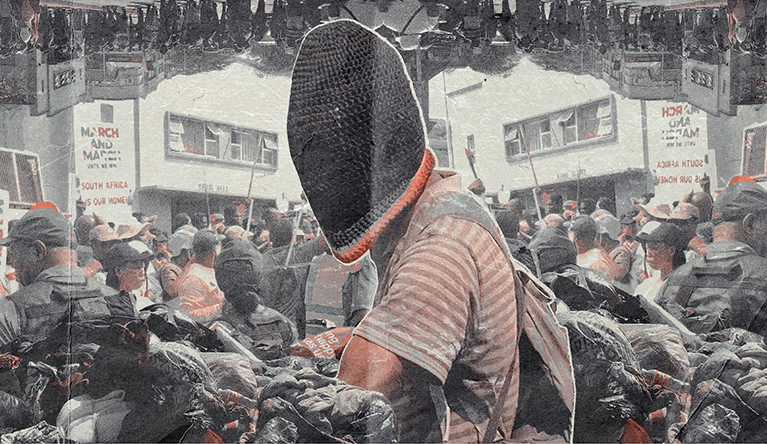
Last month, on 3 September, March and March supporters converged on an encampment of displaced immigrants at Che Guevara Road in Durban in a “clean up” operation. But, in their own words, the people displaced there had been driven from their homes and businesses by March and March in the months before.
March and March has consistently said that it is concerned with illegal immigration. But, a Department of Home Affairs verification process in June had found that all but three out of 457 were documented and legally resident in South Africa.
The march on 3 September turned violent and four immigrants were hospitalised. Possessions were piled in the road and marchers reportedly attempted to set these alight. This marked an escalation in the character of public demonstrations by March and March, which presents itself as non-violent, lawful and supportive of immigrants’ rights to reside legally in South Africa.
Unofficially, however, the movement’s supporters in Durban had flouted those principles for months, according to a new database containing the testimonies of 235 immigrants who say they were targeted by the movement.
The database was compiled by civil society coalition Siyafana Sonke Action Campaign and relied on individualised interviews with displaced immigrants – mostly Congolese and Burundian nationals. It describes how supporters of March and March took matters into their own hands in the run-up to the movement’s 30 June deadline for undocumented foreigners to leave the country.
In incidents throughout much of the year, and culminating in mid-May, respondents described small groups armed with machetes, spears and knopkieries marching on the homes, businesses and places of employment of scores of immigrants in and around the city centre.
Many interviewees said they were assaulted, while respondents commonly described being ordered to leave. Immigrants’ landlords were told to put them out and employers were told to fire them. Immigrant businesses and homes were looted.
Many immigrants reported that the police refused to assist or open cases, sometimes telling complainants to “go back” to their countries.
In September, Siyafana Sonke shared a redacted version of the database with Viewfinder for analysis. This article summarises the many findings.
Viewfinder also visited a shelter – at a private home in Glenmore, Durban – housing immigrants who have refused to leave the city, but are unable to return home for fear of attack.
Reports of violence and assault
Nearly a third of the 235 testimonies contained descriptions of physical assault by supporters of March and March, sometimes with the use of weapons.
A 54-year-old Burundian man, a Hutu who said he fled ethnic attacks in his home country, said he spent a week in King Edward Hospital after a group of around 20 people assaulted him on 14 July 2026.
A 58-year-old Congolese woman, who worked as a vegetable vendor on Smith Street in Durban, described how a group of March and March supporters attacked her, hit her on the head. While fleeing, she said that a nail got lodged in her leg and she required a tetanus injection.
A 46-year-old Burundian woman, who worked as a shoe vendor at Durban’s Sunday Market, said that she and her son were attacked at their stall on 8 March 2026. She was also forced from her home by her neighbours, who threatened to attack her family. She described five other attacks on her and her family at the market between 2019 and 2024, and shared police case numbers for each.
Loss of livelihoods and businesses
About a fifth of the people interviewed said they had lost their livelihoods. The reasons mostly related to businesses being attacked, looted and destroyed; to employers turning people away; or, to trading sites being abandoned due to threats.
A 51-year-old Congolese woman said that she was chased from a market where she traded in 2024. Protesters allegedly stole the business permit and subsequently operated from the site themselves. She was put out of her home on 27 May, she said.
A 29-year-old Burundian man said that protesters destroyed his motorbike which he used to generate an income.
A 27-year-old Burundian man said that his barbershop was attacked on multiple occasions between April and May 2026. He attempted to restart the barbershop several times, and was attacked each time. He described being assaulted with fists and sticks.
Theft, looting and destruction of property
In some instances, people described being robbed and looted as they were chased from their homes or turned out from their places of business.
A 38-year-old Congolese man from Umbilo said that protestors came to his mechanic yard and demanded that he close shop. He said that he was badly beaten and that the perpetrators took over his business and seized control of his equipment, which he estimated as being valued R42,000.
A 40-year-old Congolese man described how a large group attacked his barbershop in Chesterville on 14 March. One attacker allegedly had a knife and another a gun. He was robbed at knifepoint, with attackers taking his equipment and inverters.
Police allegedly refused to open dockets
About a fifth of respondents reported that police refused to open cases when immigrants tried to report the types of incidents outlined above.
Umbilo police station was most frequently accused of this, with seven people complaining that officers there refused to help them. Other stations accused of refusing to take cases included Mayville, Sydenham, Berea, Glenwood, Pinetown, Umkomaas, Durban Central, Point and Broad Street.
A 38-year-old Congolese nail technician who was attacked, chased from her stall and robbed said she attempted to open a case at Umbilo police station. She says the officer refused to open a case and told her to “go back” to her country, and that “if you don’t leave, we will hit you more”.
A 49-year-old Burundian woman said she tried to report an assault by March and March supporters on her son to police (her account does not identify which police station). Police told her, she said, that there are too many cases like this and that they do not have the capacity to give her a case number.
A 34-year-old Congolese woman from Mobeni who said that both the contents of her home and of her shop was looted bare, in April and July respectively. Her shop, she said, was looted in front of police officers who refused to intervene, despite her requests that they do. She attempted to report both incidents to Umbilo police station, but in both instances she was turned away.
SAPS says it is unaware of xenophobic attacks
Viewfinder put a query to KwaZulu-Natal police spokesperson Colonel Robert Netshiunda. It asked for SAPS’s response to allegations that it failed to protect migrants and refused to open cases in response to xenophobic attacks linked to March and March supporters.
“Police in KwaZulu-Natal are not aware of any xenophobic attacks at any part of the province,” he said.
“As for the alleged refusal to open cases by police, we will appreciate to be given specific details of each matter, what day, which police station and the names of police officers who refused to open cases (every police officer at the Community Service Center wears uniform with a name tag). They should be held accountable if found to have refused to open cases.”
“You must leave, or they will kill you”
Last month, Viewfinder visited one of the shelters – a residential home where at least fifteen people were huddled together in a small living room.
Burundian national Germain Semihare, 46, said he fled his home country in 2004 after his father was shot and killed during a dispute over the seizure of his property. Fearing the same fate, he left.
Semihare told a story of resilience and resolve. He arrived in Durban not knowing a word of English. He spent his first nights at the central police station for shelter and found work as a car guard in South Beach.
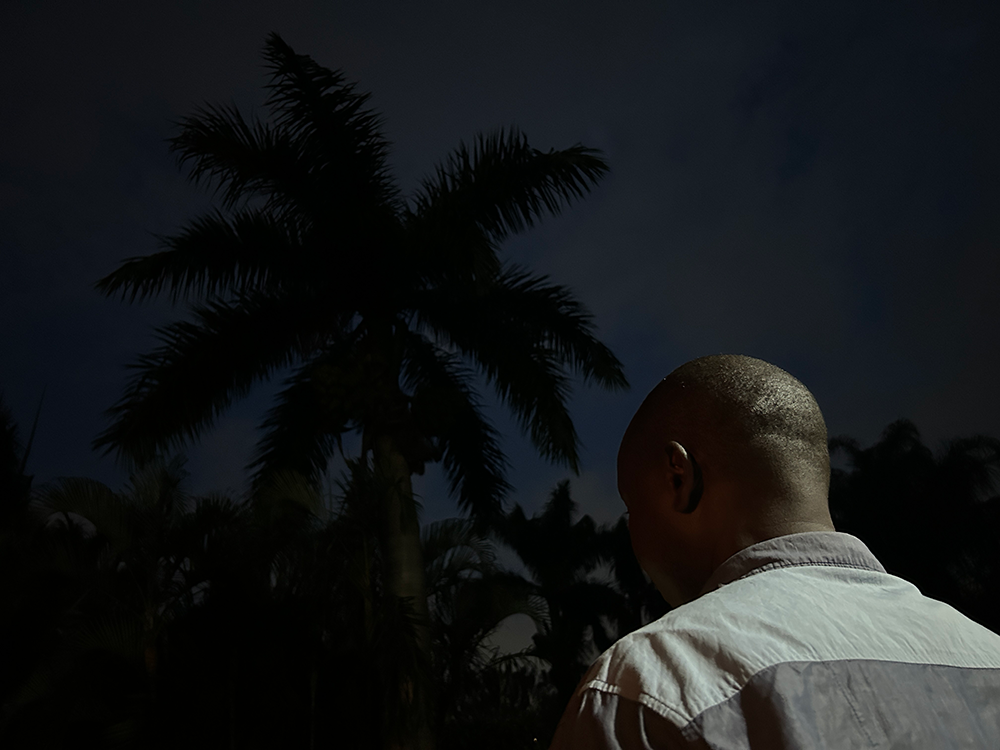
Germain Semihare was driven from his home in May, and has not seen his wife and children since. He asked to be photographed anonymously. (Photo: Daneel Knoetze, Viewfinder)
Twenty-two years later, before the attacks, he had come to consider himself settled, stable and integrated. He had married a Xhosa woman, with whom he has two children. He had opened a hair salon which employs four people. He also worked full-time as an admin clerk at a laboratory, earning a decent income. He said he was spared when xenophobic violence flared up in South Africa in 2008 and again in 2015.
In May, that all changed. He was attacked with sticks on the streets. His barbershop was looted. His employers asked him not to return. Then the vigilantes came for him at home.
“They beat our door. They said that they are going to kill us if we don’t leave. Luckily my wife was talking to them in Zulu,” he recalls.
“She then said to me ‘you must leave, or they will kill you.’”
He fled with just a tog bag. His wife later took the children to her parents in Mthatha. He has not seen them for four months.
“She says that she is praying for me to be stable again, like before. She says that it is going to be okay. I have to wait, maybe they are going to stop. We can go to the community. And start to open a business again, like before,” he said.
“We wish that, but we don’t know.”
March and March responds
Two weeks ago, Viewfinder interviewed March and March spokesman Sandile Dube over the phone.
He was asked what the movement’s position was on why more than 400 immigrants ended up sleeping on the street on Che Guevara Road for months, in light of claims that March and March supporters had displaced them. He did not answer directly.
“First and foremost, we are concerned about those people (the immigrants) and their own safety,” he said, explaining the movement’s rationale for marching on the encampment.
“It is inhumane that you can have a human being living under those conditions, both foreigners or South Africans. That must be condemned. There are children involved there. They must be protected.”
He was again asked to take a position on March and March supporters who had allegedly driven these people from their homes.
“Any South African who stands up for his country, we support that action. But, it must be within the laws of this country. So what does that mean?” he said.
He did not explain what that meant. He pivoted instead:
“Any illegal immigrant that is found in our country – we still stand to say that those immigrants should leave the country with immediate effect.”
When pressed, he acknowledged that he was aware that only three of the 457 people on Che Guevara Road were found to be undocumented. He was asked to reconcile his response with that fact.
“They are documented. However they don’t want to go back to their respective communities where they were. So, in the absence of going back to their communities, they must be deported to your respective countries.”
When asked point blank what he made of reports of widespread violence and intimidation by March and March supporters in Durban in the run up to the 30 June deadline, he pointed to the fact that on 30 June there were scores of non-violent marches in South Africa described by government as “peaceful”
“Then you come to say it was violent. There is a contradiction there. There is a possibility that these foreign nationals are not telling the truth.”
A query to eThekwini Municipality asked it to explain its failure to provide safe accommodation and protect the refugees from attacks. Spokesperson Senzelwe Mzila responded that immigration and refugee affairs fell under the mandate of the Department of Home Affairs, while policing, public order and criminal investigations were the responsibility of SAPS.
“We therefore respectfully refer you to SAPS and the Department of Home Affairs for
comment on the matters raised in your correspondence,” he concluded.
XenoBarometer tracks the anti-immigrant movement and its impact. We aim to surface underreported stories, paying close attention to potential rights abuses, emerging patterns in anti-immigrant mobilisation and failures in the government’s response. It is produced by the Southern Africa Accountability Journalism Project (SA | AJP), an initiative of theHenry Nxumalo Foundationworking withViewfinderand with the financial assistance of the European Union. It can under no circumstances be regarded as reflecting the position of the EU.
The drought-adapted succulent spekboom has long been trumpeted as the crown prince of South Africa’s nature-based carbon sink solutions.
The World Bank ensured its coronation with a $120 million outcome-based bond, structured and named in its honor.
According to Amazon, the tech giant’s commitment to buy carbon credits from the first developer to draw on the bond gave other financiers the confidence to back the industrial-scale project. Does this make the tech giant the power behind the throne of an emerging nature-based carbon credit sector?
Our investigation uncovers a sector dominated by international corporations whose investment promises are hard to scrutinize, in a cautionary tale of what happens when projects fail.
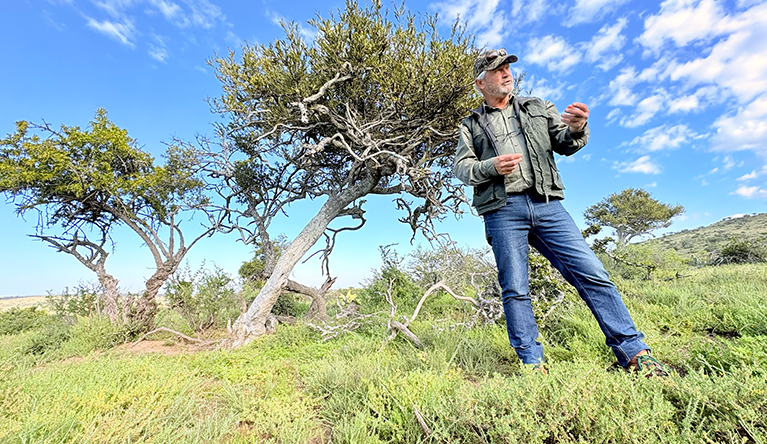
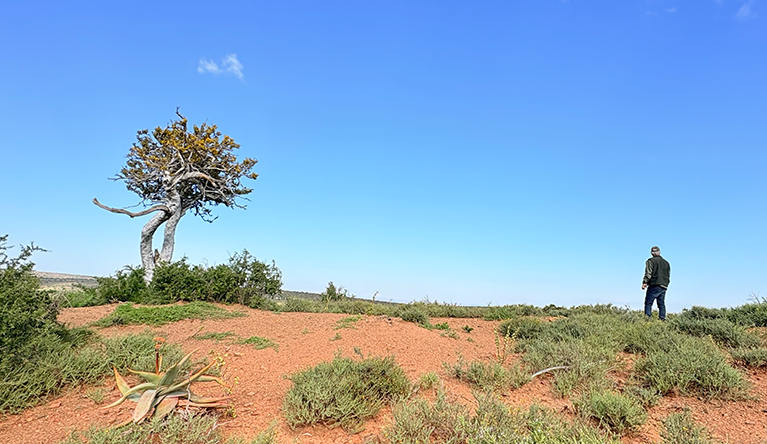
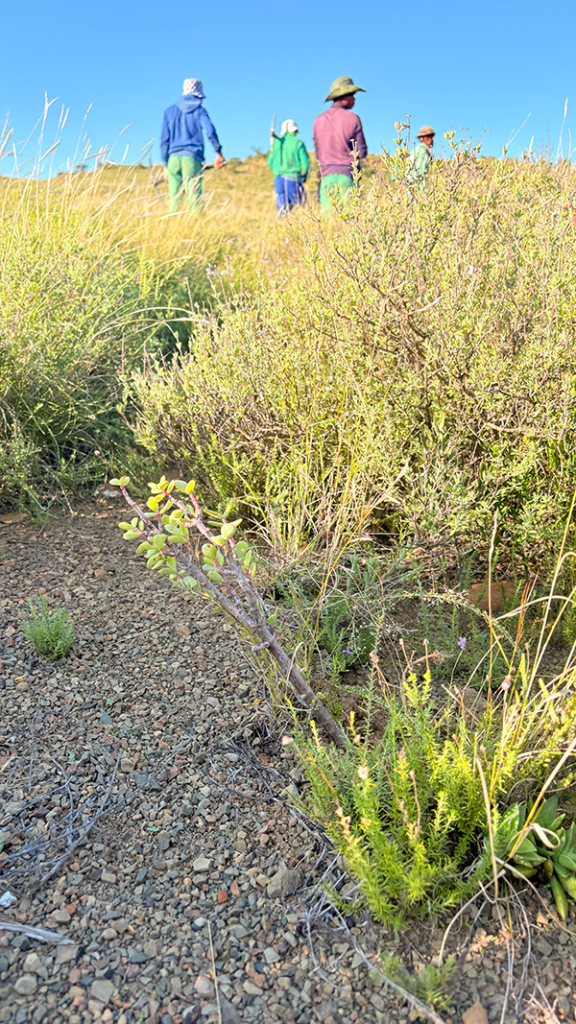
Browsed. Heavily browsed. Knackered. This farm camp is well on the knackered side of the degradation scale, threadbare after decades of heavy livestock pressure. But the single shrub at Nick Hamp-Adam’s feet may help change that. It just needs a second chance.
For generations, the Albany thicket biome in the Eastern Cape fueled a thriving economy of sheep and goat farming. Today, an area of 1.5 million hectares needs urgent ecosystem repair. Pic: Leonie Joubert
This young spekboom plant (Portulacaria afra) is more stocky shrub than rooted cutting. It’s had more time than usual in the nursery to bulk up ahead of being released into the wild. But for the moment, it’s stricken on its side, roots exposed.
Hamp-Adams, general manager for Return to Thicket, one of the smaller restoration projects in this nook of South Africa’s Eastern Cape province, is about to set things right. He sinks to his knees, finds a hand-sized stone and begins reopening the original planting hole.
“Kudu, most likely …”
His breath is metered by his efforts with the digging tool.
“… came through …”
Strike.
“… grabbed it …”
Strike.
“… probably wasn’t planted deep enough.”
Strike.
He’s gentle when he rights the plant, taking care as he tamps the soil around its roots. Tough plants, generally. Don’t need much coddling. Except during planting. Treat them like babies during planting.
This individual is one of thousands of cuttings of this drought-tolerant endemic succulent that are being popped into the ground across 2,100 hectares (5,200 acres) of exhausted farmland recently purchased by Return to Thicket. As the vegetation regrows, it’s expected to draw the equivalent of 10.3 metric tons of carbon dioxide from the atmosphere per hectare per year over the course of three decades. That’s the equivalent emissions from nearly four round-trip flights for a single person between London and New York.
But that’s not what makes this particular shrub noteworthy. This plant, and the countless others around the camp, were rescued from another thicket restoration project in the area, one that closed down a few years back when its international backer pulled out.
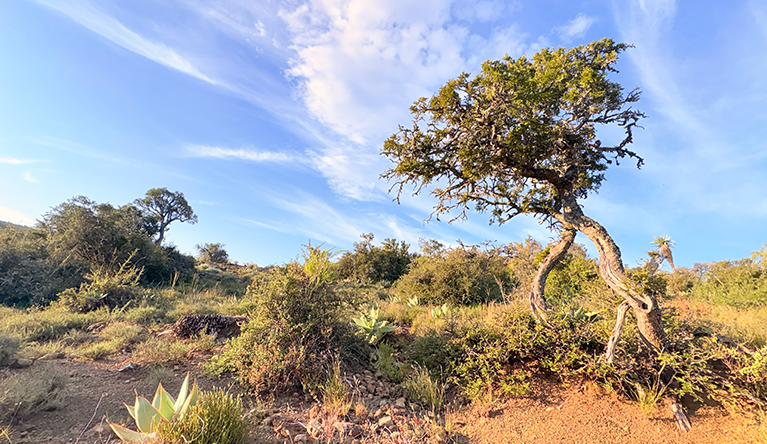
Pastures cut into the near-pristine Albany thicket outside Makhanda in Eastern Cape province show how extensive and dense the hedge-like plant community once was. Pic: Leonie Joubert
It’s a cautionary tale of what happens when developers, carbon market control bodies and financiers aren’t transparent in their operations or open to public scrutiny.
Examining this novel kind of industrial-scale development — ecosystem repair funded by carbon markets — has become particularly relevant now. The World Bank has created an outcome-based bond tailored specifically to help fund restoration projects working to repair Albany thicket, a small but important biome in South Africa where spekboom grows naturally and where its mass planting is expected to help heal degraded farmlands.
The thicket biome is a small plant community, covering only 1.71 million hectares (about 4.2 million acres) and making up just 2.4% of the country’s total footprint. Yet this niche bond recognizes the need for a fund that’s specifically structured to restore the 90% of the biome that’s partially or badly degraded. Where there once was impenetrable hedge-like thicket, many places have been reduced to near desert. The most likely way to repair the region is through the mass planting of spekboom and paying for the work through the carbon markets.
The World Bank created a pot of $120 million specifically for this. According to Amazon, the tech giant’s commitment to buy some of the carbon credits from the first project to benefit from the bond gave financiers enough confidence in the business model to come on board with additional funding.
The first project to draw on this purse expects its restoration work to bring around $500 million into a stagnant farming community over the next 40 years. This will come from just over half its operations, with more planned, and will flow in through wages, rental income, carbon credit revenue sharing with farmers, taxes, and small business development initiatives.
This investigation has examined the origins of spekboom-led restoration the science behind its potential promise (Part 1), and the possible pitfalls if projects don’t meet those expectations [link-part 2]. In this third and final part, we find an emerging nature-based carbon capture sector that has become dominated by international corporations whose investment promises are hard to scrutinize. Now, key questions remain around what happens when projects operate in an opaque accountability environment, and the possible fallout if projects fail.
Going bust
The trail of breadcrumbs between this former farm camp and what’s become known as the Lake Kariba scandal is sparse in the news coverage. But it’s there.
Concerns about the possibility of fraud in the nature-based carbon offsets sector had been surfacing for some time. But one particular case sent shockwaves through the industry in Southern Africa in 2023. The New Yorker magazine’s Heidi Blake broke the story of a forest conservation project in Zimbabwe, billed as one of the largest of its kind and spanning more than 700,000 hectares (1.7 million acres), that had grossly inflated the amount of atmospheric carbon pollution it claimed to have avoided through keeping trees standing in the Zambezi River Valley.
Studies of wild and cultivated spekboom, such as these at a research plot on the Return to Thicket farm, contribute to ecologists’ understanding of how much carbon dioxide these plants can draw from the atmosphere, and how fast. Pic: Leonie Joubert
The repercussions were felt as far south as here, close to where Hamp-Adams is doing his veld inspection. South Pole, which had been running a small spekboom restoration operation nearby, quietly shut it down following the Lake Kariba incident. In the wake of the closure, Hamp-Adams’ team rescued some of the orphaned spekboom.
The closure left an unknown number of people without jobs, and an unknown number of hectares abandoned in a state of disrepair. Were these lands browsed, heavily browsed, or knackered? It’s hard to know. South Pole, one of the most powerful global brokers in the industry, is tight-lipped.
When we asked for details on the project’s closure — how far along it was, how many jobs were lost or didn’t materialize, what the carbon-capture goals were — the company said merely that this was an early-stage pilot.
“As with many pilot initiatives, we periodically assess their commercial viability,” South Pole responded by email through a media consultant. “In this case we decided to close the project. We’re not able to offer further information at this time.”
Clear as mud
Spekboom has long been trumpeted as the crown prince of South Africa’s nature-based carbon cleanup solutions. The World Bank ensured its coronation recently with its newly minted $120 million outcome-based bond, structured and named in its honor. The listing of this novel financial instrument was made possible through Amazon’s backing, according to the tech giant, with the corporation agreeing to buy some of the carbon credits from the first developer to draw on the funds.
Does this make Amazon the power behind the throne in an emerging nature-based carbon credit sector?
Not in terms of the running of the restoration projects themselves, but in what sustainability scientist Henrik Österblom and colleagues at the Stockholm Resilience Centre at Sweden’s Stockholm University say is the emergence of a keystone actor from the corporate world that has an outsized influence on the system in which projects like this operate. The idea riffs off the concept of keystone species in nature, like termites in an African savanna, which are regarded as ecosystem engineers, so significant is their role in shaping the environment around them.
Here the concept applies to Amazon having disproportionate influence to shape a niche emerging nature-based carbon sink sector in a tiny corner of Africa where farmers need ecosystem repair as urgently as a burn victim needs lifesaving skin grafts.
Did Amazon’s door-to-door consumer goods delivery model find another commodity to trade with?
Amazon isn’t investing directly in this farming community, as has been misreported in places. It also isn’t buying these spekboom-generated carbon credits to offset its own emissions, either. The corporation is frank that its approach is to buy credits in order to sell these on to partners in its supply chain who need to offset their own emissions. Amazon has created a one-stop digital shop to handle the transactions: Its newly launched carbon credit exchange, the Sustainability Exchange, where its partners can buy “trusted” and “high-quality” carbon credits.
The corporation was vague on the details of how it will trade the credits on its exchange and would not reveal if it will pay market prices or benefit from a bulk-buy discount. Its media office said only that the price for these credits reflects their higher market value as a result of being of better quality.
Amazon said it doesn’t disclose the commercial terms of its agreements; however, the media office confirmed that the corporation will build a charge for administering the service into the selling price. This includes a “small margin to cover headcount, tech, registry fees, and other costs.” Amazon would not share details on the precise structure and pricing of these add-ons.
Intermediary traders and carbon market exchanges usually charge between 5% and 30% for administrative fees, according to Carbon Market Watch.
In its 2023 report, the nonprofit watchdog warned that without a line of sight on the costing structure of these fees, the public can’t adequately scrutinize the numbers. This lack of transparency makes it difficult to verify if fees are reasonable or if profit markups have been built in. Carbon Market Watch calls for greater transparency around pricing, markups and admin fees, and urges buyers to boycott intermediaries who don’t make this information public.
Big promises, closed books: The opaque new currency of carbon credits
The first spekboom restoration project to benefit from the World Bank bond is Singapore-based infrastructure developer Imperative Global Solutions Pte. Ltd., a company founded in 2022 that focuses on nature-based ecosystem restoration, funded through carbon markets.
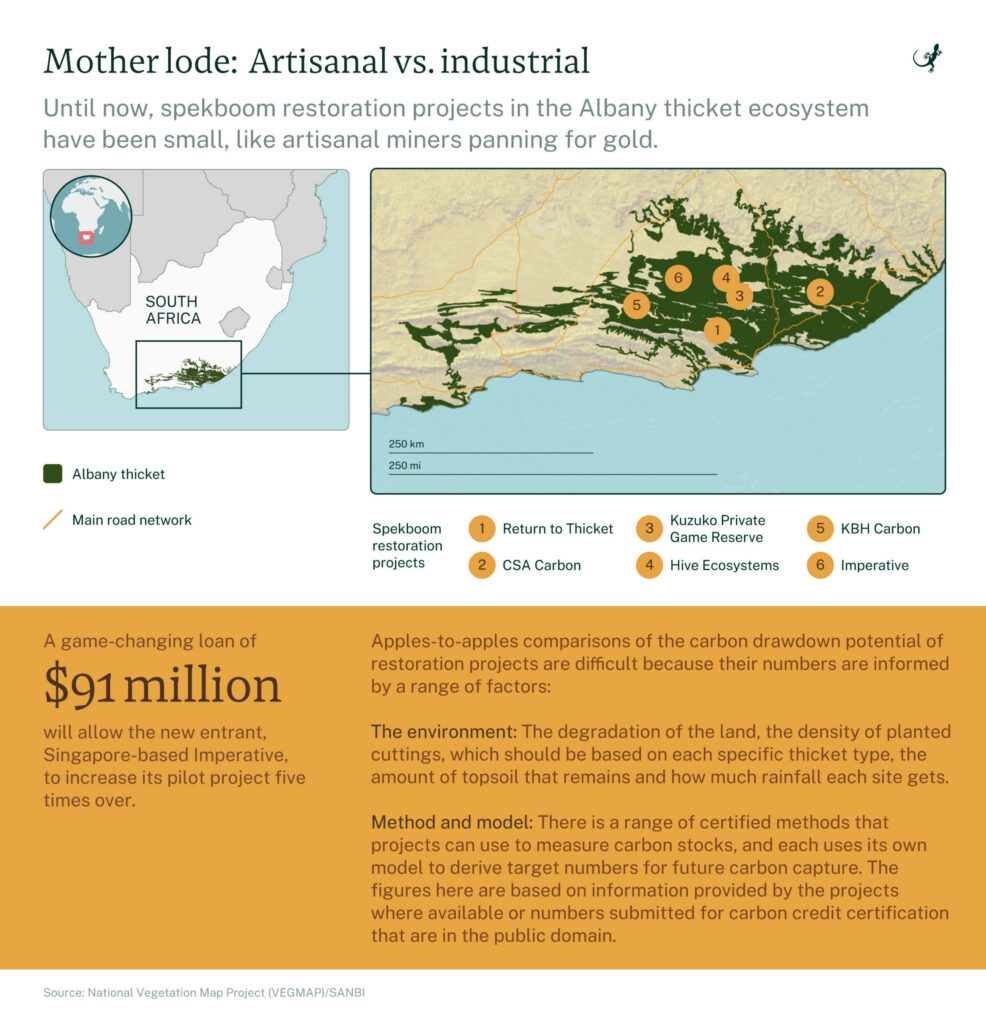
Spekboom restoration projects until now have been artisanal in scale, most of them under 5,500 hectares (about 14,000 acres).
Imperative’s arrival in 2024 changed that. Work kicked off in November that year with a 10,000-hectare (nearly 25,000-acre) pilot planting phase, which it completed in just over a year. The company then secured $91 million in loans, which accelerated its planting ambitions. The World Bank bond provided $25 million, and another $66 million came from a handful of other investors. The flush in money allows it to increase its first-phase operation five times, with another big expansion planned thereafter. Imperative plans to have a total of 100,000 hectares (about 247,000 acres) under spekboom by around 2030.
As these tough succulents grow, the company expects them to draw down 41.6 million metric tons of carbon dioxide equivalent (tCO2e) over the next 40 years. This will allow Imperative to earn the equivalent number of carbon credits, as one metric ton of CO2 removed from the atmosphere converts to one carbon credit. Amazon has agreed to buy some of the first crop to come from one half of the project: 1.95 million credits in all, which amounts to 9.4% of the 20.8 million carbon credits that this new 50,000-hectare (124,000-acre) planting is expected to produce over four decades.
Imperative anticipates $500 million reaching the community from the first 60,000 hectares (nearly 150,000 acres) over 40 years. How much of this materializes depends on how much atmospheric carbon the spekboom plantings draw from the atmosphere as they grow, the price of carbon credits over time, and the revenue sharing agreed between Imperative and the farmers it has partnered with. Imperative wouldn’t disclose the terms of the contracts with farmers, though, which stipulate the details of the revenue share. (Imperative’s business model differs from others in that it opts to rent land from farmers rather than buying. This allows the restoration work to reach more land and landowners to keep their properties.)
The method to calculate the carbon drawdown potential of a recovering thicket has been developing for over two decades. But it’s still a relatively young field, and it can only advance as fast as the early spekboom plantings grow. A project’s business model may forecast 10 tCO2e of drawdown per hectare per year. But project staff may only know in 10-15 years what the actual accumulation of carbon is in the soils and plants. If it’s only 5 or 7 tCO2e, the project will only earn the equivalent number of carbon credits.
“We only get paid for what we deliver,” says Scobie Mackay, Imperative’s CEO.
The market price of this novel currency is another factor.
Carbon credits from the first plantings should start to trickle in as soon as 2027 or 2028, according to Imperative. How much each credit is worth depends on its type and price fluctuations on the market. Nature-based carbon drawdown credits that come from forestry plantations involving monocrop tree planting are on the lower end of the range for the reforestation and revegetation category. These were selling for around $14 in 2025, according to the World Bank. Projects that provide biodiversity habitat repair alongside their climate benefits, like these spekboom projects, have higher values. Imperative’s Mackay references the data provider and analytics firm MSCI Carbon Markets on this, although he wouldn’t disclose the price category that applies to Imperative’s credits. MSCI told us that the most likely price point for these spekboom-generated credits is around $45.
Meanwhile, an industry insider who asked not to be named said that most local projects are working on a value of $20 to $25 a credit.
How much will Amazon pay for its 1.95 million carbon credits? How much of that will flow into the farming community in Albany thicket country, and over what period of time?
Neither Amazon nor Imperative would reveal the price they’ve settled on. But these credits, they say, will be high-value, bought at a fixed price and purchased during the first earning period, which Amazon gives as an open-ended “more than a decade.”
Based on this, and the range of prices for this category of credit, I estimate that Amazon’s bill for the 1.95 million carbon credits could be anything from $39 million at the lower range of $20 per credit, to $87.75 million if trading at $45 a credit.
The carbon credit returns reaching the community will ultimately depend on how much organic carbon shows up in the plant and soil samples measured over coming years, which depends on how well the next four or five years of plantings take root, as reported previously, and on the company’s profit-sharing agreements.
Keep it real
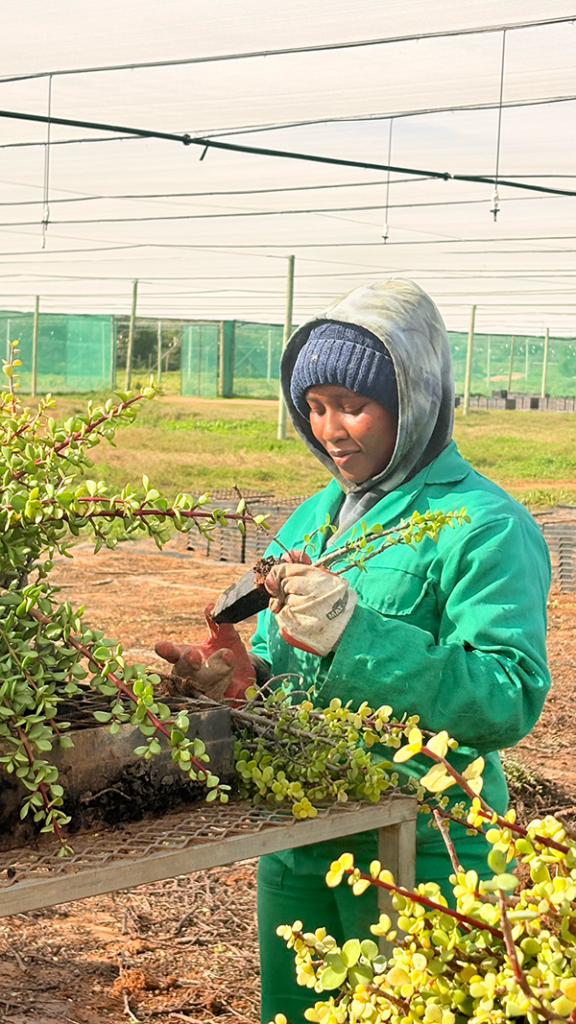
Sonia Latola smiles coyly when the attention turns to her on a warm winter’s afternoon as she knock-knock-knocks a 3-month-old spekboom cutting free from its rooting container beneath the domed shade cloth at the Hive Ecosystems nursery, less than an hour’s drive from some of Imperative’s farms. She and her colleague Elistine Fisant live in the area and are, for the time being, enjoying the flush of jobs that these planting projects bring. Every day, these two transfer thousands of cuttings into crates that get hauled up a precarious country road by tractor. There, a crew with pickaxes and hand trowels will place the young plants gently but speedily into the ground, cutting by cutting, laboriously and by hand.
Like Return to Thicket, Hive Ecosystems is a small but established spekboom restoration project in a sector that is now seeing a growth spurt as the World Bank and other financiers recognize the business model for funding ecosystem restoration in these exhausted farmlands.
Many of the people interviewed — farm laborers, businesspeople, landowners, and many others — say they don’t understand how this strange new currency of carbon credits works. They can’t fully grasp how invisible carbon dioxide translates into the tangible dollars and cents that are promised in recent press releases. They do hold onto the hope, though, that these new investments will bail out desperate farmers and put real cash in the pockets of people in a part of the world where jobs are scarce and the farming economy of yesteryear is on its knees.
For more than two centuries, South Africa’s big developers have mostly been in extractive sectors such as mining and related industries. The developers of tomorrow are viewing ecosystem repair as a new frontier, recognizing the business opportunities that will allow for the rehabilitation of the very natural infrastructure left damaged by extractive industries. That some prominent Global North financiers are seeing the business potential of investing in ecosystem repair in an area as tiny and niche as South Africa’s Albany thicket biome suggests that farming with a novel agricultural crop in the Global South — carbon — may indeed be the new gold rush, for better or for worse.
This is the third article in a three-part investigation of spekboom-led ecosystem restoration in South Africa. This is part of an award-winning collaboration between independent science writer Leonie Joubert, the Stellenbosch UniversitySchool for Climate Studies, and theHenry Nxumalo Foundationwhich supports investigative journalism in Africa. Read partsoneandtwo.
The number of cuttings this Hive Ecosystem team manages to plant in a day is dizzying. This project is halfway toward its original goal of planting spekboom across nearly 5,500 hectares (nearly 13,000 acres). Picture: Leonie Joubert
A unique approach to ecosystem restoration in South Africa — repairing exhausted farmlands through the mass planting of spekboom — is receiving global attention as one new entrant gets an injection of $91 million to dramatically increase its plantings.
This will contribute toward the goal of planting more than 300 million spekboom (Portulacaria afra) cuttings, funded by investors through global carbon markets.
Smaller restoration projects have blazed a trail until now, helping to improve planting and land management methods to get maximum plant survival, bush recovery and, ultimately, carbon credit returns.
Plant survival rates through the next five planting seasons will dictate how well farmlands recover in coming decades, whether they deliver on the carbon drawdown expectations, and whether investors get their returns. But our investigation finds that things may be getting off to a rocky start.
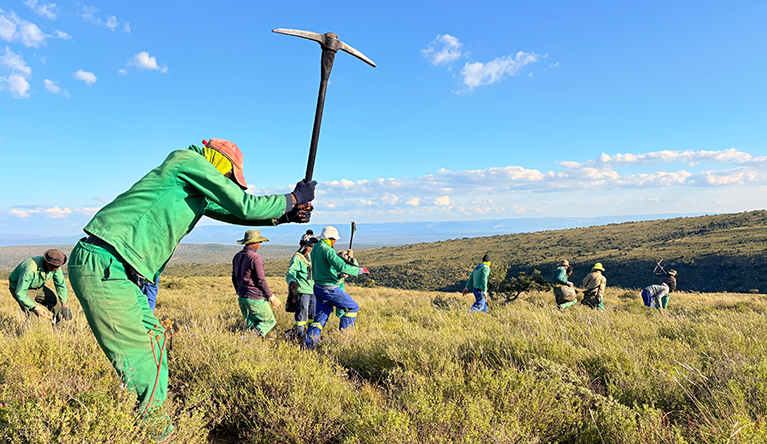
The team of diggers crisscrossing a hard-to-reach hill on a remote farm in South Africa’s Eastern Cape province shows how tough spekboom planting is. A row of men, each arcing a pickax over his head to his own rhythm, punctures a Morse code of holes into the earth. Behind him, a planter drops a rooted spekboom cutting into the hole, fills it, and tamps the soil gently with a trowel. Between them, a runner, his bag not unlike that of an old-school postman, ferries cuttings from the tractor that has labored up a treacherous country track from the nursery on a nearby farm.
They’ll get a few thousand plants into the ground today, give or take, but the team works so fast that the numbers blur after a while.
It’s grueling. But the men are upbeat. It’s work, many say, in a region where unemployment is high and the stagnant farming sector unlikely to change anytime soon.
The planters are doing the first steps in helping repair the land on a farm owned by Hive Ecosystems, one of the more established outfits in a small but emerging restoration sector. Here, ecologists hope that mass planting with spekboom (Portulacaria afra) will be the first step in the recovery of what’s known as the Albany thicket ecosystem. Generations of heavy livestock rearing — mostly with mohair-producing goats — have reduced once-impenetrable hedge-like bush to something akin to desert across 1.5 million hectares (3.7 million acres) of farmland. Nothing much will grow here anymore. Except spekboom.
These projects are drawing on carbon markets to raise the capital needed to fund the wide-scale planting of this drought-hardy, easy-to-grow plant. Investors provide the funds now, with the promise of earnings from a new kind of agricultural crop down the line: atmospheric carbon banked away in the plants and soils, which translates into the currency of carbon credits.
The business case for this has been in development for roughly two decades. It is now so convincing that the World Bank recently listed an outcome-based bond tailored specifically to fund the work, with a pot of $120 million that’s available to developers in the spekboom sector. The first to draw on this loan is a new entrant: Singapore-based infrastructure developer Imperative Global Solutions Pte. Ltd., which specializes in ecosystem restoration at scale, and whose operations are taking what was artisanal and making it industrial in size and approach.
Where once there was impenetrable hedge-like Albany thicket, today many farms look like a desert. These farmlands need spekboom-led repair the way a burn victim needs lifesaving skin grafts. Picture: Leonie Joubert
Spekboom planting is now increasing at a pace and scale unlike anything tried before. What happens in the field over the next four or five years will determine how well the vegetation and, hopefully, the broader ecosystem recover over the coming decades. Planting success will dictate whether it delivers on the carbon capture expectations promised by developers, how this translates into carbon credits and, ultimately, whether investors get their returns.
This little corner of the country needs the restoration work the way a burn victim needs lifesaving skin grafts [TK Link to story 1]. Many of these farmlands are so exhausted that there may only be one agricultural crop left to grow here: carbon. If projects don’t make good on their promises, insiders worry that it will undermine investor confidence, scare off financiers, and be the death knell for a farming sector that’s already on life support.
Getting it right: How to plant a succulent, at scale
The Hive Ecosystems project is roughly halfway toward its goal of getting spekboom sprigs into 5,431 hectares (13,420 acres) on its properties near Jansenville, about an hour’s drive inland of the port city of Gqeberha. Managing director Japie Buckle would like to double that planting area if they can buy more land.
The thicketeers — that’s what some ecologists, researchers and project implementers call themselves — agree that planting spekboom isn’t rocket science. But doing so fast and at scale needs to be done carefully, and they’re sharing what they learn as they go.
Their field notes might sound like succulent wonks geeking out on gardening hacks. But their watchful attention to planting and post-planting teething issues — what works and what doesn’t, even months or years down the line — will be key to ensuring the survival of well over 300 million spekboom plants that will be put in the ground across all projects, cutting by cutting, laboriously and by hand, over the next four or so winter planting seasons.
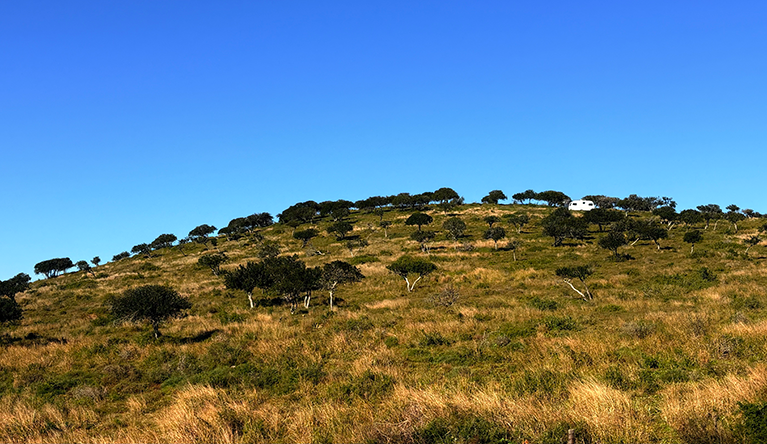
Intensive goat browsing creates what ecologists call a pseudo-savanna. This hill should be covered with impenetrable thicket. Instead, heavy browsing has opened it up, leaving sparse trees with artificial mushroom-shaped
“Spekboom is hardy. It’s evolved here,” says Nick Hamp-Adams, general manager of Return to Thicket, one of the smaller restoration projects that incorporates two exhausted former mohair goat farms. No need to coddle it in the nursery or too much after planting, he says, but be gentle when putting it in the ground and do immediate post-planting follow-up.
“How you plant matters,” Hamp-Adams adds, smiling. “Make sure your teams are handling them like babies.”
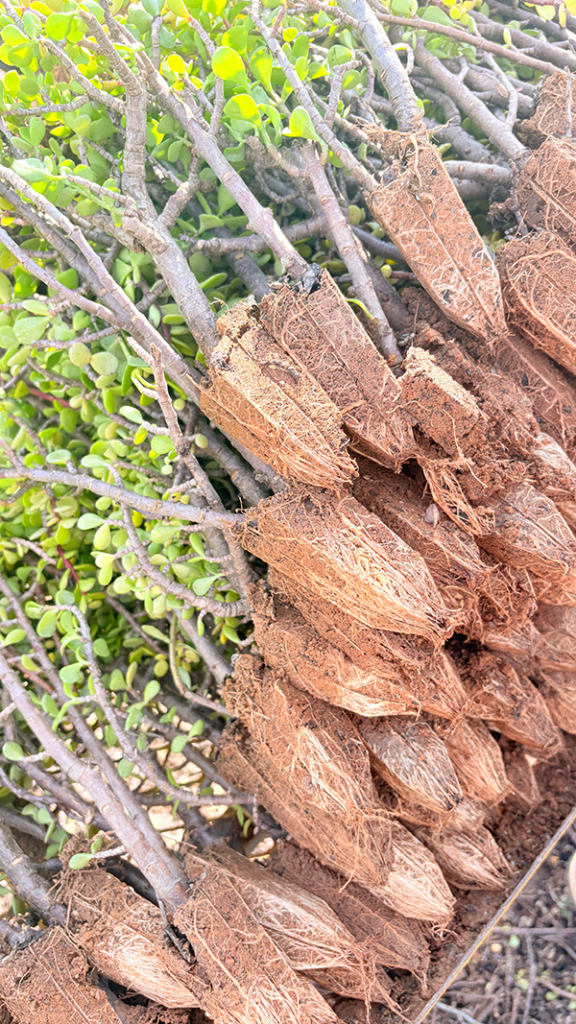
The process that most projects follow is simple: Harvest cuttings from wild-growing spekboom; give them roughly three or four months in the nursery to establish roots; and then plant them in a degraded spot. Most of the projects are deliberately low-tech and bare bones. They might work on an estimated cost-per-unit of 9-21 U.S. cents to get a cutting through the process.
Rooted cuttings take time and cost more to get veld-ready, but they establish better than unrooted ones, which don’t need much nursery time, according to Buckle, a seasoned restoration ecologist with decades of wetland rehabilitation under his belt. There’s a sweet spot where a cutting’s stem thickness and root size improve its odds, without spending too much time in the nursery.
Little tweaks at planting can improve a cutting’s chances, like propping a small rock at an angle to its base. This captures condensation, moistens the roots, and creates a gentle microclimate, says Jacquie Pastor, a consultant to a restoration project KBH Carbon, set up by its parent company, the mining conglomerate KBH Group, which has planted the first 1,000 hectares (about 2,500 acres) with the goal of eventually restoring 5,000 hectares (roughly 12,000 acres) of land.
The tradeoff: Slower planting speed, better survival.
Learning from the teething problems
“You need to calculate in some die-off,” Hamp-Adams says, scanning a section of one Return to Thicket farm where the sparse ground cover has sprigs of spekboom dotted about in every direction. It’s early winter, and the cuttings have had four months to settle in.
The Rhodes Restoration Research Group at Rhodes University in Makhanda, Eastern Cape province, hopes to get its nursery up and running again after work stalled due to government funding cuts. Researchers are exploring what a broader thicket restoration approach could be, in which species other than spekboom are introduced into planted areas. Image by Leonie Joubert for Mongabay.
There will always be some cuttings that don’t make it. Many of the smaller projects report relatively low mortality — between one and three cuttings dying for every 10 planted. But that figure can vary, depending on how the cuttings are planted and how the land is managed in the weeks and months that follow.
One pilot site at Kwandwe Private Game Reserve near the town of Makhanda — part of an ecotourism-focused collection of farms owned by C-SA Properties, whose restoration work is being done by CSA Carbon — had “super high mortality rates” along one edge of the plot, according to Kwandwe’s environment manager, Craig Sholto-Douglas. Six or seven out of 10 cuttings died. But toward the center of the plot, jackpot: Eight out of 10 made it.
Speaking at a thicket restoration forum in 2024, Sholto-Douglas put this down to the dance between predator and prey: Antelopes were lingering in a part of the site where they felt safe, so they browsed heavily here. But they moved quickly through the open area where they felt in danger, only nibbling the plants along the way.
Sholto-Douglas has been overseeing spekboom planting across 2,000 hectares (roughly 5,000 acres) of reclaimed farmlands around the edge of the reserve. This initiative is one that’s geared toward improving natural bush for wildlife and ecotourism, much like a similar project run at Kuzuko Private Game Reserve not far from here.
In spite of having a breather from heavy livestock pressure, parts of these farms still haven’t recovered on their own after 25 years, according to Sholto-Douglas. The spekboom plants should change that.
These real-life experiences are all critical data points for landowners who might one day want to reintroduce wildlife or livestock onto recovering lands. All have different histories, Sholto-Douglas says, all are in different states of disrepair. With only four years to learn from these teething problems, time is ticking for this emerging sector.
Going big
Most projects are artisanal in size, and planting is proceeding slowly. It’s taken Hive Ecosystems three years to achieve the first half of its planting goal with a crew of nearly 50 people in the nursery and out in the veld. Return to Thicket got its first 1,000 hectares planted in 14 months, with 10 people handling the nursery side and 10 planting.
The new entrant to the sector, Imperative, which has attracted World Bank funding and Amazon’s attention, has bigger ambitions. It aims to complete its goal of planting 100,000 hectares (about 247,000 acres) within the next four to five years. According to Tiaan Burger, Imperative’s spekboom restoration project manager, the operation will be able to plant 20,000 hectares (nearly 50,000 acres) per year once it’s running at full speed.
The company has also opted for a more technical approach to propagating its cuttings, using a trademarked specialist rooting method from Danish company Ellepot, which is said to shorten nursery time and protect against planting shock, according to the manufacturer.
Burger wouldn’t comment on Imperative’s cost per unit to get a cutting from harvesting to planting. And Ellepot’s South Africa office also wouldn’t disclose the cost per unit for the product that Imperative uses. However, based on industry information from others familiar with such calculations, Mongabay estimates that Imperative’s cost per unit is perhaps 50 U.S. cents per rooted cutting, roughly double what smaller operators budget for.
While the smaller projects’ plantings are ticking over slowly, Imperative arrived in the area in 2024 and had its first 10,000 hectares (25,000 acres) planted in just over a year. According to Burger, planting began in November 2025 on the second phase — the 50,000 hectares (nearly 124,000 acres) that have attracted a $91 million loan funded in part by the World Bank and derisked with Amazon’s buy-in. The goal, he says, is to complete all this planting — five times the size of phase one — within two years. With further planned expansion, Imperative calculates a total carbon drawdown of 41.6 million metric tons of carbon dioxide across its 100,000 hectares over 40 years, averaging out to 10.4 metric tons of carbon dioxide per hectare per year.
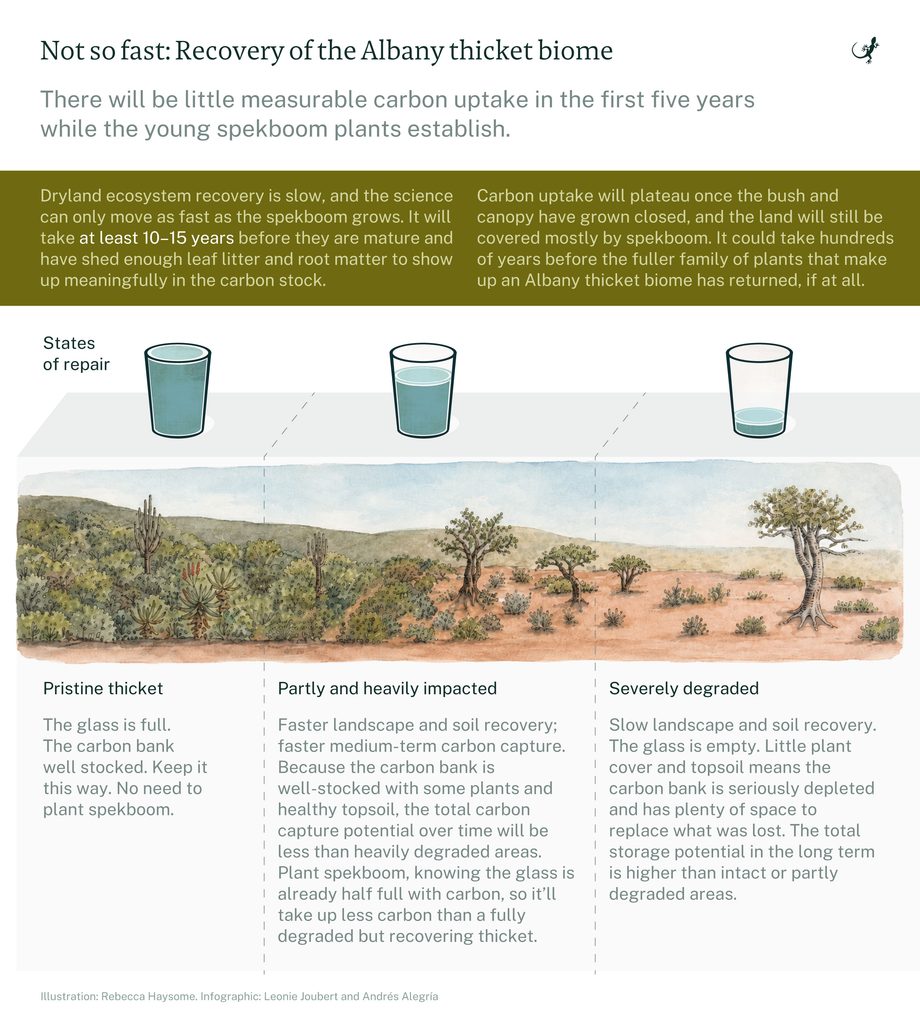
Projects are unlikely to see much carbon build-up in the total carbon stock — the plant matter and soils — in the first five or so years, because the young trees will need to establish. It will take roughly 10-15 years before they’re developed and shedding enough leaf litter and root matter to reflect significantly in soil and plant biomass samples. Carbon uptake will plateau once the canopy has grown closed, and spekboom will still be the predominant plant.
Whether the recovering lands show they’ve captured as much carbon as hoped for will depend on how well and how quickly the young cuttings establish.
How fast is too fast?
Questions have emerged about how successful Imperative’s first-phase plantings have been, though, whether it’s scaling up too fast and whether it’ll be able to meet its ultimate targets.
Mongabay has credible information from sources indicating that some of Imperative’s early plantings have experienced die-offs of as much as 80-90%. Burger wouldn’t comment on whether these figures are accurate. He did say, however, that investors had done their due diligence, including visits to first-phase plantings. Mongabay wasn’t able to establish which sites were visited, by whom or when. But Burger maintained that Imperative’s financiers wouldn’t have agreed to the loans if they didn’t have confidence in the company’s ability to deliver.
Imperative CEO Scobie Mackay also wouldn’t comment on mortality rates and said the developer was learning from its early planting experiences. Many parties working with Imperative, including its implementing partner, NatCarbon Africa, are tied into nondisclosure agreements — standard practice for commercial ventures of this scale, according to Mackay — which makes it difficult to independently verify information provided by Imperative representatives or its partners.
An environmental scientist with extensive experience in restoration work of this type in South Africa, but who asked not to be named because of their proximity to the sector, told Mongabay that such high mortality rates are possible — and not just for spekboom — if plants don’t get the right follow-up care and appropriate land management.
“Our experience on other projects in the region where such care is absent has shown that an 80% to 90% plant mortality rate is not uncommon,” they said. “One cannot just stick a sapling in the ground and hope it will survive.”
There are many things that can kill a sprig: a heat wave; a frosty snap; or unusually wet soils causing rot. Hungry animals, too.
The Kwandwe reserve team found a few unusual candidates taking advantage of some of their young spekboom.
One batch of plants had been in the ground for 18 months and, by all accounts, looked like they were surviving. But they weren’t thriving.
“All of them still upright. All of them rooted beautifully,” Sholto-Douglas says.
Post-planting inspection is essential to ensure that cuttings survive. Most projects anticipate that seven out of 10 cuttings will take. New entrant Imperative would not disclose what its planting survival rate is, but some reports suggest that the developer may be experiencing some teething problems. Image by Leonie Joubert for Mongabay.
Post-planting inspection is essential to ensure that cuttings survive. Most projects anticipate that seven out of 10 cuttings will take. New entrant Imperative would not disclose what its planting survival rate is, but some reports suggest that the developer may be experiencing some teething problems. Image by Leonie Joubert for Mongabay.
Most restoration projects have low-cost, low-tech nursery operations where the spekboom cuttings can grow roots before being planted in the wild. Image by Leonie Joubert for Mongabay.
It turns out that, while the reserve’s management team had been able to keep the large browsing animals out of these recovering lands, they hadn’t accounted for the little ones, like Cape scrub hares (Lepus saxatilis) and gray duikers (Sylvicapra grimmia), a regular antelope to these parts.
Locals here say that spekboom is to goats what ice cream is to a toddler. But it seems that small wildlife feel the same way about these irresistible plants, another important data point for the sector as spekboom planting goes industrial scale.
This is the second article in a three-part investigation of spekboom-led ecosystem restoration in South Africa. It is part of an award-winning collaboration between independent science writer Leonie Joubert, theStellenbosch University School for Climate Studies, and theHenry Nxumalo Foundationwhich supports investigative journalism in Africa.Read partsoneandthree.
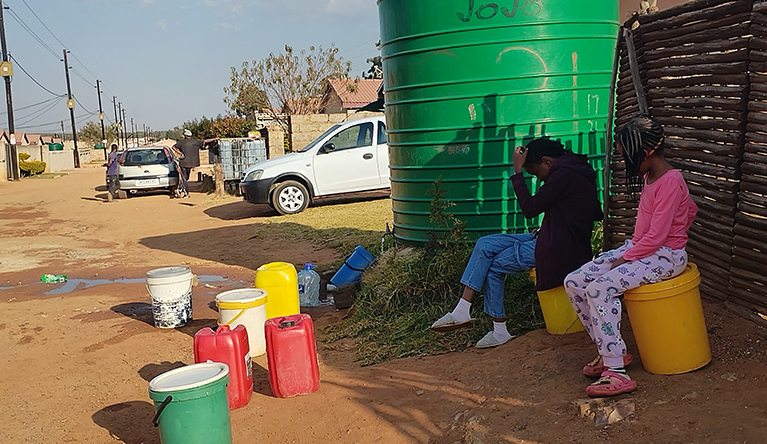
Empty water containers in the street tell the story of Siyanqoba’s ongoing water crisis in Emalahleni Local Municipality. Photograph: Rodney Hlatshwayo
A weeks-long investigation into water tanker procurement and service delivery in Mpumalanga’s Nkangala District reveals what happens when a temporary emergency measure becomes a long-term way of supplying water.
This comes as President Cyril Ramaphosa launches South Africa’s National Water Action Plan to address the country’s worsening water crisis. The Plan argues that water revenues should be ring-fenced to protect investment in water services.
In Nkangala District, the Lynnville office water depot in Emalahleni, and the Vezubuhle Gundry Water supply in Thembisile Hani are meant to supply communities with piped water. But recurring drought, ageing infrastructure and water sources that have failed to meet demand have left many communities dependent on erratic tanker deliveries that were intended only as an emergency measure.
This investigation found that Nkangala municipalities have become locked into a costly tanker system that has evolved from an emergency response into a long-term substitute for functioning infrastructure.
In parts of Emalahleni and Thembisile Hani municipalities, residents describe years of unreliable tanker deliveries, empty JoJo tanks and long periods without running water despite millions of rand being spent on emergency water provision.
Municipal records show that Emalahleni Local Municipality spent about R46 million on water tanker services in a single year, while neighbouring Thembisile Hani spent more than R21 millionover four financial years.
Despite this public expenditure, residents remain trapped in an unpredictable emergency water system, with little certainty about when water will arrive, whether it will be free or come at a cost, and little public accountability for how millions of rand spent on tanker services translate into reliable access to water.
Erratic delivery has opened the way for independent private providers to step in, charging even more for water delivery.
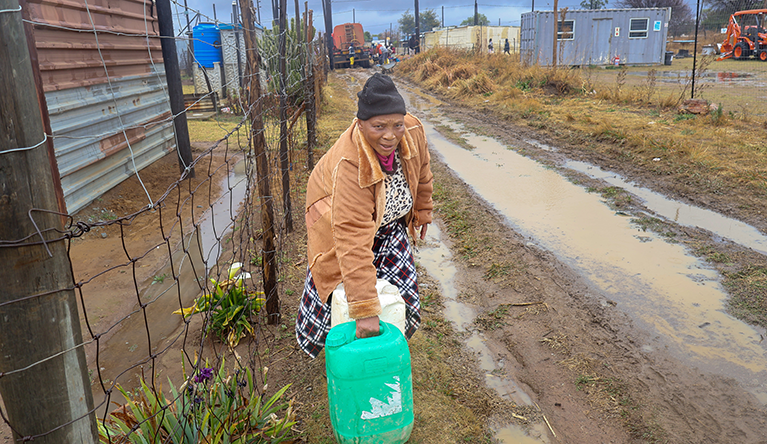
Elderly women carry water in their daily struggle for a reliable supply in Mimosa Township, Delmas. Photograph: Rodney Hlatshwayo.
And the private companies contracted by the municipality sometimes require payment in cash to the driver, raising suspicions that this money never gets to the municipality.
The investigation also found that some of the companies delivering water are owned by relatives of influential local politicians, raising questions about conflict of interest.
Living with a permanent emergency
Across Nkangala, residents describe profound frustration with inconsistent and often unreliable water tanker services that affect almost every aspect of daily life. Communities, particularly in Emalahleni and Thembisile Hani, have grown dependent on JoJo tanks, yet frequently endure weeks without refills, forcing them to resort to unsafe alternative water sources.
Frans Duma, a resident of Waaikraal, says residents have raised serious concerns about how payments for municipal water tanker deliveries are being handled.
“As members of the Waaikraal community, we rely on municipal water tankers, and while I understand and accept that people may have to pay for water, the problem is that payments are made directly to the driver instead of through official municipal channels. There is no assurance that the money is reaching the municipality,” says Duma.
“Residents with JoJo tanks in their yards are charged R450 for a 5,000-litre delivery, while water from the communal JoJo tanks is free. For households like mine, where both my mother and I are unemployed, this is a significant expense.” Duma says earlier this year there was an attempt to increase the price, and he had to plead for the increase not to be implemented because many families have no source of income.
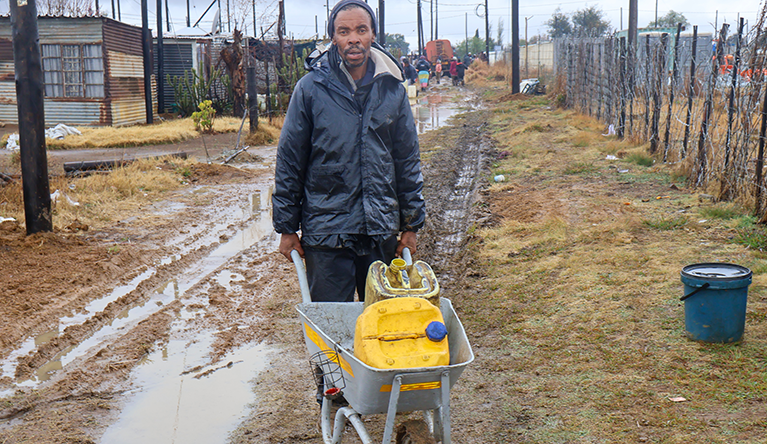
Residents push wheelbarrows carrying water containers through muddy streets in Mimosa Township in Delmas, as they search for water amid ongoing water shortages. Photograph: Rodney Hlatshwayo.
Duma wants the municipality to introduce a transparent payment system. “If payments were properly managed through the municipality, costs would be more transparent and there would be greater accountability. This situation places an unfair burden on vulnerable households and it calls for urgent intervention to ensure fairness and proper governance in water distribution within our community.”
A Waaikraal community member, who wished to stay anonymous, says he hasn’t received any water for about two to three months and that other residents have gone for more than eight months without receiving any water at all. “We have been left to fend for ourselves,” she says. “When people become desperate, they end up paying cash to the municipal water truck driver, whom we know as Sabza.” Sabza charges R300 to deliver a 2,500-litre load of water.
“Water is a basic service, yet we are forced to pay for something that should be provided by the municipality”, she says. Many families cannot afford these payments, and those who can’t are left without water.
Sebenzile Mnguni from Siyanqoba in Emalahleni Local Municipality describes how her community has had to rely on JoJo tanks since 2018, “We can go weeks without refills, forcing residents to collect water from streams,’’ she says.
Mnguni says she has seen some tanker drivers collecting water from unsafe sources, posing serious health risks. A visit to the Siyanqoba community confirmed that a private water tanker was being filled from a nearby dam.
“I have lived in Siyanqoba since 2018, and throughout that time we have struggled with water every single day,” says Bennett Mdluli. “When there is no water, we are forced to fetch it from the river, where people are washing clothes and carrying out other activities. Mdluli says the Jojo tanks are often empty, and refilled only once a week. One 5,000-litre tank is expected to supply an entire street of about 50 households, which is simply not enough, meaning residents can’t even flush their toilets. When the water tanker eventually arrives, all rush to collect water, he says, but it is often yellow, and has an unusual taste. “Our struggle is severe, and we need a lasting solution.”
Patricia Zwane from Moloto in Thembisile Hani says her community only gets tap water once a week, after which tanker deliveries take over. This raises concerns about whether water is being shared fairly and why such limits exist. For residents, it means living with constant uncertainty, never knowing when water will come, and facing extra struggles in their daily lives. The system leaves people vulnerable and makes it easy for exploitation to creep in.
Taken together, these accounts describe more than isolated service failures. They show how a system introduced as an emergency response has become part of everyday life for many communities.
That raises the question of why when municipalities have spent tens of millions of rand on water tanker operations, residents still report empty JoJo tanks, erratic deliveries and long periods without water? More importantly, where has the money gone?
Follow the money
An analysis of municipal expenditure shows sharp disparities in water tanker procurement across Nkangala. Emalahleni Local Municipality spent about R46 million in a single year under Bid ELM 17/2023, appointing 47 companies for services between 2024 and 2027. Thembisile Hani Local Municipality spent R21 million over four financial years, involving at least 34 companies.
The dominance of water tankers reflects the failures of the piped water system. Aging infrastructure, drought conditions, and poor maintenance have left many communities without reliable tap water. Instead of repairing the system, municipalities have entrenched tanker operations as the default solution. What began as an emergency response has become permanent, with residents suffering expensive, irregular and unclear service delivery.
Financial analysis shows that Emalahleni spent an estimated R3.83 million a month on water tanker operations, compared with about R437,500 a month in Thembisile Hani over the same period. Although the two municipalities serve similar populations — about 455,000 people in Emalahleni and 431,000 in Thembisile Hani — Emalahleni’s monthly expenditure was more than eight times higher. The gap raises questions about the condition of Emalahleni’s piped water system and whether procurement practices have entrenched a costly dependence on tankers.
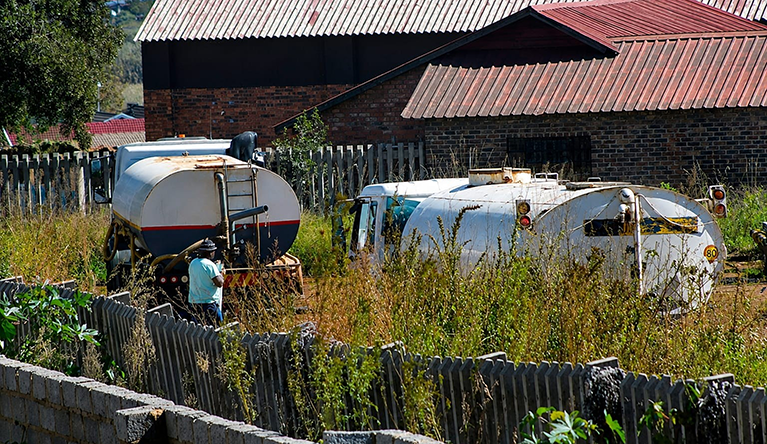
Tankers remain a lifeline for residents during the water crisis in Mimosa Township, Delmas, in Victor Khanye Local Municipality, which neighbours Emalahleni Local Municipality. Photograph: Rodney Hlatshwayo.
The disparity is stark on a per-resident basis. Our calculations show Emalahleni spent about R101 per resident on tanker services in a single year. Thembisile Hani spent about R49 per resident over four years — roughly R12 per resident each year. The figures point to a more deeply entrenched reliance on tanker water in Emalahleni.
The Nkangala findings are consistent with broader national concerns. Johannesburg Water spent R130.5 million on tanker services in 2024/25, and the Gauteng High Court later declared a R263 million tanker tender invalid because of procurement irregularities. The cases illustrate how prolonged reliance on tanker procurement can increase corruption risks while diverting resources from repairing piped water infrastructure.
The spending disparity is also reflected in contractor allocations. Emalahleni averaged about R81,500 per contractor per month, compared with about R12,900 in Thembisile Hani. The financial records show that municipalities have committed substantial resources to emergency water provision. But they do not explain how suppliers were selected, whether procurement processes were consistently followed, or why emergency water provision has become such an enduring feature of service delivery.
With municipalities providing few answers, the investigation turned to the companies behind the contracts. We compared municipal supplier lists with Companies and Intellectual Property Commission (CIPC) records to see whether the companies could be verified.
Procurement and Supplier Integrity
CIPC checks found discrepancies in 32 of the 47 companies Emalahleni appointed, including inactive registrations, naming inconsistencies and companiesthat could not be matched to the municipal records.
The records also showed uneven contractor allocation patterns, with some companies receiving multiple allocations while others appeared inactive or unused. While these findings point to weaknesses in supplier verification and procurement oversight, the investigation found no documentary evidence that contracts were awarded unlawfully or that political interference influenced procurement decisions.
Experts at the University of Pretoria’s Centre for Human Rights say Nkangala’s experience illustrates the wider risks of relying on emergency procurement to deliver basic services
Olayinka Adeniyi and Ebenezer Durojaye at the Centre argue that Nkangala’s reliance on water tankers is a systemic governance failure with human rights implications. Drawing on similar cases, they stress that this “seems to involve a combination of infrastructure failure, weak planning, procurement risk, governance gaps – and thus human rights concerns – and in particular a violation of socio-economic rights.”
Tankers are defensible in emergencies, they say, but their entrenchment as the default mode of supply signals a deeper breach of constitutional guarantees.
Several interviewees raised concerns about political influence and potential conflicts of interest in procurement, though no documentary evidence was available.
A senior municipal insider with firsthand knowledge of infrastructure projects in Emalahleni, who requested anonymity for fear of victimisation, alleges that Municipal Member of the Mayoral Committee (MMC) for Technical Services Thabang Mathebula plays a significant role in project allocation and maintains close relationships with contractors involved in infrastructure delivery.
The whistleblower further alleges that individuals involved in project implementation and community liaison have close personal and residential ties to officials responsible for technical services oversight.
The source also claims that several contractors working on the Hlalanikahle Bulk Water Project and the Doornpoort pipeline project, including one linked to the MMC’s brother, regularly fund community activities and local events. While these contributions are presented as corporate social responsibility, the whistleblower says they also help cultivate political goodwill and strengthen the contractors’ influence over municipal project allocations.
The investigation also identified companies owned by relatives of prominent political figures within the broader procurement environment. These include Mamolato Construction, owned by Sophie Sibanyoni, the ex-wife of former Municipal Public Accounts Committee (MPAC), chairperson Obet Skhosana, and another company owned by Poppy Mahlangu, the spouse of ANC regional secretary Sello Matshoga.
These relationships raise questions about potential conflicts of interest. When contacted for comment, ANC regional secretary Sello Matshoga maintained that his wife Poppy Mahlangu operates her business independently and without his involvement. Former MPAC chairperson Obet Skhosana could not be reached for comment, and Sophie Sibanyoni did not respond to inquiries. Similarly, MMC Thabang Mathebula failed to respond to detailed questions regarding his alleged role in project allocation and the contracts linked to his brother.
Operational distinctions: municipal vs. independent suppliers
Recurring droughts and declining local water sources have left municipal systems unable to meet demand. In many areas, boreholes and reservoirs have either run dry or cannot supply enough water, forcing municipalities to rely on tanker deliveries as a substitute for piped supply.
This has created space for private suppliers to step in. Unlike municipal tanker operations, which are funded through public contracts, companies such as DES Emergency Water Supplies operate on transparent commercial rates, charging households directly for deliveries.
DES Emergency Water Supplies charges about R500 for a 2,000-litre delivery, roughly 25 cents per litre. By comparison, ordinary municipal tap water in Victor Khanye Local Municipality costs about R5 to R6 per kilolitre, or less than one cent per litre. The comparison shows how prolonged reliance on tanker deliveries shifts the cost burden onto households, forcing residents to pay many times more for water than they would through a functioning municipal system.
Gert Oosthuizen of DES Emergency Water Supplies says these are fuel, transport, labour and logistics charges – not for the water itself.
Private suppliers publish what they charge. In contrast, residents and whistle-blowers say some municipal tanker drivers collect cash directly from households outside the municipality’s billing and accounting systems.
Accountability in Question
One of the biggest obstacles the investigation encountered was the municipalities’ lack of transparency. To understand how millions of rand had been spent on water tanker contracts, we submitted Promotion of Access to Information Act (PAIA) requests to Emalahleni, Thembisile Hani and Victor Khanye municipalities in February 2026.
The requests sought contracts, invoices, procurement records, payment schedules and supplier appointment documents. Thembisile Hani and Victor Khanye acknowledged receipt but provided no substantive response. Emalahleni did not acknowledge the request at all.
We followed up repeatedly by telephone, email, WhatsApp and in person between March and June 2026. Despite these efforts, none of the municipalities provided the requested records or meaningful responses.
What millions of rands bought
Millions have been spent, an emergency water supply system has become entrenched, and accountability remains incomplete.
The silence from the Nkangala municipalities over these multi-million-rand contracts reflects the very governance weaknesses the National Water Action Plan seeks to address. If that plan is to succeed, it will first have to assess and repair ageing infrastructure. It will also have to ensure that emergency measures do not become a long-term substitute for reliable municipal water services.
The new National Water Action Plan recognises that emergency measures cannot become permanent. In Nkangala, they already have. The challenge now is whether the plan can reverse that reality.
If Sizeni Dlamini makes R300 from a day’s trade in second hand clothing and shoes, she’ll dip into it to buy basic groceries A bit more, and she’ll add a few more things to the food basket on her way home. More still, and she’ll replenish her business’s stock. Picture: Leonie Joubert
No work, no pay.
No one knows this better than Sizeni Dlamini. She’s been selling second-hand clothes and shoes from her patch at Warwick Junction, beneath an overpass in Durban’s inner city, for 16 years. If it rains, passers-by dash through the usually bustling market. Who’s going to stop to browse soggy clothing, and likely get soaked through?
Same in the heat.
“People just pass by,” the 55-year-old says. “They don’t have time to stand in the sun and choose clothes. It would be much better if we had shelter.”
Call her what you will — micro-business operator, entrepreneur, street trader — but Dlamini’s isn’t the kind where she can close the shop door when it’s a scorcher, even if trade is down.
The recent summer was pretty grim, even for someone like her, whose body is acclimatised to the notoriously muggy East Coast weather where the warm Indian Ocean puts plenty of water vapour into the air, pushing up the discomfort levels and health risks on hotter days.
“It was really bad,” she recalls.
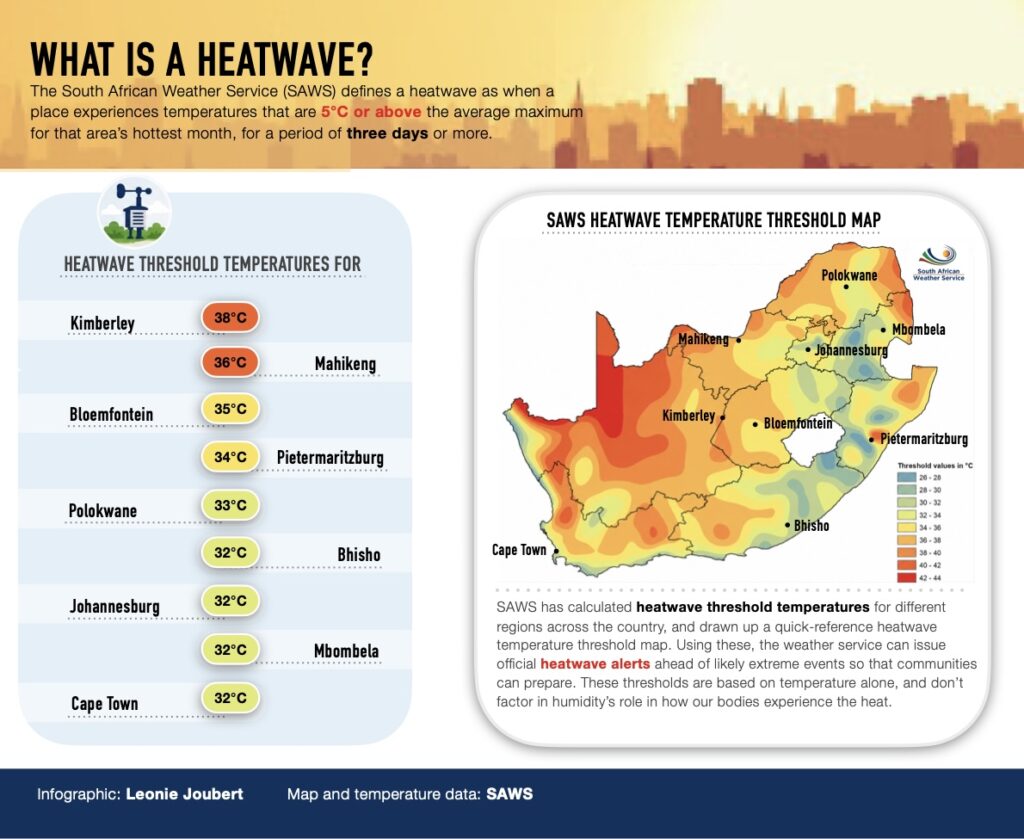
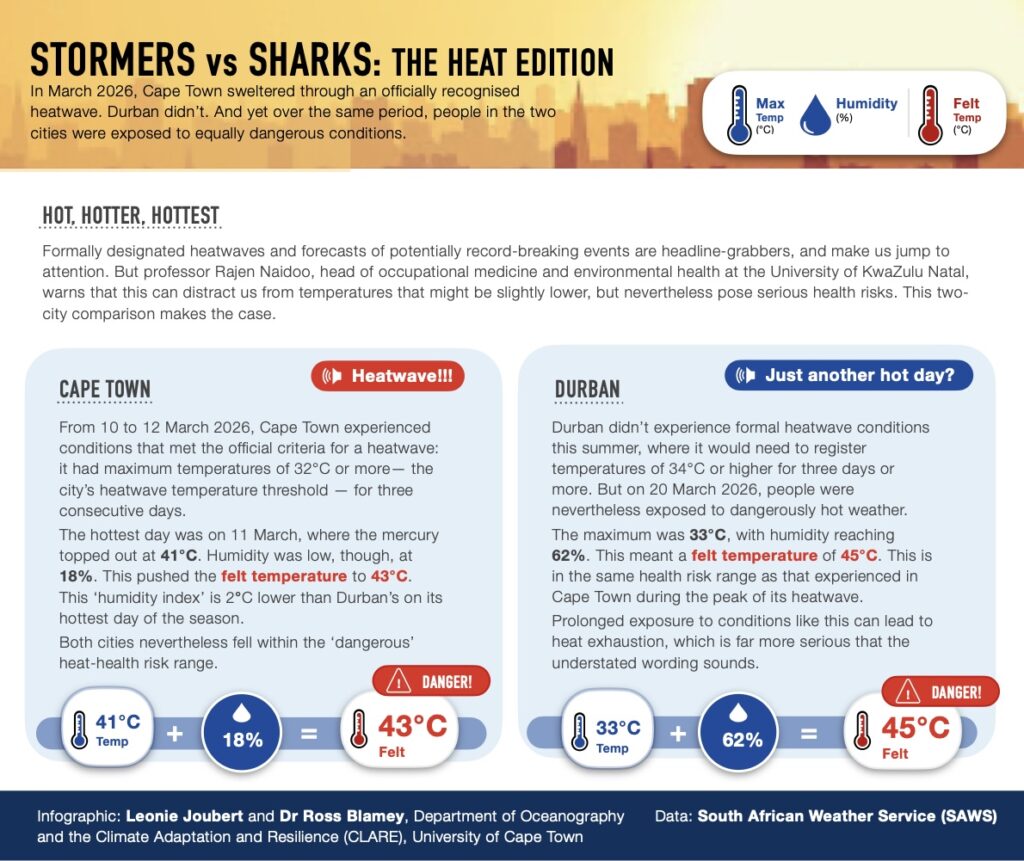
Durban didn’t experience any formal heatwave conditions this summer, according to climatologists — for that, the city would need to register temperatures of 34°C or higher for three days or more — but people were nevertheless exposed to dangerously hot weather at times. The most sweltering day came in early autumn: the Ballito weather station, about 50km north of the inner city, registered a maximum of 33°C on 20 March. With the humidity reaching 62%, the felt temperature would have been 45°C, well into the range for developing symptoms of heat exhaustion for those not able to find ways to shelter from the heat.
But densely built-up inner city areas like Warwick Junction are heavily tarred, paved and concreted over. Surfaces like this trap heat, making conditions in these heat islands 5°C to 10°C hotter than a city’s leafier outskirts.
Women feel the heat more acutely than men, and are more likely to be hurt by income loss because of it. It’s partly their body’s make-up — women don’t shed heat through sweating as efficiently as men do, so will experience health impacts at a lower threshold than men — but also because many work in lower-paying and informal heat-exposed jobs, such as farming, street trading, garment making, or care work, according to the US-based non-profit HERA. The organisation recognises the greater risk that lower-income and self-employed women face because of extreme heat, both to their health, and their income, and works in various Global South countries to help them become more heat-resilient.
The first line of defence for traders who are exposed to the elements in this way, local occupational health expert from the University of KwaZulu Natal professor Rajen Naidoo says, is to put in heat-buffering solutions — think in terms of shelter, water, and rest — with the city responsible for most of the necessary infrastructure.
Once that’s in place, though, a novel form of income protection insurance might be something that could encourage women to shut up shop during the worst of a heat event, without fear of her family going hungry.
Bathroom breaks
“This is the piss wall,” says Patrick Ndlovu, cheeks dimpling with humour as he points out the face-brick wall with its makeshift urinal along a stretch of pavement not far from the stall holders.
Hand-sprayed lettering barks a command to passers-by in isiZulu. The sentence is poetic and gritty: two layers of paint, florid green over black; some ee cummings flare to the grammar, which doesn’t bother with capital letters.
There’s no polite way to tell the urinal’s users that this is no place for solids.
“If you defecate here,” Ndlovu translates delicately, “if caught, you will be compelled to take it away.”
The wall is topped with coils of barbed wire and some medieval-looking spikes overlooking a riot of off-duty minibus taxis getting soaped down on the pavement.
At first glance, these facilities look pretty grim. The air is thick with the smell of urine being alchemised into vapour in the mid-morning heat. The two 25-litre water containers — each with a shoulder cut away to create a pee bucket — are working overtime. One’s overflowing, the other’s getting there. But it’s much better than it used to be, according to Ndlovu, who is the co-founder of the urban renewal non-profit Asiye eTafuleni. The organisation has been working here for nearly two decades, supporting informal traders to know their rights and legitimise their place in the city’s economy.
At a most practical level, that means sorting out the lavatory situation.
Warwick Junction’s broken-down municipal toilet block has been barred and bolted for six years, with the city giving no indication of why it hasn’t been repaired, or if it will be. For the many thousands of people who pass through this rabbit warren daily, or ply their trade in and around the market, this means that when their bladders call, they have little option but to go al fresco.
This is easier said than done if you’re a woman, which matters during summer. Many women traders say they hold back on drinking water during the day because they don’t want to have to deal with the inevitable consequences.
Between beach brollies and a makeshift sprinkler, fruit trader Nomusa Luthuli protects herself and her stock from the sun which can pummel the delicate plums she’s selling today. Picture: Leonie Joubert
This will lead to dehydration. When the body’s heat-stressed, it puts extra strain on the kidneys, leaving the body’s clean-up system overloaded with salts and toxins but with too little water to do the job. The upshot: higher risk of urinary tract infection, but also longer-term kidney damage.
In principle, a key solution to a heat-resilient trading community here is simple: get clean drinking water coming in, and black water flushing out. In a sentence: restore the municipal ablution block.
The eThekwini municipality did not respond to a request for clarity on why the public amenities at Warwick Junction aren’t working, why they haven’t been repaired, or if there are plans to do so.
Until such a time, Ndlovu and his team have been experimenting with low-cost outdoor urinals, knocked together from materials you can pick up at a local hardware store — PVC piping, wooden planks, buckets, shade cloth. Men, at least, have a discrete nook to relieve themselves. They’re asked to pay R2 for the convenience, but no sweat if they can’t, says Ndlovu.
But what about the women?
There’s a nondescript plywood walk-in booth near Dlamini’s clothing stall. It’s the size of an average wardrobe, and the only thing telling a passer-by that it’s the women’s facility is the universal sign on the door: a stick-figure illustration of a person in a dress.
There’s no comfortable sit-down loo with flushing water inside, or even a dry-toilet system. But it’s a private, dignified place for a woman to relieve herself over a small bucket, the contents of which she’ll toss down the nearest storm water drain.
The next step is to recruit what the Asiye eTafuleni team calls urine entrepreneurs — most likely people living rough in the neighbourhood who are keen to make a bit of cash — to empty the urinal buckets into nearby stormwater drains for a small fee.
It’s one small part of the shade-water-rest triage that’s necessary to make these traders more heat-resilient in an ever hotter world.
“Back in five minutes”
Besides drinking plenty of water during hot weather, traders like Dlamini should do one more thing that they’re not likely to: take a break.
Because: no work, no pay.
But what if they have income protection insurance that paid out if conditions get hot enough — dangerous enough— that they need to close their stalls for a few hours? Allowing them to stay safe without foregoing the food they need to put on the table that night.
HERA is piloting something like this in India, Sierra Leone, Pakistan, Thailand and the USA, using philanthropic money, buy-in from local insurance companies, and small premiums paid by traders. Founder and CEO Kathy Baughman McLeod reckons it could work for Warwick Junction traders, too.
“Women in a market in Freetown, Sierra Leone, lose 60% of their income to heat,” says Baughman McLeod. “Whether that’s their own illness, if foot traffic is down, or (when their stock) has gone bad.”
For the price of roughly one day’s takings — in Sierra Leone, that’s around R130; for Dlamini, it might be R200 — the woman will get paid out the equivalent of a day’s earnings for every day that conditions are hot enough to be recognised as dangerous. It’s an index-based insurance, meaning they’re guaranteed to get a paid out purely on the basis of a heat event occurring. No site-visits or assessments to verify the impact of the heat event.
The threshold temperature that triggers a heat-event payout is site-specific.
For traders like those in Durban, this could be calculated based on the city’s own weather station data — it has several — and satellite imagery. Given the Warwick traders operate in an urban heat island, the trigger temperature would need to be calculated to accommodate that, too. Ideally an on-site weather station would give the most accurate measurements of temperature and humidity in the market complex. Some of the HERA pilot initiatives are also drawing on biometric data from traders themselves, using digital fitness trackers which allow a correlation between weather data and the physical markers of women’s heat stress.
The current insurance structure is event-based. Once a triangulation of different weather data registers that the trigger temperature has been reached, the insurance company partners will guarantee the payout, usually within 10 days or less.
“But we want to go to forecast-based payouts,” says Baughman McLeod. “If we know it’s going to be hot and humid, and the trigger (conditions) are predicted for, say, five days from now, then half or all of the payout (will be made) in advance. The trigger is the forecast, not the actual event.”
A forecast-based approach would also give women early warning of an approaching extreme event so they can plan stock purchases, make alternate childcare arrangements, and change their operating hours.
Making a plan
The income insurance isn’t a silver bullet, says Baughman McLeod. The heat resilience triage needs to start with heat-buffering solutions — think in terms of shelter, water, and rest — with the city responsible for most of the necessary infrastructure and various social protections.
The eThekwini municipality says it recognises heat stress as a pressing issue. It has various climate-focused plans, strategies and working groups in place, and has a range of partnerships such as with the World Resources Institute and the C40 Cool Cities network which aim to coordinate climate responses. Although it’s unclear what the timelines are for these solutions materialising in this part of the inner city.
Until such a time as the city brings the shelter, water, and resting options, the old South African maxim — ’n boer maak ’n plan — is alive and well amongst these stallholders. Thandazile Nyathi sells beef and chicken braaied over open coals at her stand not far from Dlamini’s clothing stall. BBQ sauce, shisanyama spice, plain salt, curry. Loads of sides — rice, phuthu (a stiff porridge from maize meal), beans, spinach, samp, cabbage.
She trades from a makeshift shelter on a pavement where taxis roar past nearby. Her work-around for not having a fridge?
“You buy your food in the morning, and sell it all in one day,” she says.
Nomusa Luthuli has some beach brollies that she puts up over her fruit stand when the sun gets hot and high. Soft fruits, like today’s plums, go pap quickly in the heat. Her solution: a repurposed 500ml cool drink bottle, with a few holes punctured on one side, makes a sprinkler system. A few squirts every now and then to cool things down, and her stock will likely have of a longer life.
Streetview of Vanderbijl Park. Pic: Nathalie Bertrams
Built on steel and state planning, the Vaal Triangle once symbolized South Africa’s economic future. Today, its residents are living through the long aftermath of deindustrialization.
Cold November rain turns Toto Street in Sebokeng township into mud. The road, like most here, is unpaved. Diluted sewage seeps between the small houses behind brick walls and sagging fences, past a general dealer under a corrugated roof, through scattered rocks and loose rubble. Children kick a soccer ball while cars carefully pick their way past.
Inside a backyard house (an informal dwelling built on an existing property), Maselo Lemphane sits wrapped in a red bathrobe. The room is dark — electricity is expensive. A pot of pap, a thick maize porridge that is a staple in South African homes, simmers on the stove. Her baby daughter stares from the doorway of a small bedroom.
“Can’t say it was a nice job,” Lemphane says, remembering her work as a valet at a panel-beating company. “You’re working with water 8-to-5. It doesn’t matter which season it is. You see the weather conditions, it’s raining. But if the clients want the car, they’re like, ‘Gou, gou. Kom, kom! Roer julle gat!’” (“Hurry up, come on! Move your ass!”)
In 2024, the company went bankrupt, and Lemphane was laid off. “Everything changed,” she says. “The food, the insurance. My policies lapsed. Then my mother died. Afterwards, we even struggled to give her a simple dignified funeral. Like, yoh, it strained a lot. Everything changed. Everything.”
At almost 30, Lemphane now raises two children and three siblings while searching for work in South Africa’s rusting industrial heartland, the Vaal Triangle, which consists of three cities — Vereeniging, Vanderbijlpark and Sasolburg — an hour south of Johannesburg.
Her struggle reflects a broader transformation of South Africa’s postapartheid economy. After 1994, the country dismantled the industrial model that had built places like the Vaal. Under three decades of rule by the African National Congress (ANC) party, liberalization and privatization were not matched by the investment and institutional discipline required to sustain heavy industry. Since 2008, more than 560,000 manufacturing jobs have disappeared nationwide.
The Vaal epitomizes that trend. Built around factories that once sustained entire communities, it now faces the compounded effects of industrial decline and a weakened state. In 2011, unemployment in Emfuleni stood at 35%. Today, it is 56% — with youth unemployment far higher — reflecting a decade of deepening labor market collapse. Nearly 28 million South Africans now receive some form of social assistance, including millions who survive on the Social Relief of Distress grant of 370 rands (equivalent to $23) per month.
On Toto Street in Sebokeng. Pic: Nathalie Bertrams
“It assists,” Lemphane says. “But it can only afford a portion of food. That cannot even take up to the whole month till we wait for another payment.” She looks around the small room. “Yoh, there’s a lot of social problems here,” she says. “People are struggling, especially here in Sebokeng. There’s a lot of struggles behind closed doors.”
Lemphane was born after apartheid ended. Her generation came of age with promises of opportunity — just as the industrial economy that had shaped the Vaal for decades was beginning to unravel.
The region’s industrial rise began in the early 20th century, centered on steel production in Vanderbijlpark and Vereeniging — the triangle’s two main cities in Gauteng province — and petrochemicals in Sasolburg, just across the border in the Free State. Behind much of this was the engineer Hendrik van der Bijl, who helped establish key state institutions such as the electricity utility Eskom in 1922 and the South African Iron and Steel Corporation (ISCOR) in 1925, laying the foundations for an economy driven by cheap electricity and heavy industry.
Under apartheid, that system served political power as much as economic growth. Protective tariffs and subsidies consolidated white — particularly Afrikaner — wealth, while Black workers supplied labor without access to political rights. Townships like Sebokeng, where Lemphane lives, housed workers close to factories, preserving inequality and solidifying it in a new geography.
For those employed in steel and petrochemicals, the system did offer stable and unionized jobs, though those would later prove fragile. The exclusion of Black workers from skilled labor was structural and profound. But the industries themselves were strong, and for decades underpinned the local economy.
The ambition of that era survives in remnants, in unexpected places. At the end of a tree-lined driveway off Beethoven Street in Vereeniging stands the Vaal Teknorama museum. Rusting artillery pieces, an ancient tank and a steam engine from 1938 sit on the massive front lawn. Opened in 1990 by apartheid President F. W. de Klerk, the museum was meant to celebrate South Africa’s industry. Today, it is in shambles — dim lights, a photo archive in disarray and abandoned, dusty displays.
In the years after apartheid, the foundations of the model altered. Trade liberalization accelerated. Privatization reshaped ownership. Factories faced new competition as technology changed and global steel markets shifted. ISCOR was absorbed into the global steel giant ArcelorMittal in 2004, and the industry increasingly answered to market logic rather than state mandates.
The consequences filtered through the region. Electricity became less reliable and more expensive. Rail infrastructure deteriorated. Imported steel — particularly from China — intensified pressure on local producers, even as export markets grew more volatile. South Africa once benefited from preferential access to the United States under the African Growth and Opportunity Act. But successive rounds of U.S. trade measures — including steel tariffs imposed in 2018 and new 30% reciprocal tariffs announced in 2025 — narrowed that advantage, adding uncertainty for manufacturers reliant on overseas markets.
The strain extends beyond steel. Sasol’s operations in nearby Sasolburg — once a pillar of industrial expansion — now face strategic uncertainty as the company restructures debt and scales back investment. The state-owned PetroSA refinery has closed. A proposed deal involving Gazprombank fell through amid political and financial turbulence. In Durban, Shell and BP sold their refinery to the government for a nominal sum, but it remains shut. Three decades after liberation, much of the industrial energy infrastructure built in the 20th century is shrinking, stalled or for sale.
A former local mayor recalls warning the national government about rising unemployment in the early 2000s, but large-scale investment never followed.
“The firms are closing down. The companies are liquidated,” says Lemphane. “There’s always retrenchments in the firms, in the companies. So, we’re going to struggle more. This unemployment thing that we’re crying about now, it is definitely going to get worse.”
Vincent Ndemande, born in 1981, also lives on Toto Street with his granddaughter and wife. A black-and-white photograph of his father hangs on the wall of his small living room. He works as a chef, but the job is precarious — his employer recently lost a major client. Around him, people work fewer days or shorter shifts. Salaries no longer stretch to the end of the month, and debt piles up quickly.
“We are asking ourselves,” he says, “when we wake up in the morning and go to work — what will happen?” He shifts in his chair. “I want to tell you straight up. You see all of this. This is torment, guys. I don’t want to look like someone who’s just going to work … and ends up with nothing. There’s never been enough.” He pauses, then adds: “But there’s enough in our government. They told themselves there’s never been enough in their pockets.”
Seven miles away, the cooling towers of the Lethabo coal-fired power station rise above Vereeniging, visible long before you reach the city itself. For decades, electricity from Lethabo fed the steelworks that shaped life across the Vaal. ArcelorMittal’s mill was set to close at the end of December 2025, losing around 3,500 jobs. The Samancor manganese alloy smelter, used in steelmaking, shut down in 2020.
A few blocks from the city’s crumbling main drag stands Delta Marine. Inside, recreational fishing boats loom out of the shadows. A generator throbs in the workshop; the municipality cut the electricity after a dispute over meter readings.
Sonja Theron, 68, stands behind the counter with paperwork spread before her. She has spiky black hair, nail art and a tattoo around her wrist. Her hands cut through the air as she speaks. “I’ve come to a point,” she says, “where I want to say to the municipality, you know what, stick your stuff up your, wherever. … I feel they are still stealing. … I just think that the corruption is sky, sky, sky high. Sky high, the corruption.”
She and her husband bought Delta Marine in 1996, when orders flowed. Their son now designs the boats. Business has been slowing for years. She frequently has panic attacks. “We are,” she says, “literally living from hand to mouth.”
The decline began in the 2000s, when sewage spills into the Vaal drove recreational boaters away. COVID-19 made things worse. Before the pandemic, the company employed 25 people. Today, it’s 15.
“If we make it, I don’t know,” she says. “We’ve sold our caravan, we’ve done this, we’ve done that, to try and just keep going for our son’s sake. But we are going to come to a point where we haven’t got much more to sell.”
She pauses. “I say my knees have got patches on already from praying and asking God, please just give us an outcome. Give us an outcome on this whole situation that we are in. It’s gone down to ground level.”
The generator hum continues behind her, mocking the dream of cheap electricity. Rolling blackouts — known as loadshedding — began in 2007 after years of underinvestment in electricity generation. The state utility Eskom had been earmarked for partial privatization in the early 2000s, and expansion plans stalled just as demand rose.
Later, corruption and state capture hollowed out the utility further. Supply declined while prices rose sharply. Industry groups say the average tariff jumped from about 20 South African cents per kilowatt-hour in 2008 to more than 165 cents in 2024 — another cost absorbed by businesses already fighting to stay open.
Beyond the factory gates, the crisis spreads. On Union Street in Vereeniging, the effects are visible at street level. Potholes scar the road, dirt obscures what remains of the tarmac. Once-thriving shops now struggle to survive.
Inside Taxido Chemist, Faatema Patel, 44, a pharmacist and mother of three boys, works behind the counter, often chatting with regulars. Many once worked in steel or in the industries that depended on it. “January used to be busy,” she says, because that was the month when medical aid benefits reset and people collected prescriptions. “Now we worry.”
Job losses often mean treatment is delayed. Chronic illnesses go unmanaged. Patel says many former industrial workers will end up relying on the public health system, which she describes as already overstretched. “We see patients coming to us looking for medication that just isn’t available there,” she says.
Some antiretroviral medicines are among those facing shortages. A month’s supply in the private sector can cost roughly $22 — almost the same as the 370-rand Social Relief of Distress grants on which many unemployed South Africans depend.
Some arrive with prescriptions they cannot afford to fill all at once. Others ask for smaller quantities, hoping money will stretch a little further. “When socioeconomic circumstances worsen,” she says, “it shows here.”
The pharmacy has ceased selling codeine-based medication to stop a constant stream of teenagers looking to get high: another sign, Patel says, of strain spilling into everyday life. “You already have children seeping through the cracks,” she says. “That’s where your drugs come in.”
Patel lives in Roshnee, a suburb on the edge of the Vaal developed under apartheid as a segregated area for Indian South Africans. The community fixes potholes and looks after its own security and education. Within its boundaries, Roshnee has zero crime.
“I always tell my husband that living in Roshnee sometimes feels like you’re living in The Truman Show,” she says. “You’ve got cameras in every street, access control, and the kids can ride around. But it’s utopian. It’s utopian because the moment you drive out, that’s where the real world begins.”
From township to suburb, residents talk about drugs and how they are tearing apart the social fabric — especially nyaope, a cheap street drug widely smoked in South Africa, containing low-grade heroin mixed with cannabis and often cut with a variety of household chemicals such as pool cleaner and rat poison.
On Toto Street, Selina Marilitsi has watched the change up close. She has lived in the same small house for all her 44 years. She has not had steady work since the Samancor smelter closed in 2020, and has survived on government grants and by selling snacks outside her home.
Like many former industrial workers, she speaks less about factories now than about what happens after they close: long stretches without work, young people with too much time, alcoholism and families stretched thin. Her greatest concern is her two sons, both still at school.
“We don’t want drugs,” she says as damp seeps through the roof. “Drugs are killing our kids. We want our kids to go to school and get education and work for their parents.”
A few blocks away, Kgokare Secondary School stands behind a concrete slat fence topped with broken razor wire. The buildings are worn. Some classrooms have digital teaching aids, but the walls and corridors show years of neglect.
Jeanette Vis is part of the Community Policing Forum, a volunteer patrol group formed by residents in Sebokeng’s Zone 7. She has two children and receives a monthly stipend of $90 for her work at the CPF. In addition to night patrols, she helps guard the school. Crime reaches here too. Some break in to steal copper piping. Others come for food from the storeroom.
“First thing we do every morning, we search to make sure that children are not carrying weapons and drugs in their school bags,” Vis says. “If there was no CPF, these kids would carry the knives to school to stab each other or teachers. It would be really bad.”
Once, unions organized political life here, much as community patrols do now in places such as Roshnee and Sebokeng.
At the regional office of the National Union of Metalworkers of South Africa (NUMSA) in Vanderbijlpark, Kabelo Ramkgathadi traces the arc of the industry through his own career. He started as a general worker 25 years ago after completing high school, later becoming a drill operator and shop steward at MacSteel before moving into local organizing. Since 2019, he has served as NUMSA’s regional secretary.
“When I joined the industry in 2001,” he says, “the rate of unemployment was very low. You would resign or be dismissed from one company and get a job next door.” Back then, factories competed for workers. Union membership was strong because the industry felt permanent.
Now, Ramkgathadi spends much of his time managing retrenchments. ArcelorMittal has cut operations, coking ovens are shutting down and workers have been pushed into working shorter shifts. NUMSA’s regional membership, he says, has fallen from about 25,000 before COVID-19 to roughly 17,500.
“ArcelorMittal now, their main objective is to maximize profit,” Ramkgathadi says. “So they have moved away from that objective of ISCOR.” He says that the company had been expected to stabilize the industry and support surrounding communities, but privatization has created a new reality. “ArcelorMittal does not care about if the community is going to benefit.”
For him, the argument is no longer only about wages or working conditions. It is about whether South Africa still has an industrial strategy at all. “Because while they are wasting time,” Ramkgathadi says of the government, “the moment they wake up, there will be no ArcelorMittal. Because the speed that ArcelorMittal is moving is actually more than 100 kilometers per hour, while the government is moving at 10 kilometers per hour.”
“The problem,” he says, “is that decisions are made far away from here — but the consequences land here.”
Six miles away, the trade union Solidarity describes the same problem in different words. This union — historically aligned with white workers — has also watched its membership collapse as mills downsized. Organizers now help long-time steelworkers write their first CVs and, in some cases, provide food support.
“If I do my part and government does not do theirs, then I feel betrayed,” says deputy general secretary Willie Venter. “People paid their taxes. They trusted government to find solutions.”
The two unions may not agree politically, but they do when it comes to the future of steel. Politicians still speak about reindustrialization, local manufacturing and renewal. Municipal plans tout a new international airport as a “gateway to global markets.” In the Vaal, these promises sound all too familiar, especially around election time.
Pizzo Rapudungwane, 68, spent much of his life involved in ANC politics. He joined protests against racial segregation in education in the 1970s and took part in stayaways and boycotts in the 1980s. His last job was with a garden services company, which maintained the grounds of the steel manufacturer Cape Gate.
He believed in the promise of “jobs, jobs, jobs” in 1994. “Yes, I did believe that they can make jobs. But when time goes on, I see that, no, these people, they are playing with people. There are no jobs. In terms of jobs, we get this thing of retrenchment, company of retrenchment,” he says.
Many older residents still vote ANC, he says — out of loyalty, for grants, for housing, for what the party once represented. “I tell them those things are supposed to be there,” he says. “They are not gifts.”
In 2010, he left the ANC. Rapudungwane explains that he was “talking too much,” being too vocal in his criticisms. “I was an activist who was making strikes at the company, then I saw them killing people inside. But it was an internal thing that they didn’t want people to see. So I said, no, let me get out from this.”
Now he votes for the Democratic Alliance, a party historically associated with white and middle-class voters. Asked what it feels like to leave the movement he once fought for, he pauses. “I feel lonely,” he says.
Lemphane leans forward when politics comes up. She once served as deputy secretary for the Economic Freedom Fighters in her ward, but stepped away after deciding that activism was not changing her circumstances. “I saw myself running for nothing,” she says. “There’s no better change at all.”
She says young people follow politics closely through social media. They see corruption scandals. They watch leaders attack one another. Many no longer take elections seriously. “Whenever a person goes and votes,” she says, “we only vote for a better future. Is it happening? No.”
Asked whether she will still vote, Lemphane nods. “I haven’t given up on voting. What I gave up [was] being an active member of politics. But I’m always practising my right, which is to vote.” Her voice firms. “That one I will never, never let go.”
Lemphane’s insistence on voting comes less from optimism than from resilience. In the Vaal, industry is shrinking and political loyalties are shifting, yet people still turn out to vote. Whether that faith can withstand prolonged economic decline is an open question — not just for this industrial heartland, but for South Africa itself.
This story was supported by the Henry Nxumalo Foundation and the Pulitzer Center.
Tristen Taylor is a South African investigative journalist covering politics and the environment, and a research fellow in philosophy at Stellenbosch University.
Nathalie Bertrams is a documentary photographer and journalist reporting on environmental conflict and social justice.
Jackson James appears alongside co-accused Sivuyile Gqabati in the Humansdorp Magistrate’s Court. They were arrested in Gqeberha on 27 March in connection with the alleged theft of firearms from a municipal facility, with a third suspect still at large. James faces charges of housebreaking, theft, and the unlawful possession of 17 firearms and more than 500 rounds of ammunition. Pic: Catherine White
Two men stand accused of stealing 17 firearms from a government building, in Humansdorp in April 2025. A year later, all but two guns remain missing, some already linked to organised crime.
The case is not just a local security breach. It exposes how weaknesses in the management of state-owned firearms allows weapons to slip into criminal circulation, with consequences far beyond a single town.
Weapons that resurface
Since then, the Hawks have found two of the stolen firearms in the possession of kidnapping suspects in Chatty, Bethelsdorp. State prosecutor Mr William Booysen described the case as “organised crime in its purest form”.
The other 15 firearms are still unaccounted for.
Humansdorp lies just 80 kilometres from Gqeberha, one of the country’s most violent metros. Some of the stolen weapons have already made their way there, circulating in gang-affected areas. Murder rates in the Nelson Mandela Bay Metro have risen sharply over the past five years, increasing from 865 cases in 2021 to 1 452 in 2025.
And illegal firearms follow the networks of gang violence and kidnapping across the country. In the final three months of 2025, the Eastern Cape recorded 185 kidnapping cases and 471 incidents of illegal firearm and ammunition possession. Nationally, SAPS data shows an average of 52 kidnappings were recorded daily in the same period, alongside 276 gang-related murders.
Murder rates in the Nelson Mandela Bay Metro have risen sharply over the past five years, increasing from 865 cases in 2021 to 1,452 in 2025.
A local story, a national pattern
Investigating how weapons go missing from a government building in a small town like Humansdorp may seem trivial, but the ease with which this happens speaks to a larger national problem.
Humansdorp falls within the Kouga Municipal Area in the Eastern Cape. Community members here describe violence as part of daily life. A group has established a victim support centre in response, calling it the Fallen Angels.
Michelle Titus, one of the organisers, says: “There is so much anger in the community. Parents are having to pick up their children from the streets. Enough is enough. How would you feel if it was your child?”
In 2025, 34 firearm-related incidents were recorded in this small town. Sixteen people were killed, five of them in shootings. One victim was gunned down on Christmas Day, allegedly over a cigarette.
Annie Rossouw from Humansdorp says: “These 18-year-olds hold themselves brave with their guns. They rule the township. Then they make themselves small in front of the courts … they appear so innocent.”
Criminal defence attorney Chris Morgan, from Jeffreys Bay, says firearm-related offences have become increasingly common. “I’ve spent every day in these courts for the last 20 years. Almost every second case [now] involves a firearm, whether it’s robbery, housebreaking where firearms are stolen, or cases where someone has been killed.”
Around 1 800 police-issued firearms are reported lost each year, with limited transparency over how they are tracked or secured across state institutions.
More than a decade ago, officials indicated that hundreds of government bodies collectively held over a million firearms, many outside direct police or military control. The absence of clear, publicly accessible records raises concerns about how these weapons are managed and how easily they can enter criminal circulation.
Where the system fails
The Humansdorp case is not isolated.
Parliamentary records show that thousands of police-issued firearms have been lost or stolen over time, many later recovered in criminal cases.
A 2021 report by the Global Initiative Against Transnational Organised Crime warned that weak accountability allows state firearms to disappear without consequence.
A 2018 Small Arms Survey estimate placed the number of illegal firearms in circulation in South Africa at around 2.35 million.
More than 30 people are shot and killed every day in South Africa, with firearms involved in around 40% of murders.
Former police colonel Christiaan Prinsloo admitted to diverting around 2 400 firearms earmarked for destruction into criminal networks between 2009 and 2015. Those weapons were later linked to more than 1 000 murders in the Western Cape in internal SAPS and Project Impi records that later became public through court papers and media reporting. Gun Free South Africa’s class action documents show that at least 67 children were killed with firearms linked to the Prinsloo gun trafficking network, with many more wounded.
Gun Free South Africa has since instituted class action proceedings against SAPS, arguing that systemic failures in firearm management enabled weapons to flow into communities.
Warnings ignored
In his 2026 State of the Nation Address, President Cyril Ramaphosa again pledged to strengthen firearm regulation and enforcement. But these commitments are not new. Illegal firearms and organised crime have featured prominently in policy discussions for years.
Despite repeated warnings, weaknesses remain. In Humansdorp, those failures can be traced.
Our investigation has uncovered security failures at the facility, including alarm system faults and discrepancies in official records in the days leading up to the break-in, highlighting the importance of adequate oversight and safeguards in protecting state owned weapons.
The break-in
The theft took place over the Freedom Day long weekend in April 2025 at the Kouga Local Municipality traffic department office in Humansdorp. Evidence suggests the intrusion was planned and coordinated.
Parts of the alarm system were tampered with during the break-in. The radio communication unit was unscrewed and disconnected, preventing the system from transmitting signals, while the alarm panel itself was also physically damaged.
Documents reviewed indicate that the municipality’s Incident Command Centre may not have been alerted to critical alarm failures, despite established reporting protocols.
Investigators believe the perpetrators gained entry through the roof, removing roofing sheets to access the exact room where the firearms were stored, effectively bypassing conventional entry points. Their point of entry raises serious questions about whether the structure met the requirements for a walk-in-safe under the Firearms Control Act.
A side window was also allegedly opened shortly before the long weekend, creating an additional potential point of entry.
The facility lacked basic detection measures, including roof passives and motion sensors designed to detect movement from above, leaving the intrusion undetected.
Once inside the “walk-in safe”, the perpetrators used heavy-duty tools and construction equipment to force open two smaller safes containing the firearms.
In terms of the Act, and standards set by the South African Bureau of Standards, firearm strongrooms and walk-in safes are meant to be built with reinforced concrete walls, floors and ceilings designed to resist forced entry, including cutting, drilling and even explosives.
Weeks after the theft, a high-security fence was installed at the site, a measure experts describe as “target hardening” aimed at deterring future incidents.
“Operations like this are rarely opportunistic,” said Lizette Lancaster of the Institute for Security Studies. “They often require inside knowledge about where weapons are stored and how to access them.”
Dr Guy Lamb, a criminologist at Stellenbosch University, says targeting state armouries is a known pattern. “Criminal groups often aim to secure multiple firearms at once,” he said. “A traditional method has been to target police stations, metro police or traffic departments. These are highly organised operations because firearms are highly sought after.”
Who is responsible?
The responsibility for keeping these firearms safe doesn’t fall on just one person. The designated firearms officer is responsible for the day-to-day handling, storage and records. The leadership of Kouga Local Municipality must make sure the right systems and security are in place. The South African Police Service is meant to check that everything follows the law under the Firearms Control Act. And G4S, as the contracted security company, should be monitoring alarms and responding if something goes wrong.
During a municipal council meeting on 30 April 2025, a day after the alleged break-in was discovered, councillors debated whether to launch an internal investigation. Councillor Bazil Human of the Patriotic Alliance tabled an urgent motion, describing the incident as a “serious and deeply concerning security breach” and raised concerns that no security personnel had been on site.
While some councillors supported reviewing failures in municipal security procedures, Executive Mayor Hattingh Borman argued the matter was already under police investigation and should await the outcome of the criminal case. Human countered that an internal review could proceed as the matter was not yet sub judice. The motion for internal investigation and further discussion was ultimately defeated, with six councillors in favour and 18 against.
Ivor Chipkin, a political economist focused on state capacity and institutional failure, says a political or administrative enquiry should be expected under the circumstances.
“These are issues which the Municipality should be investigating and the criminal investigation might be able to add value to their investigation but it’s autonomous. It would be absolutely in order.”
While a criminal investigation focuses on identifying suspects, Chipkin says an internal process is aimed at understanding systemic weaknesses and preventing future failures.
Lizette Lancaster of the ISS said that internal reviews are standard practice, even when criminal investigations are underway. “Internal assessments help identify whether there were security or oversight failures that need to be addressed,” she said.
The municipality confirmed that no internal investigation was conducted, stating that the matter had been reported directly to SAPS and escalated to the Hawks for investigation. It further stated that no disciplinary measures have been implemented to date, pending the outcome of the police investigation.
However, these responses do not address key questions around accountability, including why no internal investigation was conducted despite the scale of the breach.
Limited access to records
Inspection records indicate the Traffic Department did not maintain a firearms register or a competency register, placing it in non-compliance with regulatory requirements.
Authorities have also refused to release key records that could shed light on how firearms were managed before the theft.
A request for access to the official firearm register, permit records and compliance documents was denied by Kouga Municipality, citing an ongoing investigation by the Hawks. A supporting letter from the Hawks stated that no information could be released while the case remains under investigation.
The request is not for operational details of the investigation, but records that would indicate whether proper procedures were followed.
The refusal raises further concerns about transparency and accountability in how state-owned firearms are managed and why Kouga Municipality would not allow access to these documents to prove compliance.
Alarm system failures
Records show irregular alarm activity in the days leading up to the break-in, including power failures, system faults and unexplained disarmings.
The last critical alert was logged on 26 April 2025. No further activity appears in the records until 29 April, when the break-in was discovered, leaving a gap of more than two days during which the intrusion may have occurred.
Although the municipality said the system had been “deliberately and strategically dismantled”, alarm records indicate that it may already have been unstable before the incident. There is no evidence that response teams were dispatched or that alerts were formally recorded in the occurrence book, as required.
Further alarm activity did not align with CCTV records, raising questions about whether the system was malfunctioning or inaccurately recording events.
Following the break-in, concerns were raised by the municipality with G4S regarding compliance with monitoring procedures and response protocols. G4S was contacted for comment on whether alerts recorded before the break-in were investigated or whether any personnel were dispatched. A representative indicated that they had been instructed by the municipality not to comment.
Security contract questions
Security for Kouga Municipality facilities had been outsourced in 2023 under a contract requiring alarm monitoring, incident reporting and armed response. The contract, held by G4S, required site inspections, response vehicles on standby and clear reporting procedures.
However, during a visit to the premises on the first anniversary of the Freedom Day long weekend burglary, a guard on site was employed by a separate security provider, Exec Ops, which operates under G4S. The contract states that G4S remains responsible for anyone who may be subcontracted.
The occurrence book, which should document all security activity, contains no record of any response to alarm alerts or faults at the traffic department over the long weekend in which 17 firearms were stolen.
Correspondence reviewed indicates that G4S did not conduct full risk assessments during the transition between service providers. After the theft the monitoring company noted gaps in the existing system, including the absence of roof sensors.
The correspondence also refers to “budget constraints” affecting additional security measures, despite municipal spending on security increasing significantly over time.
G4S received battery warnings from the alarm system. However, there is no evidence that any response team was dispatched, or that these alerts were formally recorded as required.
Neither Kouga Local Municipality nor G4S have explained whether the alerts were investigated, whether a response vehicle was deployed, or what measures were in place beyond the alarm system itself.
The findings point to failures across multiple layers of security, from detection and monitoring to response and oversight.
Chain of weaknesses
The evidence points not to a single failure, but to a chain of weaknesses: alarm faults, gaps in monitoring, failures in response and a lack of internal accountability.
In Humansdorp, those failures allowed weapons to leave state control. In a country already grappling with high levels of violent crime, the consequences extend far beyond the town where they went missing.
A year after the break-in, 15 of the 17 stolen firearms remain unaccounted for, with two already linked to kidnapping suspects, who have been arrested.
Despite multiple layers of responsibility, no individual or institution has been held accountable for how 17 firearms left state control.
* Despite being asked for comment before publication, G4S has come back to us post-publication to ask to clarify that G4S and Exec Ops are separate contractors. G4S were contracted for Technological Installation and Maintenance; Monitoring and Armed Response, while ExecOps was contracted for Guarding Services. G4S also asserted that they were not responsible for the escalation in costs in 2024, as Exec Ops accounted for the larger portion. Neither the municipality nor G4S were prepared to make the tender and contractual documentation available to back this up. None of this alters the central findings of the investigation, which concern alarm failures, monitoring obligations, response procedures, security shortcomings and accountability following the theft of 17 firearms.
Photo: Three learners outside the chemical toilets at Dzivhani Primary School in Thohoyandou, Limpopo. Photograph: Chris Gilili
Twelve years after the explosion of public outrage over pit latrines in schools, many Limpopo schools still have inadequate sanitation.
While most pit latrines have been demolished, hundreds of schools now depend on badly maintained, rented chemical toilets. Where toilet blocks have been constructed, these are often inadequate for the school’s needs.
Until fairly recently, many schools used pit latrines – unsafe, unhygienic and sometimes deadly. There was a nationwide outcry in 2014 after five-year-old Michael Komape drowned in a pit toilet at Mahlodumela Primary School in Chebeng village, Limpopo.
In 2018, following a legal battle led by NGO Section 27, a High Court landmark judgement declared that the failure to provide safe sanitation at schools violated learners’ constitutional rights to dignity, equality and basic education.
The court issued an order to compel the national and provincial basic education departments to urgently eradicate all pit toilets in Limpopo schools and to provide proper sanitation facilities.
Eight years on, more than 800 of the 3 800 schools in Limpopo still do not have sanitation blocks, , according to the Department of Education (DET). And among schools where toilets have been built there are many complaints of inadequate or unsafe facilities.
Pit latrines have largely been demolished – although there is evidence that they still exist in certain rural places, such as Ga Mashashane. Lukhanyo Vangqa, spokesperson for the national DBE, said that the eradication of pit latrines identified in the SAFE Initiative audit of 2018 is now 99% complete, though he said that some schools might have slipped through the net of the audit and might still be using pit toilets.
“Limpopo had one outstanding school on the SAFE Initiative List. This list is from the 2018 audit. It may not account for pit toilets that may have come up post the audit, or schools that may have got new toilets but decided not to break down the old pit toilets, or even schools that may have been missed by the audit,” said Vangqa.
He said the DBE has requested provinces to conduct their own infrastructure condition assessments, and that the funding for these assessments is “being released” to provincial authorities.
“Once that conditional assessment is done, it will indicate the extent to which pit toilets still exist.”
Where toilet blocks have been constructed, these are often inadequate for the school’s needs, and some schools have been renting mobile chemical toilets, also unsatisfactory, as an expensive stopgap for years.
Why the delays? Limpopo’s provincial education spokesperson Mike Maringa agreed that renting mobile chemical toilets is costly and should only be temporary, but said that the construction of proper toilets, although recommended, is “a process”.
Meanwhile, learners remain at risk. To take just one example, in the past year the department has spent R110 745 on the rental and maintenance of mobile toilets at Mabila primary school, in a village 60 kilometres from Thohoyandou.
Mabila Primary has 130 learners who for years have had to share four chemical toilets, two for girls and two for boys. Such facilities are supposed to be serviced and cleaned every few days, but in March this year the Mabila toilets remained unemptied for more than three weeks, when the service provider could not reach the school because heavy rains had made the road impassable.
Rotshidzwa Maluga, chairperson of the school’s governing body, said it was a dire situation. “The poor kids were suffering. They were sitting on top of faeces and urine for weeks.”
A toilet seat in a bad condition at Mbahela Primary School, Limpopo. Photograph: Chris Gilili
Things are about to get even worse. There are plans to merge Mabila Primary with nearby Ngalavhani Primary, which will result in more than 250 learners sharing four mobile toilets. The proposed merger perversely means that plans to build proper toilet blocks have been put on hold indefinitely
Maluga said he was informed by DBE officials that the decision whether and when to construct hygienic toilets will not be taken until after the two schools are combined.
“The matter is now with district education officials. All we can do is wait for instruction,” he said. “It is frustrating that there nothing we can do, while the kids suffer from the bad stench coming from these toilets. Also, the wind sometimes blows these toilets down and teachers have to try and lift them up again.”
The irony is that construction of toilet blocks at Mabila Primary was all set to commence. Tons of bricks were delivered to the school last year, with the promise that these were for the imminent building of new toilets. Nothing has since happened, and Maluga says the unused and unsecured piles of bricks now pose a safety threat to learners.
These bricks were allegedly donated by the Mvula Trust, a non-governmental organisation which aims to provide sustainable water solutions and dignified sanitation to rural and peri-urban communities. This organisation has been contracted by the DBE to run the Accelerated Schools Infrastructure Delivery Initiative (ASIDI), aimed at eliminating school infrastructure backlogs.
When Maluga contacted the Mvula Trust to ask why construction had not commenced at Mabila, he was told that the plan was on hold because “the person who authorised the building of our toilets passed away. We told them about the danger of all those bricks lying around and they said we can use them for anything.”
Dakalo Mudzielwana, chief financial officer for the Mvula Trust, said the planned construction of toilets at Mabila Primary had been abandoned because the DBE cancelled the contract.
“Please ask the DBE why they cancelled,” he said.
Speaking for the DBE on this matter, Maringa said that the pit latrines at Mabila Primary School were demolished in 2024, and the provincial department was instructed to rent mobile chemical toilets while waiting for budget approval for the construction of proper sanitation blocks.
He did not comment on the bricks already supplied by the Mvula Trust, saying only that the plans to merge the two primary schools had caused the delay.
“The consultations are ongoing. So the department will not build new toilets for the school until this process has been finalised,” said Maringa.
Mudzielwana said that the Mvula Trust is “contracted by the Department to construct a certain number of sanitation facilities per annum depending on budget availability. Since 2013, we have constructed toilets in more than 3 000 schools in Limpopo province. We plan to build sanitation facilities for 201 more schools during 2026/2027, and another 128 during 2027/2028.”
Another school still waiting for adequate sanitation is Dzivhani Primary, about 15 minutes outside Thohoyandou. In 2023, the Limpopo DBE ordered the demolition of 10 dangerous and unhygienic pit latrines at the school. Since this was carried out, the school’s almost 300 learners have had to queue constantly to use six rented mobile chemical toilets: three for girls and three for boys.
Todani Makhado, principal of Dzivhani Primary, said the DBE promised him that building of new toilets would commence within a few months after the pit latrines were demolished. “It has been three years and we are still waiting on that promise. Some schools have been told what their budget is and when they can expect construction to start. In my case, I remain in the dark while my learners are suffering every single day.”
Construction delays and insufficient temporary chemical toilets are not the only issues. In some cases, toilets built by the Mvula Trust – funded by the Department of Education – are inadequate and/or not repaired or maintained.
Frank Mukhaswakule Primary School in Mashau is a case in point. The dangerous and derelict old pit latrines were broken down and burnt by protesting residents in 2018. In 2021, new toilets were finally built, but, says school principal Elizabeth Mashau, eight toilets are not nearly enough for a school that has more than 500 learners. Some of these toilets are now broken and there is also no running water for learners to wash their hands.
Mashau said that apart from needing more toilets and for taps to be provided, her school needs funds for the cleaning, repair and maintenance of sanitation facilities.
Although on paper Limpopo schools have improved their track record in the area of sanitation, these examples show that in practice a lot more attention needs to be paid to the allocation, disbursement and overseeing of funds for the construction of sufficient and properly equipped school toilets. Until then, learners will continue to suffer the indignities and health hazards of poor alternatives.This report has been produced by the Southern Africa Accountability Journalism Project (SA | AJP), an initiative of the Henry Nxumalo Foundation with the financial assistance of the European Union. It can under no circumstances be regarded as reflecting the position of the EU.
Nkosi Sonjica has a permit to catch fish here as his lineage has for generations. He also ferries tourists across the Mtentu River mouth. Picture: LEONIE JOUBERT
LEDE: Development is contested at South Africa’s newly minted RAMSAR wetland on the Wild Coast. The story of a Pondoland fisherman shows that while the bull elephants tussle, it’s the grass that gets trampled.
Nalo Danca was so engrossed in working his fishing line at the Strandloper River mouth on the Wild Coast one November day last year that it took him a while to clock that the person locking him in a choke-hold from behind might be law enforcement.
He’d say that he was fishing in his backyard, just as the amaMpondo have been doing for longer than recorded history. He’d also say that customary fishermen like him don’t need a permit to cast their lines here, and that he was doing so in a designated fishing spot.
The ranger who had him in the choke-hold would say that he was poaching in a nature reserve, finish and klaar.
Danca is from Nyavini village, just across the Mtentu River that marks the northern boundary between communal amaMpondo land on the Wild Coast and the Mkhambathi Nature Reserve. He’s not the first fisher from here to find himself in hot water.
Local farmer, agro-ecology trainer and tour guide Siyabonga Ndovela catches up with admin on Signal Hill, one of the few spots within walking distance of his home next to the Mtentu River mouth where there’s phone reception. This village arguably needs connectivity more than tarred roads. Picture: LEONIE JOUBERT
But his case comes just as the reserve is declared a RAMSAR wetland. Last week , government officials jetted in to this remote piece of Wild Coast where they joined local leaders and communities to celebrate the declaration of South Africa’s 31st UNESCO-recognised wetland of international importance, the first for the Eastern Cape province.
Officials spoke with one voice of Pondoland’s untapped potential. They spoke of how the UNESCO world heritage accreditation will boost tourism and stoke the local economy. They called for private investment in the infrastructure needed to support development.
What was missing from the celebrations was recognition that for the amaMpondo, development means the preservation of their heritage, and their role in keeping this stretch of coastline as relatively untouched as it is. They say they are the original conservation managers, whose relationship with the coastal habitat is what has made Mkhambathi a reserve worthy of international recognition, and kept the entire Pondoland coastline the biodiversity haven that is is.
They’ve been tending to its sour veld grasslands, coastal forests and fish-rich estuaries since before the Pondoland marine protected area (MPA) was declared in 2004, the Mkhambathi Nature Reserve established in 1977, or South Africa was even a country.
The amaMpondo want development, but in a way that allows their customs to continue. They want inclusive law-making and governance that allows them to continue to be the custodians of the land.
New N2: road to riches or ruin for untouched Wild Coast?
It’s 66 years since it happened, but Nozilayi Gwalagwala still remembers clearly how the helicopters hovered above the grass next to her family’s rondavels, the pah-pah-pah-pah-pah of the blades, how she gripped her infant son — not 24 hours old, not yet named — how the police threw her husband into a military truck and sped away.
Centenarian Nozilayi Gwalagwala’s family survived the Pondoland Revolt of 1960. The younger generation is bringing the same spirit of resistance to deal with mining and other extractive developments in their ancestral lands. Picture: LEONIE JOUBERT
It was just before Christmas in 1960, six months after the Ngquza Hill massacre where police killed 11 men and gunned down countless others in what was the climax of the Pondoland Revolt, Of the many arrested that day, 30 were executed by hanging in Pretoria.
Government had declared a state of emergency and police where back to round up the last of the trouble makers who were boycotting tax impositions and resisting puppet chiefs. Gwalagwala’s husband was amongst them.
After that, Gwalagwala named her son Gunyazile, because he was born during a time when the “authorities forced the people”.
This year, she turns 100. Her larder brims with home-grown maize drying on the cob, green beans, and a few bushels of the cannabis, a staple in these parts. Her generation is recognised by heritage authorities for holding the line against the apartheid state back then. Subsequent generations say they’re bringing the same spirit to protecting their ancestral lands today, by keeping extractive mining and similar industrial developments at bay and preserving the kind of relationship with the environment that Gwalagwala’s generation handed to them.
The centenarian’s home looks down onto the red dunes of Xolobeni, whose titanium-rich sands kicked off a two-decades long battle first to keep Australian company Mineral Commodities Ltd (MRC) out, then to stop marine prospecting by oil giant Shell, and push back against SANRAL’s proposed N2 highway development that locals fear will upend their culture and economy.
Xolobeni’s dunes and its untouched Sikombe River mouth — a stone’s throw from the Mkhambathi reserve — would already be irreversibly changed without the amaMpondo’s determination to favour light-touch tourism as the economic driver, rather than the irreparable damage caused by mining.
All the dignitaries at the RAMSAR wetland launch spoke of Pondoland’s untapped potential. They called for private sector investment to support this. But the contested development agendas were writ large, with questions remaining about what kind of investors will get the nod, and whose development agenda the toll road will serve.
“Inclusive economic growth and job creation can go hand-in-hand with conserving biodiversity,” said DFFE deputy minister Narend Singh. “In recognition of the importance of Mkhambathi, (DFFE has) committed R17-million toward improvements to infrastructure and visitor access in the reserve.”
But Singh was frank that the DFFE can only prevent disruptive development inside the reserve.
The N2 toll road will upgrade the existing highway between East London and Mthatha, along with the R61 that runs from Mthatha to Port St Johns and to Lusikisiki. From here, a stretch of new highway nearly 100km in length will cut directly through Pondoland’s communal lands, to Port Edward.
The amaMpondo fear that the easy access of the highway will bring more people, city ways that will disrupt local customs, crime, and brothels. With the highway comes the filling stations, the KFCs, the small supermarkets, and the bigger supermarkets.
“We cannot stop development,” Singh said in response to these concerns. “As long as it doesn’t impact on this protected area.”
Outside of the reserve, all bets are off.
“We appreciate the employment,” said Lwandile Gcume, representing acting amaMpondo king Daluxolo Sigcau at the event. “But we seek equity. We are the owners of the land, therefore we must be treated as such.”
He pointed to Norway, which he said has a strong economy because of draws on its marine economy and gas resources.
“Why can’t it be the same for us?”
Ten years ago, long before the DFFE began applying for Mkhambathi’s RAMSAR accreditation, a local environmental defender warned that the N2 highway was a trojan horse for damaging extractive industries.
“It satisfies the needs for mining, and because we have rejected the mining, we definitely do not want it now,” said Sikhosiphi Bazooka Radebe, who at the time was the chair of the Amadiba Crisis Committee (ACC). Radebe was later gunned down outside his home in what many believe was an assassination linked with his role in pushing back against the titanium prospectors. His murder wasn’t fully investigated, his killers have not been identified, and locals say that the N2 highway development continues to fuel internal community divisions.
The toll road may be a fait accompli, but the fate of the amaMpondo culture and ancestral lands is not, according to some die-hards.
“We still have hope,” said Valumsindo Fana, a retired migrant miner. “We have our traditional council. If that gets strengthened and works, if the council listens to the voices of the people, we might manage what (development) comes.”
Youngsters who want to grow tourism here fear the development trajectory already favours influential and wealthy tourism investors over smaller and less influential operations, referencing to the ultra-elite lodge in Mkhambathi Nature Reserve.
Out of bounds
Meanwhile fishers like Danca, with little political, economic or social power, are disproportionately punished for their conduct here, argues Sinegugu Zukulu, director of the civil society group Sustaining the Wild Coast. Zukulu and fellow activist with the ACC Nonhle Mbuthuma, jointly received the prestigious Goldman Environmental Prize in 2024 for their efforts to stop Shell’s offshore prospecting.
Whether or not Danca was breaking the law when the rangers nabbed him depends on which of two pieces of marine law have the final word.
Many fishing communities and civil society organisations lobbying for their rights look to a 2018 Supreme Court ruling which said that coastal communities engaging in customary fishing practices do not need a permit, even in the most heavily protected marine areas.
The Department of Forestry, Fisheries, and Environment (DFFE) disagrees, saying the Marine Living Resources Act (MLRA) does require them to have a permit.
But the provisions getting such a permit shows how big the gulf is between the air-conditioned offices of city bureaucrats and the realities on the ground in places like Pondoland.
The original MLRA only provided for three categories of fishers: big commercial operations, recreational fishing, and subsistence fishing. It didn’t recognise the thousands of bread-and-roses fishers like Danca: people who draw their livelihood from catching some fish for the pot, and selling some so they have cash for school fees, taxi fare, airtime, and the likes.
A 2014 MLRA amendment corrected this, and now includes a category for small-scale fishing. Fishers first have to apply to the minister to be recognised as falling into this category. Then communities must set up co-operatives, which must be registered businesses, and which then receives a group permit. A fisher like Danca must join his local co-op to get a permit.
For fishers who can’t get a licence in this way, some resort to the recreational fishing permit. But this doesn’t allow them to sell their catch, they’re only available through a post office, and a person must pay a fee for each permit application.
After canvassing many Pondoland fishers, it soon became clear how inaccessible this is for them.
How do off-grid, barely literate communities handle the red tape of business management when they don’t make sense of its provisions, and struggle to understand complicated forms. Many can’t get online because they don’t have a smart phone, spare cash to buy data, or even get a few bars of phone signal because the networks are so patchy. There are very few working post offices left in this part of a province where it can take three hours to drive 100km and there aren’t many taxis running to town.
Human rights attorney Wilmien Wicomb with the Legal Resource Centre has spent at least a decade lobbying for better realisation of small-scale and customary fishers’ rights. The key sticking point, she explains, is that while the MLRA allows for the DFFE minister to recognise the rights of such fishers, fishers don’t automatically get those rights. They must first apply for recognition — which is more than just a legal technicality. In practice, it’s prohibitively inaccessible for fishers like Danca.
None of this mattered in his moment of arrest, though. For Danca, what followed was a tussle that had the lanky 27-year-old punched in the face, pinned to the ground, and pepper strayed even after he’d been restrained. By Danca’s telling, even the second ranger present could see that he was swatting at his captor to defend himself, not as an attack. Danca says the second ranger tried to talk his colleague down from what appeared to be an excessive use of force.
In response to these allegations, the Eastern Cape Parks and Tourism Agency (ECPTA) said that according to the available information, Danca wasn’t assaulted.
“Minimum force, including the use of pepper spray, was applied in response to resistance during the arrest process. At this stage, there is no evidence to support claims of excessive force or misconduct by officials,” said ECPTA’s Oyanga Ngalika.
Ngalika also said that permits are required for this kind of fishing in the protected area, that allocated spots are marked with signs, and that the reserve conducts “awareness and education engagements with surrounding communities to ensure understanding of access conditions and conservation requirements”.
When Danca and his friends set out with their fishing rods that morning, the plan was to catch a few fish to sell in the village for a bit of much-needed cash.
The eight bream in his bag would have fetched about R2,000.
Instead, this catch kicked off a three month ordeal: arrest, a month in jail, costly bail, repeated court delays, legal fees to a sometimes tardy lawyer, and, ultimately, an admission of guilt fine. The final bill: around R10,000. That’s roughly the value of a cow, a small fortune in this rural economy.
Why not let him off with a warning, asks Zukulu? Why punish individuals like him so severely, when illegal fishing vessels regularly trawl in this marine protected area? The punishment simply doesn’t match the crime, and even the question of it being a crime is up for debate, according to Zukulu and others.
Danca can’t make sense of the opaque and brutalising legal process or its outcome. He understands that the R1,000 fine was an above-board way to make the whole affair go away. He didn’t realise that he was admitting guilt and that he now has a criminal record.