The new gold rush (Pt 3/3): Big promises, closed books in new carbon frontier

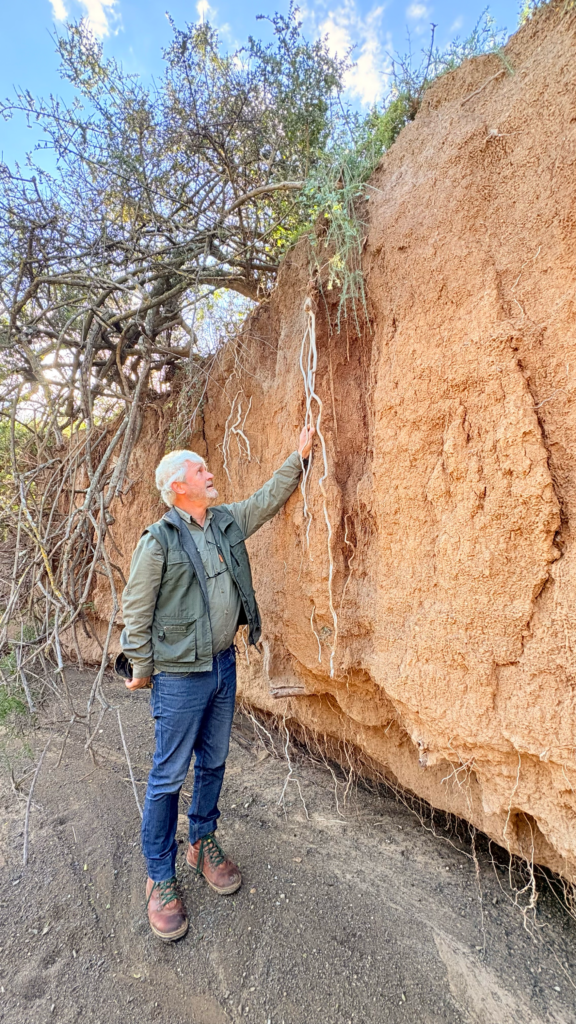
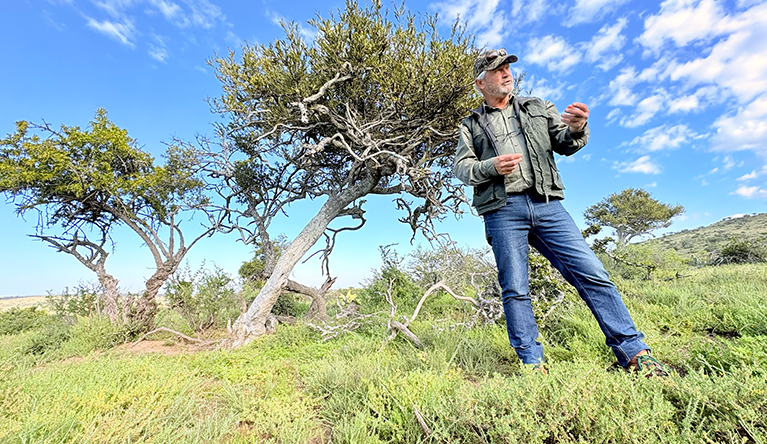
Hive Ecosystems director Japie Buckle is a seasoned restoration ecologist. Here, he explains how goat browsing strips the lower branches of trees in Albany thickets, leaving artificial, mushroom-shaped canopies above and stripped-away topsoil below. Picture: Leonie Joubert.

Key messages:

  • The drought-adapted succulent spekboom has long been trumpeted as the crown prince of South Africa’s nature-based carbon sink solutions.
  • The World Bank ensured its coronation with a $120 million outcome-based bond, structured and named in its honor.
  • According to Amazon, the tech giant’s commitment to buy carbon credits from the first developer to draw on the bond gave other financiers the confidence to back the industrial-scale project. Does this make the tech giant the power behind the throne of an emerging nature-based carbon credit sector?
  • Our investigation uncovers a sector dominated by international corporations whose investment promises are hard to scrutinize, in a cautionary tale of what happens when projects fail. 

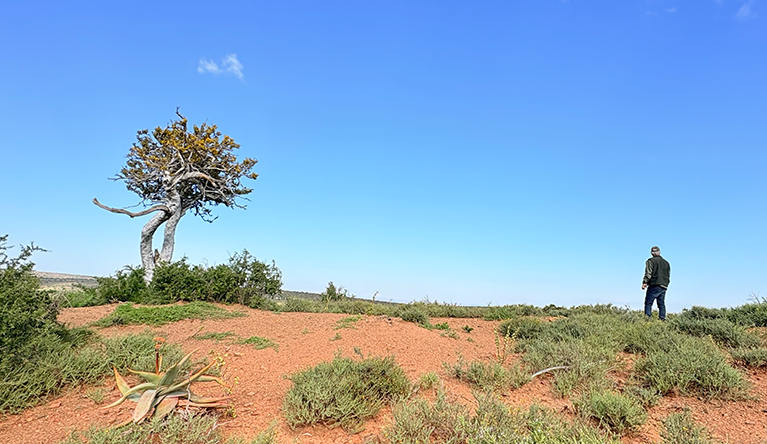
Browsed. Heavily browsed. Knackered. This farm camp is well on the knackered side of the degradation scale, threadbare after decades of heavy livestock pressure. But the single shrub at Nick Hamp-Adam’s feet may help change that. It just needs a second chance. 
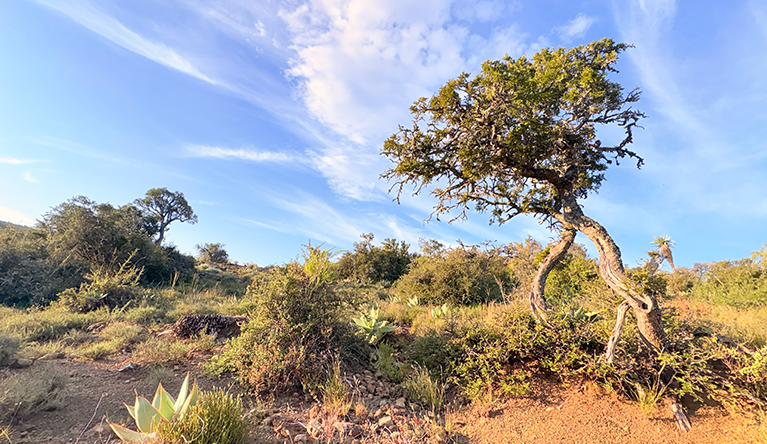
For generations, the Albany thicket biome in the Eastern Cape fueled a thriving economy of sheep and goat farming. Today, an area of 1.5 million hectares needs urgent ecosystem repair. Pic: Leonie Joubert

This young spekboom plant (Portulacaria afra) is more stocky shrub than rooted cutting. It’s had more time than usual in the nursery to bulk up ahead of being released into the wild. But for the moment, it’s stricken on its side, roots exposed. 

Hamp-Adams, general manager for Return to Thicket, one of the smaller restoration projects in this nook of South Africa’s Eastern Cape province, is about to set things right. He sinks to his knees, finds a hand-sized stone and begins reopening the original planting hole. 

“Kudu, most likely …”

His breath is metered by his efforts with the digging tool.

“… came through …”

Strike. 

“… grabbed it …”

Strike.

“… probably wasn’t planted deep enough.”

Strike. 

He’s gentle when he rights the plant, taking care as he tamps the soil around its roots. Tough plants, generally. Don’t need much coddling. Except during planting. Treat them like babies during planting. 

This individual is one of thousands of cuttings of this drought-tolerant endemic succulent that are being popped into the ground across 2,100 hectares (5,200 acres) of exhausted farmland recently purchased by Return to Thicket. As the vegetation regrows, it’s expected to draw the equivalent of 10.3 metric tons of carbon dioxide from the atmosphere per hectare per year over the course of three decades. That’s the equivalent emissions from nearly four round-trip flights for a single person between London and New York. 

But that’s not what makes this particular shrub noteworthy. This plant, and the countless others around the camp, were rescued from another thicket restoration project in the area, one that closed down a few years back when its international backer pulled out. 
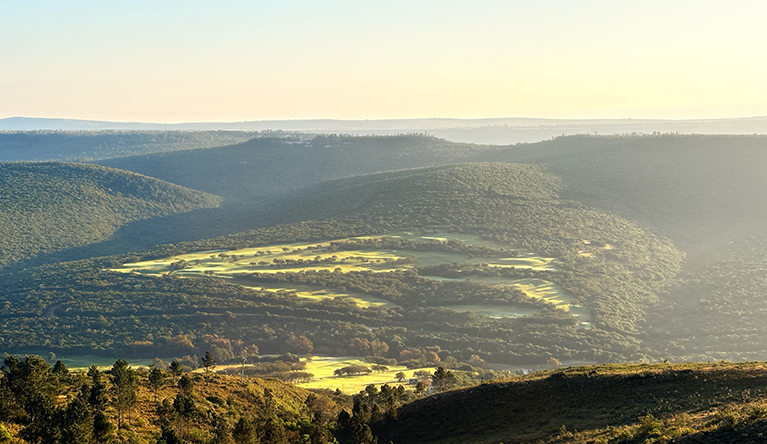
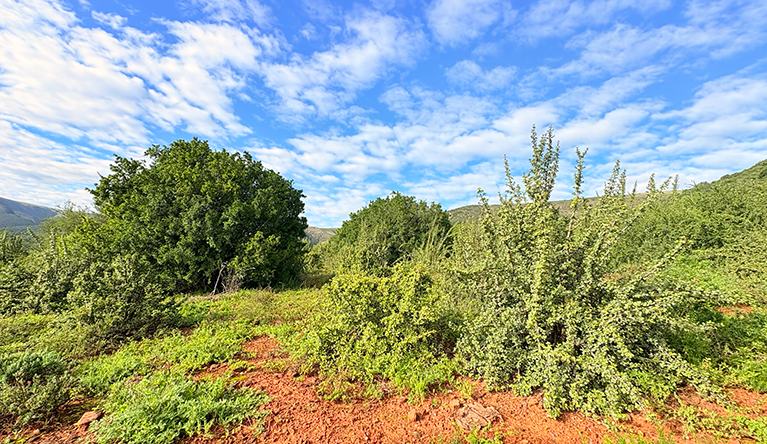
Pastures cut into the near-pristine Albany thicket outside Makhanda in Eastern Cape province show how extensive and dense the hedge-like plant community once was. Pic: Leonie Joubert

It’s a cautionary tale of what happens when developers, carbon market control bodies and financiers aren’t transparent in their operations or open to public scrutiny.

Examining this novel kind of industrial-scale development — ecosystem repair funded by carbon markets — has become particularly relevant now. The World Bank has created an outcome-based bond tailored specifically to help fund restoration projects working to repair Albany thicket, a small but important biome in South Africa where spekboom grows naturally and where its mass planting is expected to help heal degraded farmlands. 

The thicket biome is a small plant community, covering only 1.71 million hectares (about 4.2 million acres) and making up just 2.4% of the country’s total footprint. Yet this niche bond recognizes the need for a fund that’s specifically structured to restore the 90% of the biome that’s partially or badly degraded. Where there once was impenetrable hedge-like thicket, many places have been reduced to near desert. The most likely way to repair the region is through the mass planting of spekboom and paying for the work through the carbon markets. 

The World Bank created a pot of $120 million specifically for this. According to Amazon, the tech giant’s commitment to buy some of the carbon credits from the first project to benefit from the bond gave financiers enough confidence in the business model to come on board with additional funding. 

The first project to draw on this purse expects its restoration work to bring around $500 million into a stagnant farming community over the next 40 years. This will come from just over half its operations, with more planned, and will flow in through wages, rental income, carbon credit revenue sharing with farmers, taxes, and small business development initiatives.

This investigation has examined the origins of spekboom-led restoration the science behind its potential promise (Part 1), and the possible pitfalls if projects don’t meet those expectations [link-part 2]. In this third and final part, we find an emerging nature-based carbon capture  sector that has become dominated by international corporations whose investment promises are hard to scrutinize. Now, key questions remain around what happens when projects operate in an opaque accountability environment, and the possible fallout if projects fail. 

Going bust 

The trail of breadcrumbs between this former farm camp and what’s become known as the Lake Kariba scandal is sparse in the news coverage. But it’s there. 

Concerns about the possibility of fraud in the nature-based carbon offsets sector had been surfacing for some time. But one particular case sent shockwaves through the industry in Southern Africa in 2023. The New Yorker magazine’s Heidi Blake broke the story of a forest conservation project in Zimbabwe, billed as one of the largest of its kind and spanning more than 700,000 hectares (1.7 million acres), that had grossly inflated the amount of atmospheric carbon pollution it claimed to have avoided through keeping trees standing in the Zambezi River Valley. 
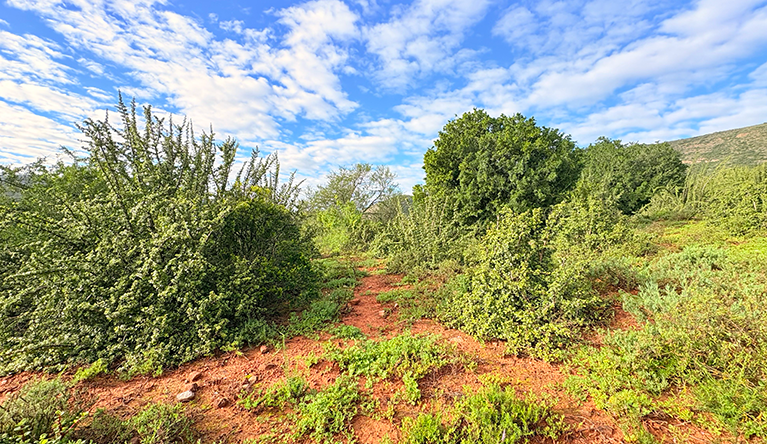
Studies of wild and cultivated spekboom, such as these at a research plot on the Return to Thicket farm, contribute to ecologists’ understanding of how much carbon dioxide these plants can draw from the atmosphere, and how fast. Pic: Leonie Joubert

More than half of the project’s 27 million carbon credits were found to be fabricated. The project was owned by Guernsey-based company Carbon Green Investments (CGI), with Swiss carbon credit broker South Pole handling the development, according to Bloomberg.

The repercussions were felt as far south as here, close to where Hamp-Adams is doing his veld inspection. South Pole, which had been running a small spekboom restoration operation nearby, quietly shut it down following the Lake Kariba incident. In the wake of the closure, Hamp-Adams’ team rescued some of the orphaned spekboom. 

The closure left an unknown number of people without jobs, and an unknown number of hectares abandoned in a state of disrepair. Were these lands browsed, heavily browsed, or knackered? It’s hard to know. South Pole, one of the most powerful global brokers in the industry, is tight-lipped.     

When we asked for details on the project’s closure — how far along it was, how many jobs were lost or didn’t materialize, what the carbon-capture goals were — the company said merely that this was an early-stage pilot.

“As with many pilot initiatives, we periodically assess their commercial viability,” South Pole responded by email through a media consultant. “In this case we decided to close the project. We’re not able to offer further information at this time.”

Clear as mud 

Spekboom has long been trumpeted as the crown prince of South Africa’s nature-based carbon cleanup solutions. The World Bank ensured its coronation recently with its newly minted $120 million outcome-based bond, structured and named in its honor. The listing of this novel financial instrument was made possible through Amazon’s backing, according to the tech giant, with the corporation agreeing to buy some of the carbon credits from the first developer to draw on the funds.

Does this make Amazon the power behind the throne in an emerging nature-based carbon credit sector?

Not in terms of the running of the restoration projects themselves, but in what sustainability scientist Henrik Österblom and colleagues at the Stockholm Resilience Centre at Sweden’s Stockholm University say is the emergence of a keystone actor from the corporate world that has an outsized influence on the system in which projects like this operate. The idea riffs off the concept of keystone species in nature, like termites in an African savanna, which are regarded as ecosystem engineers, so significant is their role in shaping the environment around them. 

Here the concept applies to Amazon having disproportionate influence to shape a niche emerging nature-based carbon sink sector in a tiny corner of Africa where farmers need ecosystem repair as urgently as a burn victim needs lifesaving skin grafts. 

Did Amazon’s door-to-door consumer goods delivery model find another commodity to trade with?

Amazon isn’t investing directly in this farming community, as has been misreported in places. It also isn’t buying these spekboom-generated carbon credits to offset its own emissions, either. The corporation is frank that its approach is to buy credits in order to sell these on to partners in its supply chain who need to offset their own emissions. Amazon has created a one-stop digital shop to handle the transactions: Its newly launched carbon credit exchange, the Sustainability Exchange, where its partners can buy “trusted” and “high-quality” carbon credits.

The corporation was vague on the details of how it will trade the credits on its exchange and would not reveal if it will pay market prices or benefit from a bulk-buy discount. Its media office said only that the price for these credits reflects their higher market value as a result of being of better quality. 

Amazon said it doesn’t disclose the commercial terms of its agreements; however, the media office confirmed that the corporation will build a charge for administering the service into the selling price. This includes a “small margin to cover headcount, tech, registry fees, and other costs.” Amazon would not share details on the precise structure and pricing of these add-ons.  

Intermediary traders and carbon market exchanges usually charge between 5% and 30% for administrative fees, according to Carbon Market Watch. 

In its 2023 report, the nonprofit watchdog warned that without a line of sight on the costing structure of these fees, the public can’t adequately scrutinize the numbers. This lack of transparency makes it difficult to verify if fees are reasonable or if profit markups have been built in. Carbon Market Watch calls for greater transparency around pricing, markups and admin fees, and urges buyers to boycott intermediaries who don’t make this information public. 

Big promises, closed books: The opaque new currency of carbon credits

The first spekboom restoration project to benefit from the World Bank bond is Singapore-based infrastructure developer Imperative Global Solutions Pte. Ltd., a company founded in 2022 that focuses on nature-based ecosystem restoration, funded through carbon markets.

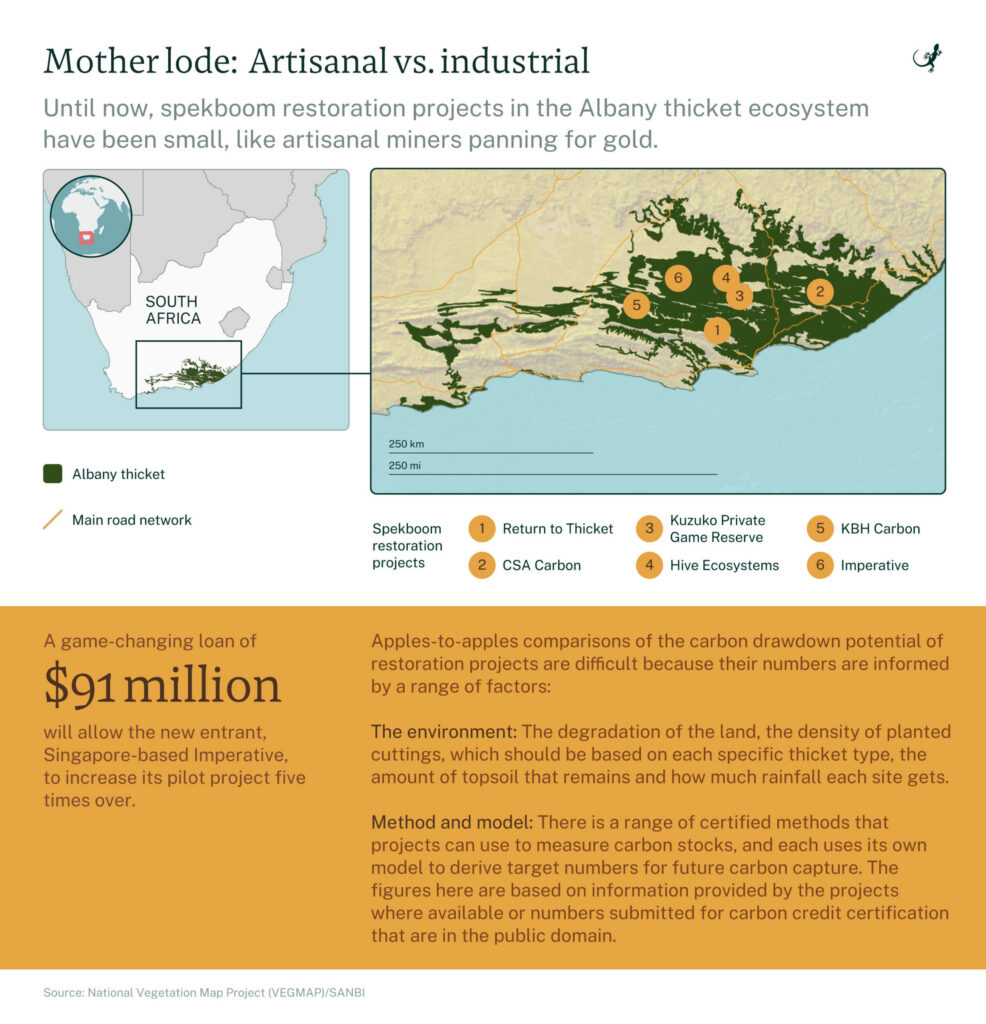
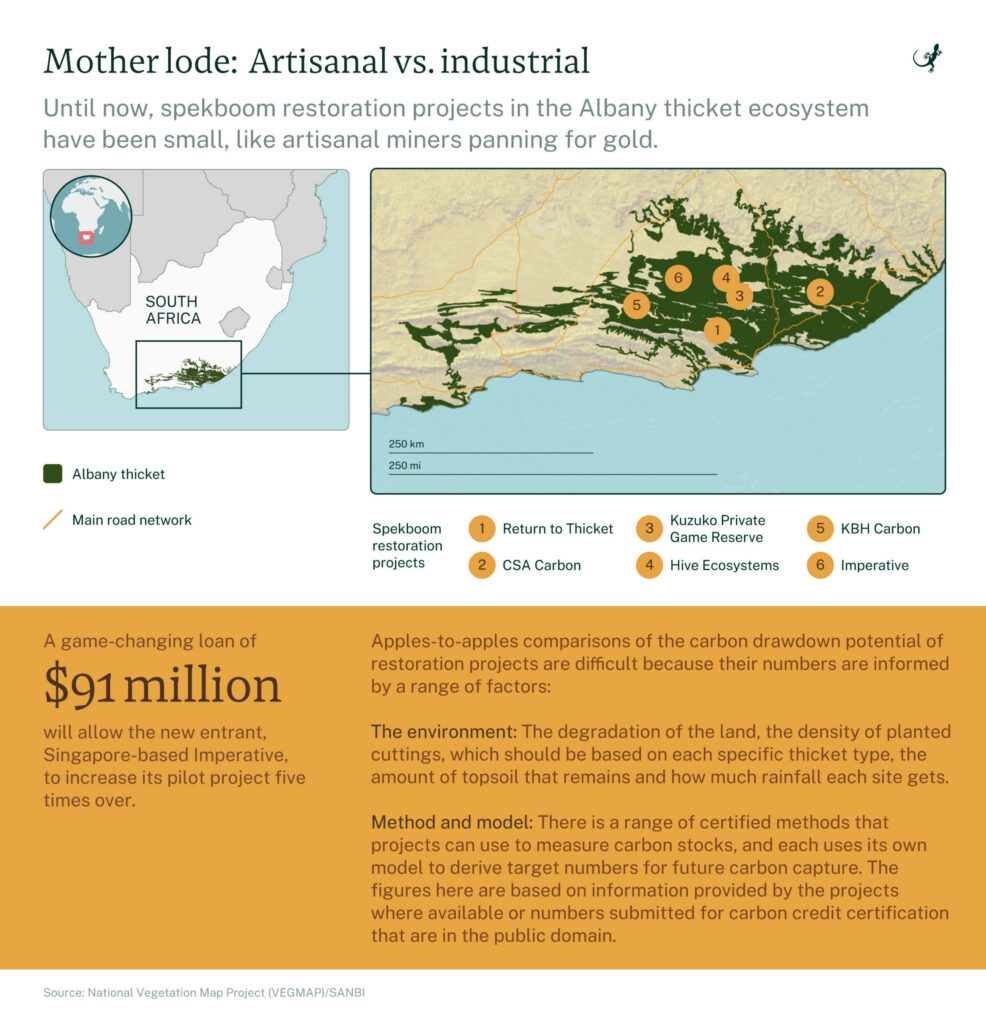
Spekboom restoration projects until now have been artisanal in scale, most of them under 5,500 hectares (about 14,000 acres).
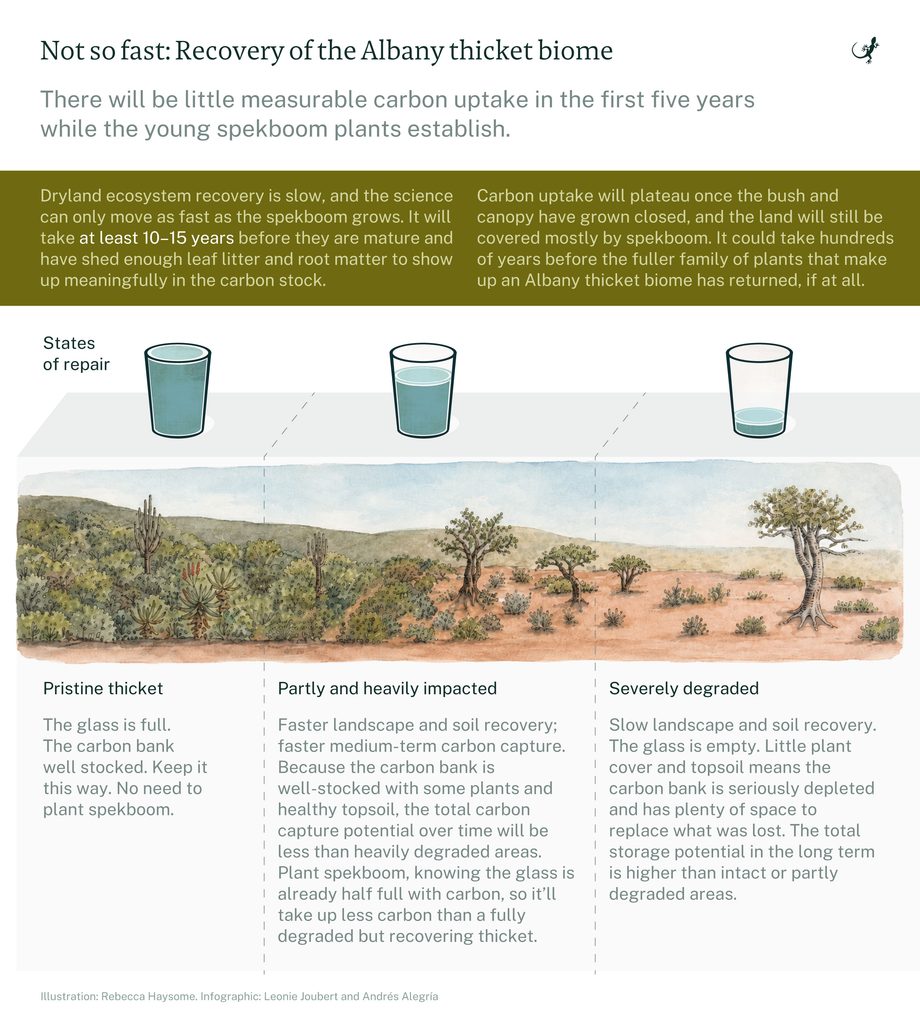
Infographic

Imperative’s arrival in 2024 changed that. Work kicked off in November that year with a 10,000-hectare (nearly 25,000-acre) pilot planting phase, which it completed in just over a year. The company then secured $91 million in loans, which accelerated its planting ambitions. The World Bank bond provided $25 million, and another $66 million came from a handful of other investors. The flush in money allows it to increase its first-phase operation five times, with another big expansion planned thereafter. Imperative plans to have a total of 100,000 hectares (about 247,000 acres) under spekboom by around 2030. 

As these tough succulents grow, the company expects them to draw down 41.6 million metric tons of carbon dioxide equivalent (tCO2e) over the next 40 years. This will allow Imperative to earn the equivalent number of carbon credits, as one metric ton of CO2 removed from the atmosphere converts to one carbon credit. Amazon has agreed to buy some of the first crop to come from one half of the project: 1.95 million credits in all, which amounts to 9.4% of the 20.8 million carbon credits that this new 50,000-hectare (124,000-acre) planting is expected to produce over four decades. 

Imperative anticipates $500 million reaching the community from the first 60,000 hectares (nearly 150,000 acres) over 40 years. How much of this materializes depends on how much atmospheric carbon the spekboom plantings draw from the atmosphere as they grow, the price of carbon credits over time, and the revenue sharing agreed between Imperative and the farmers it has partnered with. Imperative wouldn’t disclose the terms of the contracts with farmers, though, which stipulate the details of the revenue share. (Imperative’s business model differs from others in that it opts to rent land from farmers rather than buying. This allows the restoration work to reach more land and landowners to keep their properties.)

The method to calculate the carbon drawdown potential of a recovering thicket has been developing for over two decades. But it’s still a relatively young field, and it can only advance as fast as the early spekboom plantings grow. A project’s business model may forecast 10 tCO2e of drawdown per hectare per year. But project staff may only know in 10-15 years what the actual accumulation of carbon is in the soils and plants. If it’s only 5 or 7 tCO2e, the project will only earn the equivalent number of carbon credits.

Infographic


“We only get paid for what we deliver,” says Scobie Mackay, Imperative’s CEO. 

The market price of this novel currency is another factor. 

Carbon credits from the first plantings should start to trickle in as soon as 2027 or 2028, according to Imperative. How much each credit is worth depends on its type and price fluctuations on the market. Nature-based carbon drawdown credits that come from forestry plantations involving monocrop tree planting are on the lower end of the range for the reforestation and revegetation category. These were selling for around $14 in 2025, according to the World Bank. Projects that provide biodiversity habitat repair alongside their climate benefits, like these spekboom projects, have higher values. Imperative’s Mackay references the data provider and analytics firm MSCI Carbon Markets on this, although he wouldn’t disclose the price category that applies to Imperative’s credits. MSCI told us that the most likely price point for these spekboom-generated credits is around $45. 

Meanwhile, an industry insider who asked not to be named said that most local projects are working on a value of $20 to $25 a credit.

How much will Amazon pay for its 1.95 million carbon credits? How much of that will flow into the farming community in Albany thicket country, and over what period of time? 

Neither Amazon nor Imperative would reveal the price they’ve settled on. But these credits, they say, will be high-value, bought at a fixed price and purchased during the first earning period, which Amazon gives as an open-ended “more than a decade.” 

Based on this, and the range of prices for this category of credit, I estimate that Amazon’s bill for the 1.95 million carbon credits could be anything from $39 million at the lower range of $20 per credit, to $87.75 million if trading at $45 a credit. 

The carbon credit returns reaching the community will ultimately depend on how much organic carbon shows up in the plant and soil samples measured over coming years, which depends on how well the next four or five years of plantings take root, as reported previously, and on the company’s profit-sharing agreements.

Keep it real 

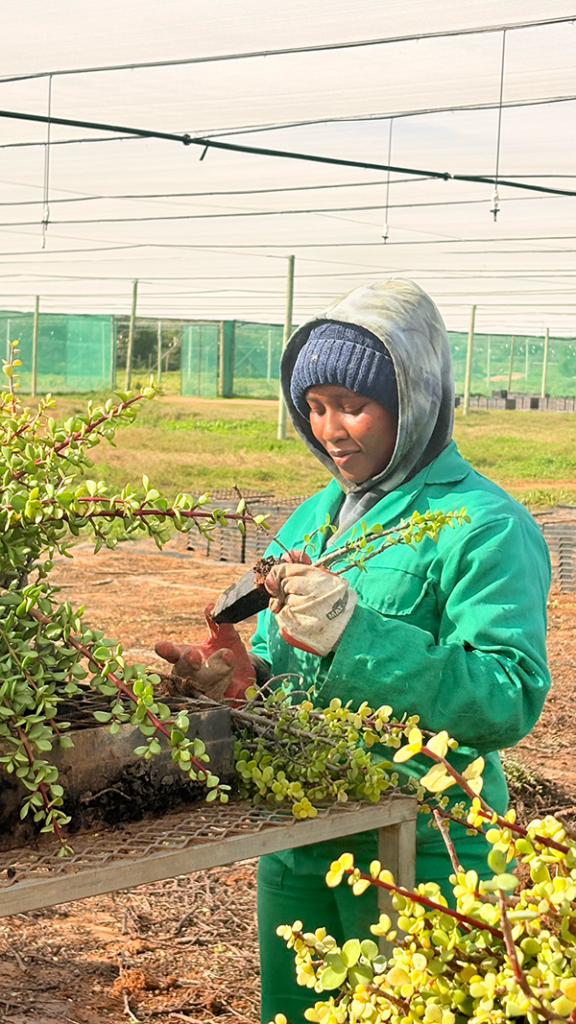
Sonia Latola smiles coyly when the attention turns to her on a warm winter’s afternoon as she knock-knock-knocks a 3-month-old spekboom cutting free from its rooting container beneath the domed shade cloth at the Hive Ecosystems nursery, less than an hour’s drive from some of Imperative’s farms. She and her colleague Elistine Fisant live in the area and are, for the time being, enjoying the flush of jobs that these planting projects bring. Every day, these two transfer thousands of cuttings into crates that get hauled up a precarious country road by tractor. There, a crew with pickaxes and hand trowels will place the young plants gently but speedily into the ground, cutting by cutting, laboriously and by hand. 

Like Return to Thicket, Hive Ecosystems is a small but established spekboom restoration project in a sector that is now seeing a growth spurt as the World Bank and other financiers recognize the business model for funding ecosystem restoration in these exhausted farmlands. 

Many of the people interviewed — farm laborers, businesspeople, landowners, and many others — say they don’t understand how this strange new currency of carbon credits works. They can’t fully grasp how invisible carbon dioxide translates into the tangible dollars and cents that are promised in recent press releases. They do hold onto the hope, though, that these new investments will bail out desperate farmers and put real cash in the pockets of people in a part of the world where jobs are scarce and the farming economy of yesteryear is on its knees. 

For more than two centuries, South Africa’s big developers have mostly been in extractive sectors such as mining and related industries. The developers of tomorrow are viewing ecosystem repair as a new frontier, recognizing the business opportunities that will allow for the rehabilitation of the very natural infrastructure left damaged by extractive industries. That some prominent Global North financiers are seeing the business potential of investing in ecosystem repair in an area as tiny and niche as South Africa’s Albany thicket biome suggests that farming with a novel agricultural crop in the Global South — carbon — may indeed be the new gold rush, for better or for worse. 

This is the third article in a three-part investigation of spekboom-led ecosystem restoration in South Africa. This is part of an award-winning collaboration between independent science writer Leonie Joubert, the Stellenbosch University School for Climate Studies, and the Henry Nxumalo Foundation which supports investigative journalism in Africa. Read parts one and two.

New gold rush (Pt 2/3): Spekboom restoration speeds up, but it’s a bumpy road

The number of cuttings this Hive Ecosystem team manages to plant in a day is dizzying. This project is halfway toward its original goal of planting spekboom across nearly 5,500 hectares (nearly 13,000 acres). Picture: Leonie Joubert

The number of cuttings this Hive Ecosystem team manages to plant in a day is dizzying. This project is halfway toward its original goal of planting spekboom across nearly 5,500 hectares (nearly 13,000 acres). Picture: Leonie Joubert

  • A unique approach to ecosystem restoration in South Africa — repairing exhausted farmlands through the mass planting of spekboom — is receiving global attention as one new entrant gets an injection of $91 million to dramatically increase its plantings. 
  • This will contribute toward the goal of planting more than 300 million spekboom (Portulacaria afra) cuttings, funded by investors through global carbon markets. 
  • Smaller restoration projects have blazed a trail until now, helping to improve planting and land management methods to get maximum plant survival, bush recovery and, ultimately, carbon credit returns.
  • Plant survival rates through the next five planting seasons will dictate how well farmlands recover in coming decades, whether they deliver on the carbon drawdown expectations, and whether investors get their returns. But our investigation finds that things may be getting off to a rocky start.

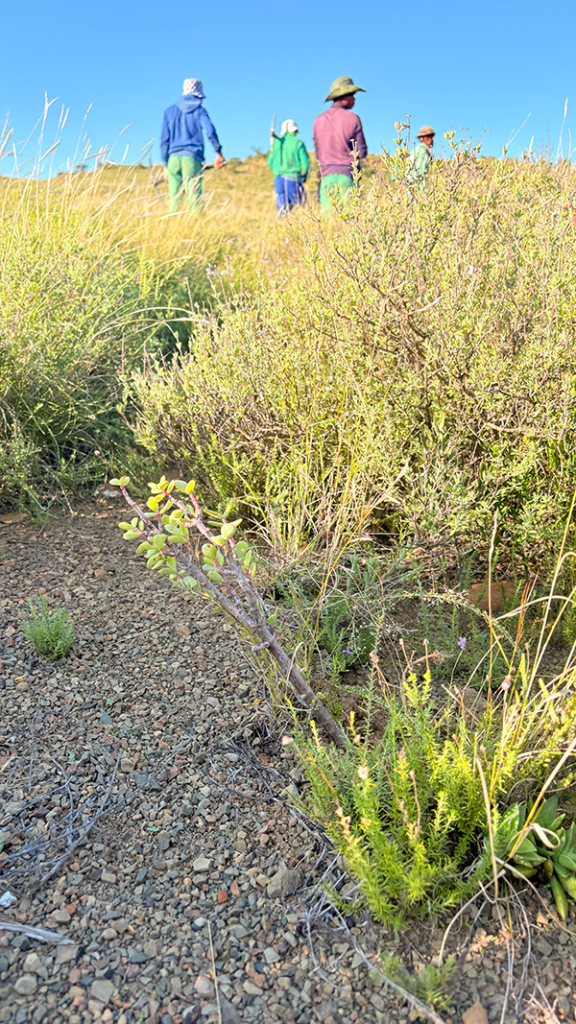
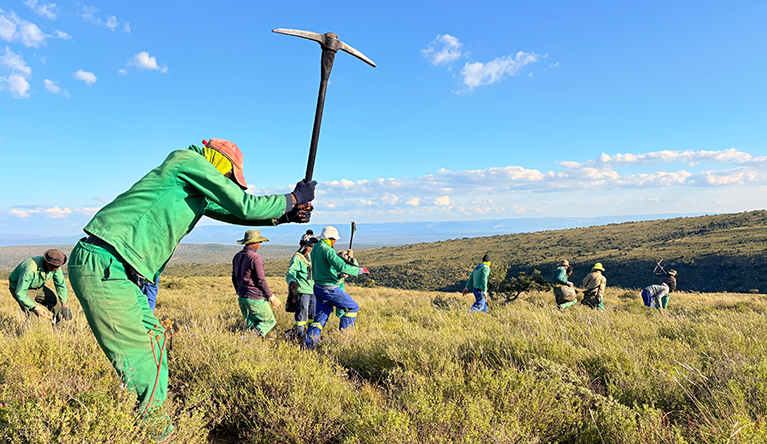
The team of diggers crisscrossing a hard-to-reach hill on a remote farm in South Africa’s Eastern Cape province shows how tough spekboom planting is. A row of men, each arcing a pickax over his head to his own rhythm, punctures a Morse code of holes into the earth. Behind him, a planter drops a rooted spekboom cutting into the hole, fills it, and tamps the soil gently with a trowel. Between them, a runner, his bag not unlike that of an old-school postman, ferries cuttings from the tractor that has labored up a treacherous country track from the nursery on a nearby farm. 

They’ll get a few thousand plants into the ground today, give or take, but the team works so fast that the numbers blur after a while. 

It’s grueling. But the men are upbeat. It’s work, many say, in a region where unemployment is high and the stagnant farming sector unlikely to change anytime soon.

Mohair-producing angora goats in South Africa. Image © Samantha Reinders.

The planters are doing the first steps in helping repair the land on a farm owned by Hive Ecosystems, one of the more established outfits in a small but emerging restoration sector. Here, ecologists hope that mass planting with spekboom (Portulacaria afra) will be the first step in the recovery of what’s known as the Albany thicket ecosystem. Generations of heavy livestock rearing — mostly with mohair-producing goats — have reduced once-impenetrable hedge-like bush to something akin to desert across 1.5 million hectares (3.7 million acres) of farmland. Nothing much will grow here anymore. Except spekboom. 

These projects are drawing on carbon markets to raise the capital needed to fund the wide-scale planting of this drought-hardy, easy-to-grow plant. Investors provide the funds now, with the promise of earnings from a new kind of agricultural crop down the line: atmospheric carbon banked away in the plants and soils, which translates into the currency of carbon credits. 

The business case for this has been in development for roughly two decades. It is now so convincing that the World Bank recently listed an outcome-based bond tailored specifically to fund the work, with a pot of $120 million that’s available to developers in the spekboom sector. The first to draw on this loan is a new entrant: Singapore-based infrastructure developer Imperative Global Solutions Pte. Ltd., which specializes in ecosystem restoration at scale, and whose operations are taking what was artisanal and making it industrial in size and approach.

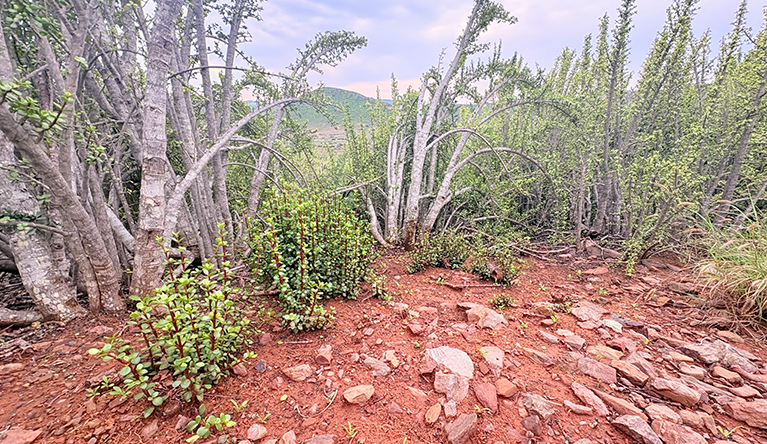
Where once there was impenetrable hedge-like Albany thicket, today many farms look like a desert. These farmlands need spekboom-led repair the way a burn victim needs lifesaving skin grafts. Picture: Leonie Joubert

Spekboom planting is now increasing at a pace and scale unlike anything tried before. What happens in the field over the next four or five years will determine how well the vegetation and, hopefully, the broader ecosystem recover over the coming decades. Planting success will dictate whether it delivers on the carbon capture expectations promised by developers, how this translates into carbon credits and, ultimately, whether investors get their returns.

This little corner of the country needs the restoration work the way a burn victim needs lifesaving skin grafts [TK Link to story 1]. Many of these farmlands are so exhausted that there may only be one agricultural crop left to grow here: carbon. If projects don’t make good on their promises, insiders worry that it will undermine investor confidence, scare off financiers, and be the death knell for a farming sector that’s already on life support.

Getting it right: How to plant a succulent, at scale

The Hive Ecosystems project is roughly halfway toward its goal of getting spekboom sprigs into 5,431 hectares (13,420  acres) on its properties near Jansenville, about an hour’s drive inland of the port city of Gqeberha. Managing director Japie Buckle would like to double that planting area if they can buy more land.

The thicketeers — that’s what some ecologists, researchers and project implementers call themselves — agree that planting spekboom isn’t rocket science. But doing so fast and at scale needs to be done carefully, and they’re sharing what they learn as they go.

Their field notes might sound like succulent wonks geeking out on gardening hacks. But their watchful attention to planting and post-planting teething issues — what works and what doesn’t, even months or years down the line — will be key to ensuring the survival of well over 300 million spekboom plants that will be put in the ground across all projects, cutting by cutting, laboriously and by hand, over the next four or so winter planting seasons. 

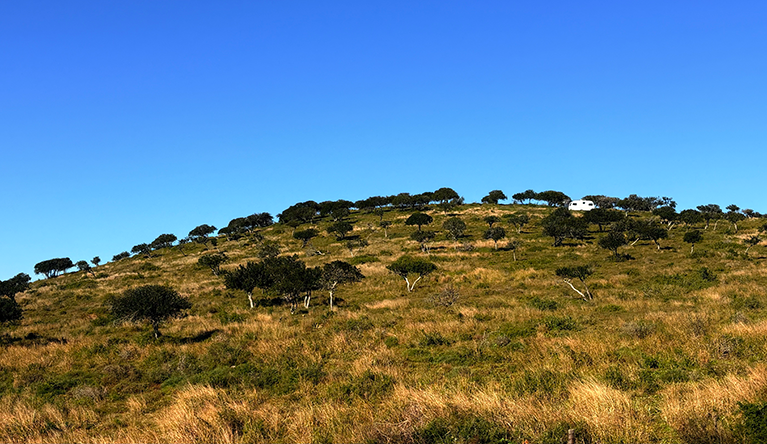
Intensive goat browsing creates what ecologists call a pseudo-savanna. This hill should be covered with impenetrable thicket. Instead, heavy browsing has opened it up, leaving sparse trees with artificial mushroom-shaped

“Spekboom is hardy. It’s evolved here,” says Nick Hamp-Adams, general manager of Return to Thicket, one of the smaller restoration projects that incorporates two exhausted former mohair goat farms. No need to coddle it in the nursery or too much after planting, he says, but be gentle when putting it in the ground and do immediate post-planting follow-up.

“How you plant matters,” Hamp-Adams adds, smiling. “Make sure your teams are handling them like babies.”

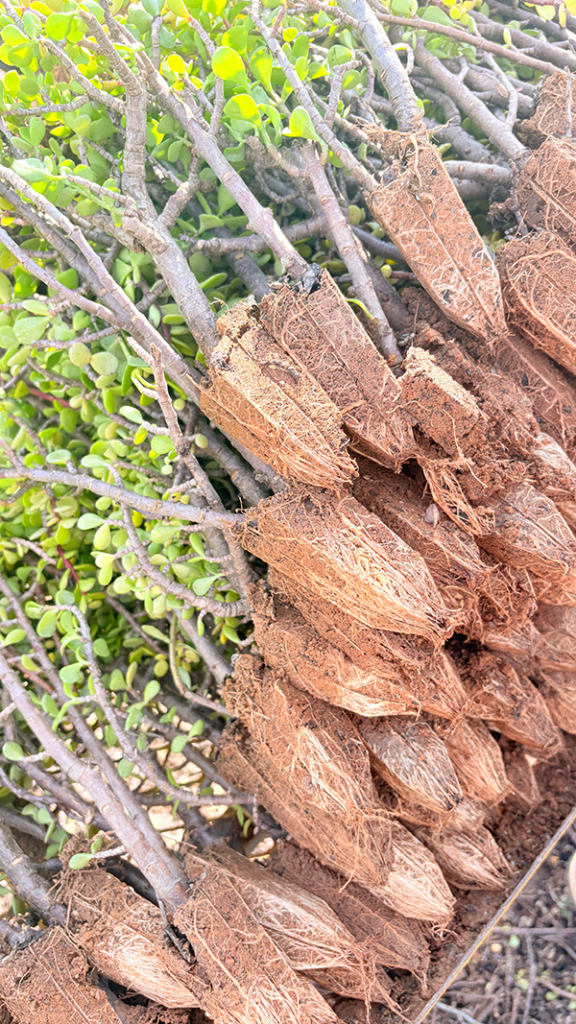
The process that most projects follow is simple: Harvest cuttings from wild-growing spekboom; give them roughly three or four months in the nursery to establish roots; and then plant them in a degraded spot. Most of the projects are deliberately low-tech and bare bones. They might work on an estimated cost-per-unit of 9-21 U.S. cents to get a cutting through the process.

Rooted cuttings take time and cost more to get veld-ready, but they establish better than unrooted ones, which don’t need much nursery time, according to Buckle, a seasoned restoration ecologist with decades of wetland rehabilitation under his belt. There’s a sweet spot where a cutting’s stem thickness and root size improve its odds, without spending too much time in the nursery.

Little tweaks at planting can improve a cutting’s chances, like propping a small rock at an angle to its base. This captures condensation, moistens the roots, and creates a gentle microclimate, says Jacquie Pastor, a consultant to a restoration project KBH Carbon, set up by its parent company, the mining conglomerate KBH Group, which has planted the first 1,000 hectares (about 2,500 acres) with the goal of eventually restoring 5,000 hectares (roughly 12,000 acres) of land. 

The tradeoff: Slower planting speed, better survival.

Learning from the teething problems 

“You need to calculate in some die-off,” Hamp-Adams says, scanning a section of one Return to Thicket farm where the sparse ground cover has sprigs of spekboom dotted about in every direction. It’s early winter, and the cuttings have had four months to settle in.

The Rhodes Restoration Research Group at Rhodes University in Makhanda, Eastern Cape province, hopes to get its nursery up and running again after work stalled due to government funding cuts. Researchers are exploring what a broader thicket restoration approach could be, in which species other than spekboom are introduced into planted areas. Image by Leonie Joubert for Mongabay.

There will always be some cuttings that don’t make it. Many of the smaller projects report relatively low mortality — between one and three cuttings dying for every 10 planted. But that figure can vary, depending on how the cuttings are planted and how the land is managed in the weeks and months that follow.

One pilot site at Kwandwe Private Game Reserve near the town of Makhanda — part of an ecotourism-focused collection of farms owned by C-SA Properties, whose restoration work is being done by  CSA Carbon — had “super high mortality rates” along one edge of the plot, according to Kwandwe’s environment manager, Craig Sholto-Douglas. Six or seven out of 10 cuttings died. But toward the center of the plot, jackpot: Eight out of 10 made it. 

Speaking at a thicket restoration forum in 2024, Sholto-Douglas put this down to the dance between predator and prey: Antelopes were lingering in a part of the site where they felt safe, so they browsed heavily here. But they moved quickly through the open area where they felt in danger, only nibbling the plants along the way. 

Sholto-Douglas has been overseeing spekboom planting across 2,000 hectares (roughly 5,000 acres) of reclaimed farmlands around the edge of the reserve. This initiative is one that’s geared toward improving natural bush for wildlife and ecotourism, much like a similar project run at Kuzuko Private Game Reserve not far from here.

In spite of having a breather from heavy livestock pressure, parts of these farms still haven’t recovered on their own after 25 years, according to Sholto-Douglas. The spekboom plants should change that.

These real-life experiences are all critical data points for landowners who might one day want to reintroduce wildlife or livestock onto recovering lands. All have different histories, Sholto-Douglas says, all are in different states of disrepair. With only four years to learn from these teething problems, time is ticking for this emerging sector.

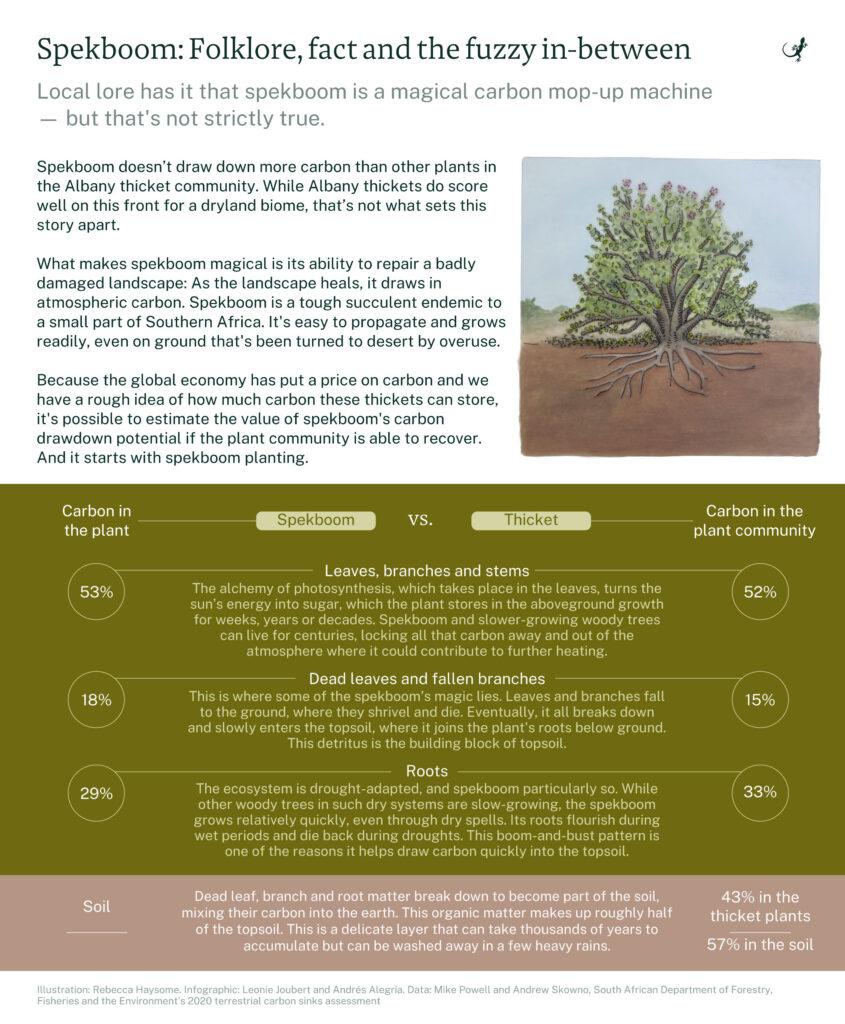
Spekboom vs thicket carbon

Going big

Most projects are artisanal in size, and planting is proceeding slowly. It’s taken Hive Ecosystems three years to achieve the first half of its planting goal with a crew of nearly 50 people in the nursery and out in the veld. Return to Thicket got its first 1,000 hectares planted in 14 months, with 10 people handling the nursery side and 10 planting.

The new entrant to the sector, Imperative, which has attracted World Bank funding and Amazon’s attention, has bigger ambitions. It aims to complete its goal of planting 100,000 hectares (about 247,000 acres) within the next four to five years. According to Tiaan Burger, Imperative’s spekboom restoration project manager, the operation will be able to plant 20,000 hectares (nearly 50,000 acres) per year once it’s running at full speed.

The company has also opted for a more technical approach to propagating its cuttings, using a trademarked specialist rooting method from Danish company Ellepot, which is said to shorten nursery time and protect against planting shock, according to the manufacturer.

Burger wouldn’t comment on Imperative’s cost per unit to get a cutting from harvesting to planting. And Ellepot’s South Africa office also wouldn’t disclose the cost per unit for the product that Imperative uses. However, based on industry information from others familiar with such calculations, Mongabay estimates that Imperative’s cost per unit is perhaps 50 U.S. cents per rooted cutting, roughly double what smaller operators budget for.

While the smaller projects’ plantings are ticking over slowly, Imperative arrived in the area in 2024 and had its first 10,000 hectares (25,000 acres) planted in just over a year. According to Burger, planting began in November 2025 on the second phase — the 50,000 hectares (nearly 124,000 acres) that have attracted a $91 million loan funded in part by the World Bank and derisked with Amazon’s buy-in. The goal, he says, is to complete all this planting — five times the size of phase one — within two years. With further planned expansion, Imperative calculates a total carbon drawdown of 41.6 million metric tons of carbon dioxide across its 100,000 hectares over 40 years, averaging out to 10.4 metric tons of carbon dioxide per hectare per year. 

Projects are unlikely to see much carbon build-up in the total carbon stock — the plant matter and soils — in the first five or so years, because the young trees will need to establish. It will take roughly 10-15 years before they’re developed and shedding enough leaf litter and root matter to reflect significantly in soil and plant biomass samples. Carbon uptake will plateau once the canopy has grown closed, and spekboom will still be the predominant plant. 

Whether the recovering lands show they’ve captured as much carbon as hoped for will depend on how well and how quickly the young cuttings establish.

Not so fast.

How fast is too fast?

Questions have emerged about how successful Imperative’s first-phase plantings have been, though, whether it’s scaling up too fast and whether it’ll be able to meet its ultimate targets.

Mongabay has credible information from sources indicating that some of Imperative’s early plantings have experienced die-offs of as much as 80-90%. Burger wouldn’t comment on whether these figures are accurate. He did say, however, that investors had done their due diligence, including visits to first-phase plantings. Mongabay wasn’t able to establish which sites were visited, by whom or when. But Burger maintained that Imperative’s financiers wouldn’t have agreed to the loans if they didn’t have confidence in the company’s ability to deliver. 

Imperative CEO Scobie Mackay also wouldn’t comment on mortality rates and said the developer was learning from its early planting experiences. Many parties working with Imperative, including its implementing partner, NatCarbon Africa, are tied into nondisclosure agreements — standard practice for commercial ventures of this scale, according to Mackay — which makes it difficult to independently verify information provided by Imperative representatives or its partners.

An environmental scientist with extensive experience in restoration work of this type in South Africa, but who asked not to be named because of their proximity to the sector, told Mongabay that such high mortality rates are possible — and not just for spekboom — if plants don’t get the right follow-up care and appropriate land management.

“Our experience on other projects in the region where such care is absent has shown that an 80% to 90% plant mortality rate is not uncommon,” they said. “One cannot just stick a sapling in the ground and hope it will survive.”

There are many things that can kill a sprig: a heat wave; a frosty snap; or unusually wet soils causing rot. Hungry animals, too. 

The Kwandwe reserve team found a few unusual candidates taking advantage of some of their young spekboom.

One batch of plants had been in the ground for 18 months and, by all accounts, looked like they were surviving. But they weren’t thriving.

“All of them still upright. All of them rooted beautifully,” Sholto-Douglas says.

Post-planting inspection is essential to ensure that cuttings survive. Most projects anticipate that seven out of 10 cuttings will take. New entrant Imperative would not disclose what its planting survival rate is, but some reports suggest that the developer may be experiencing some teething problems. Image by Leonie Joubert for Mongabay.
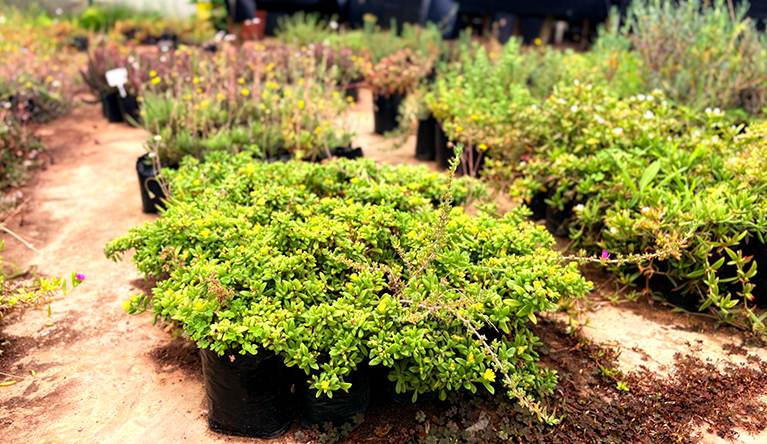
Most restoration projects have low-cost, low-tech nursery operations where the spekboom cuttings can grow roots before being planted in the wild. Image by Leonie Joubert for Mongabay.

It turns out that, while the reserve’s management team had been able to keep the large browsing animals out of these recovering lands, they hadn’t accounted for the little ones, like Cape scrub hares (Lepus saxatilis) and gray duikers (Sylvicapra grimmia), a regular antelope to these parts.

Locals here say that spekboom is to goats what ice cream is to a toddler. But it seems that small wildlife feel the same way about these irresistible plants, another important data point for the sector as spekboom planting goes industrial scale.

This is the second article in a three-part investigation of spekboom-led ecosystem restoration in South Africa. It is part of an award-winning collaboration between independent science writer Leonie Joubert, the Stellenbosch University School for Climate Studies, and the Henry Nxumalo Foundation which supports investigative journalism in Africa. Read parts one and three.

A new gold rush (Pt 1/3): Big money, high stakes in spekboom sector

These two-decade-old planted spekboom bushes at Cambria on the edge of the Baviaanskloof UNESCO World Heritage Site show the characteristic skirting that creates a nursery environment around their base in which other plants and animals can live. Picture: Leonie Joubert.

These two-decade-old planted spekboom bushes at Cambria on the edge of the Baviaanskloof UNESCO World Heritage Site show the characteristic skirting that creates a nursery environment around their base in which other plants and animals can live. Picture:  Leonie Joubert.

  • After decades of livestock pressure, 1.5 million hectares (3.7 million acres) of farmland in South Africa’s Albany thicket biome need rehabilitation — the way a burn victim needs lifesaving skin grafts.
  • Carbon finance seems the most likely source of funding, kickstarting the process with the mass planting of an endemic drought-tolerant succulent called spekboom. 
  • Until now, restoration projects have been artisanal, but that’s changed with a $91 million loan to a new entrant and tech giant Amazon throwing its hat into the ring. 
  • A flush of new funding shows growing faith in a business model for ecosystem restoration, but there’s concern that if projects grow too fast and promise more carbon dioxide drawdown than the emerging science can account for, it could leave projects on shaky ground.

The spekboom is to goats what ice cream is to a toddler, say the locals in this little nook of South Africa’s Eastern Cape province. This explains why roughly 90% of the Albany thicket plant biome has been stripped by generations of livestock farming, mostly mohair-producing goats. Where there once was impenetrable bush, many farmlands now look like a desert. 

This particular plot of cultivated spekboom (Portulacaria afra) — literally, bacon tree in Afrikaans — carries the weight of expectation, though. 

The oldest spekboom bushes on the Krompoort farm show 50 years of growth behavior. Research has a long way to go before it can answer the sector’s most pressing question: How much atmospheric carbon can they draw down into the plants and soils? Picture:  Leonie Joubert.

“These are the old ones,” says Nick Hamp-Adams, gesturing to a dense line of bushes, each a spray of boughs that erupts from the ground like fireworks. After half a century, they stand a little higher than a tall person’s head. Their plush, water-laden leaves create a pointillist hedge that’s hard to see through. Where the lower branches dip to the ground, some send out roots, which allows the plant to spread and further carpet the soil.

“The farmer planted them because mud [kept] flooding his barn,” says Hamp-Adams, an environmental policy graduate and general manager at Return to Thicket, a small restoration initiative in this emerging sector. 

From those humble beginnings in 1976 — a farmer needing to shore up a slope that had been stripped bare by goats — this plot has become the holy grail of thicket restoration research. Hamp-Adams is, for the time being, the keeper of the grail. Return to Thicket now owns the historic Krompoort farm, previously a commercial mohair enterprise and now a critical study site for thicket restoration, which sits about an hour’s drive inland of the port city of Gqeberha.

“Over time, [the plot has] been added to and expanded,” Hamp-Adams says. “Researchers have experimented with different methods of planting spekboom.”

He points to the distinctive skirting around the base of the bushes. This loose weave of low-hanging young branches and leaves creates nursery conditions beneath it, shielding the ground from the jackhammer strikes of raindrops and softening the sun’s heat. Bare ground can bake at more than 60° Celsius (140° Fahrenheit) in summer. The power of raindrops and heat can turn fluffy, seed-friendly soil to concrete-like conditions, says Alastair Potts, a botanist and associate professor at Nelson Mandela University in Gqeberha.

Spekboom is just one of many woody tree species in Albany thicket. But it’s this quick-growing skirt that is part of its magic, allowing it to heal and reverse this damage and, restoration ecologists hope, allow the original thicket to recover where the now barren landscape lets little else grow.

As the thicket has been stripped, exposed topsoils have been washed away, and unchecked runoff has carved erosion channels into stream and river systems. In addition to planting spekboom, Hive Ecosystem’s Japie Buckle is restoring eroded rivers on the property’s farms. Image by Leonie Joubert for Mongabay.

It’s this ability to heal the landscape that has had spekboom all over the news of late. As it grows, it draws down carbon dioxide from the overburdened atmosphere that is causing the global rise in temperatures. The world’s economy has put a price on carbon — for this specific kind of project, anything from $20 to around $45 per metric ton of CO2 cleaned from the atmosphere, sources say. That’s why spekboom-led restoration has attracted the attention of a big international carbon-capture project developer and financiers, including the World Bank, as well as interest from tech giant Amazon. 

Ecologists can show early estimates for how much carbon these recovering thickets might bank away in the plant matter and soils. These calculations allow developers to build a business case so that they can draw on carbon markets to pay the bill for restoration. The idea is to kick off longer-term thicket recovery and revive farms left moribund by decades of land degradation: Get investors to pay upfront  to replant the landscape, and let them cash in on carbon credits down the line. 

Growth spurt

This maiden row of 50-year-old plants in the Krompoort plot is bigger by far than the other plants  — each bush taller, wider, its fleshy hedge-like cover denser. Less competition, Hamp-Adams says, more water and nutrients. Uphill, younger rows were added over time, planted by researchers in a deliberate grid, with a meter’s gap, 3.3 feet, between individual plants, and varying spacing of 2-5 m (6.7-16 ft) between rows.

The plants’ carbon-capturing potential as it helps the thicket to recover has caught the attention of developers who are willing to pay for the mass planting of spekboom. 

And the farmers here need it like a burn victim needs lifesaving skin grafts. Where many farms were once impenetrable hedge-like bush, they have been stripped to bare ground. Almost nothing can grow on the most damaged lands now. Except spekboom. And if spekboom can take root and create the nursery environment that will allow other thicket plants to sow their seeds, it may allow the wider ecosystem to return to a semblance of its former self. Wildlife could return, for instance, or even cattle, sheep and goats, though ideally at much lower stocking rates than in decades past. 

Mass spekboom planting is the first emergency treatment that could, over time, allow the skin grafts to take. It could take decades. It could take centuries. But it starts with spekboom. Planted laboriously, one cutting at a time, but at scale and fast.

Artisanal versus industrial 

This small emerging sector is now seeing a seismic change with a new international entrant that has attracted Global North investors with deep pockets. 

The spekboom restoration community is cautiously optimistic. Wooing such hefty financiers shows growing faith in a business model for ecosystem repair that’s been in the works for roughly two decades, many say. Yet there’s concern that if restoration projects grow too fast, or if their carbon-capture numbers are more ambitious than the emerging science can account for, it could put the sector in jeopardy. 

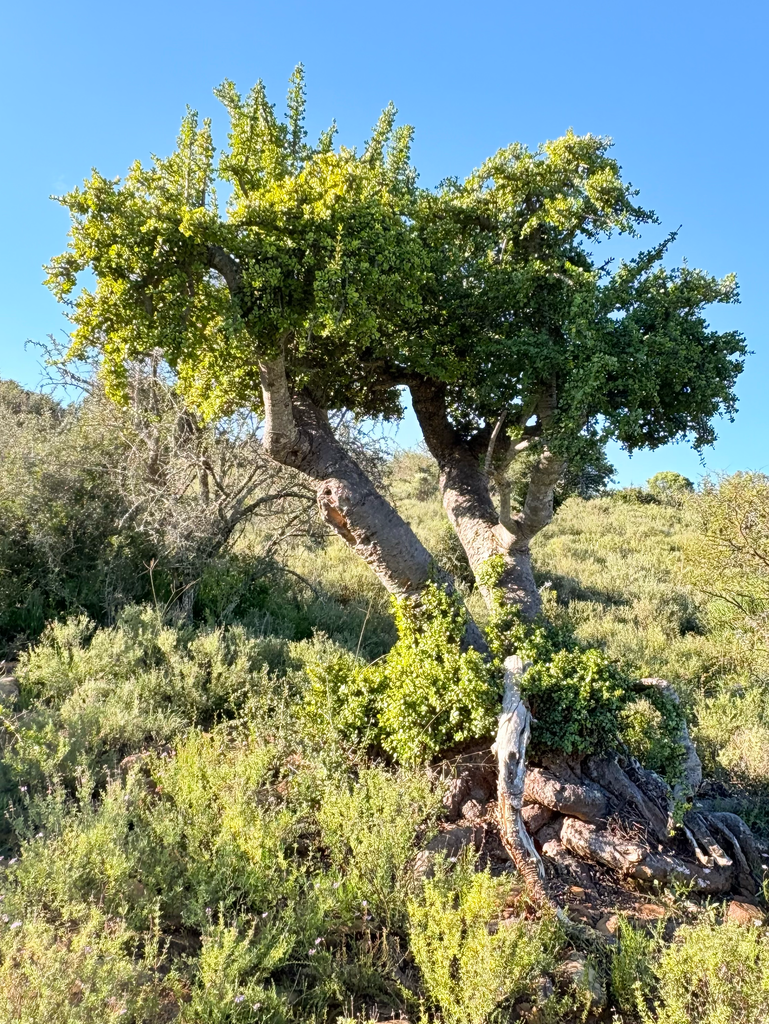
An old, badly damaged spekboom tree shows how goats browse the lower branches and leaves, stripping away its protective skirt and creating an artificial, topiary-like canopy. Picture:  Leonie Joubert.

Singapore-based Imperative Global Solutions Pte. Ltd., a company that bills itself as an infrastructure developer — albeit one that builds ecosystems rather than bridges or dams — recently secured funding that should allow it to expand its initial pilot operation of 10,000 hectares (about 25,000 acres) five times over the next two years. Founded in 2022, the privately held company says it brings expertise in nature-based solutions through carbon markets.

Imperative recently announced it had secured financing of $91 million, with $25 million coming from a newly listed World Bank outcome-based bond named in spekboom’s honor, and another $66 million from a small number of big investors. Amazon has thrown its hat into the ring, de-risking the investor finance by agreeing to buy some of the carbon credits coming from Imperative’s new plantings, amounting to 9.4% of the 20.8 million carbon credits that are expected to come from this next planting.

Most projects until now have been small — akin to artisanal miners panning for gold — with the most ambitious aiming for around 5,500 hectares (about 14,000 acres) or less of restored land. These smaller operations are banking on their properties drawing down an average of between 4.6 and 8.5 metric tons of CO2 equivalent (tCO2e) per hectare per year in coming decades. 

Mother lode: artisanal vs industrial.

Imperative is aiming for its project, which will ultimately scale up to a total of 100,000 hectares (247,000 acres) of spekboom plantings in the next four to five years, drawing down an average of 10.4 tCO2e per hectare per year over the next 40 years, according to Imperative project director Tiaan Burger.

The carbon-capture estimates used in projects’ business models are still open to debate, though. Even after decades of studying sites like Krompoort, thicket ecology research is still fairly young. 

One number from the Krompoort site that surfaced in 2006 helped build the sector’s business case over the two decades that followed: 15.4 tCO2e. If thickets were allowed to recover, with spekboom leading the way, they had the potential to draw down this much atmospheric carbon per hectare per year.  

Critics, though, urged caution, noting the figure comes from one study at a single location, and that this amount of carbon storage was only likely in optimal conditions, with good soil and higher rainfall. Respected ecologists said it shouldn’t be generalized across the entire thicket biome.

Side by side — how project numbers compare and the original carbon capture estimate

But other scientists countered, seeing the number as a back-of-the-envelope estimate that’s typical in any emerging field of scientific inquiry. 

It was a starting point and one that has be adjusted over time to reflect a more modest carbon drawdown potential.

Whatever the case, the 1.5 million hectares (3.7 million acres) of excoriated land need emergency treatment, and restoring them with spekboom planting may be the only way to do it. Many thicket ecologists are anxious, though, that using overall optimistic numbers could jeopardize the sector, and are in favor of more conservative carbon drawdown figures. They say that projects shouldn’t be surprised if carbon yields don’t measure up to today’s model projections, warning that developers mustn’t oversell what the recovering land can do. Investors must also anticipate that the returns may be lower than hoped for and shouldn’t abandon the work as a result. 

If projects don’t deliver on the promised drawdown, it could undermine investor confidence and cause capital flight from spekboom-led restoration. This could sink the broader effort, and deliver a death knell to a farming economy that’s already on life support. If spekboom projects fail, farmers won’t even be able to harvest this new kind of agricultural yield: elusive tons of atmospheric carbon. 

This is the first article in Mongabay’s three-part investigation of spekboom-led ecosystem restoration in South Africa. It is part of an award-winning collaboration between independent science writer Leonie Joubert, the Stellenbosch University School for Climate Studies, and the Henry Nxumalo Foundation which supports investigative journalism in Africa. Read parts two and three.

Cooked: the life of informal traders in a heating world 

If Sizeni Dlamini makes R300 from a day’s trade in second hand clothing and shoes, she’ll dip into it to buy basic groceries A bit more, and she’ll add a few more things to the food basket on her way home. More still, and she’ll replenish her business's stock. Picture: Leonie Joubert

If Sizeni Dlamini makes R300 from a day’s trade in second hand clothing and shoes, she’ll dip into it to buy basic groceries A bit more, and she’ll add a few more things to the food basket on her way home. More still, and she’ll replenish her business’s stock. Picture: Leonie Joubert

No work, no pay. 

No one knows this better than Sizeni Dlamini. She’s been selling second-hand clothes and shoes from her patch at Warwick Junction, beneath an overpass in Durban’s inner city, for 16 years. If it rains, passers-by dash through the usually bustling market. Who’s going to stop to browse soggy clothing, and likely get soaked through? 

Same in the heat. 

“People just pass by,” the 55-year-old says. “They don’t have time to stand in the sun and choose clothes. It would be much better if we had shelter.”

Call her what you will — micro-business operator, entrepreneur, street trader — but Dlamini’s isn’t the kind where she can close the shop door when it’s a scorcher, even if trade is down.

The recent summer was pretty grim, even for someone like her, whose body is acclimatised to the notoriously muggy East Coast weather where the warm Indian Ocean puts plenty of water vapour into the air, pushing up the discomfort levels and health risks on hotter days.

“It was really bad,” she recalls.

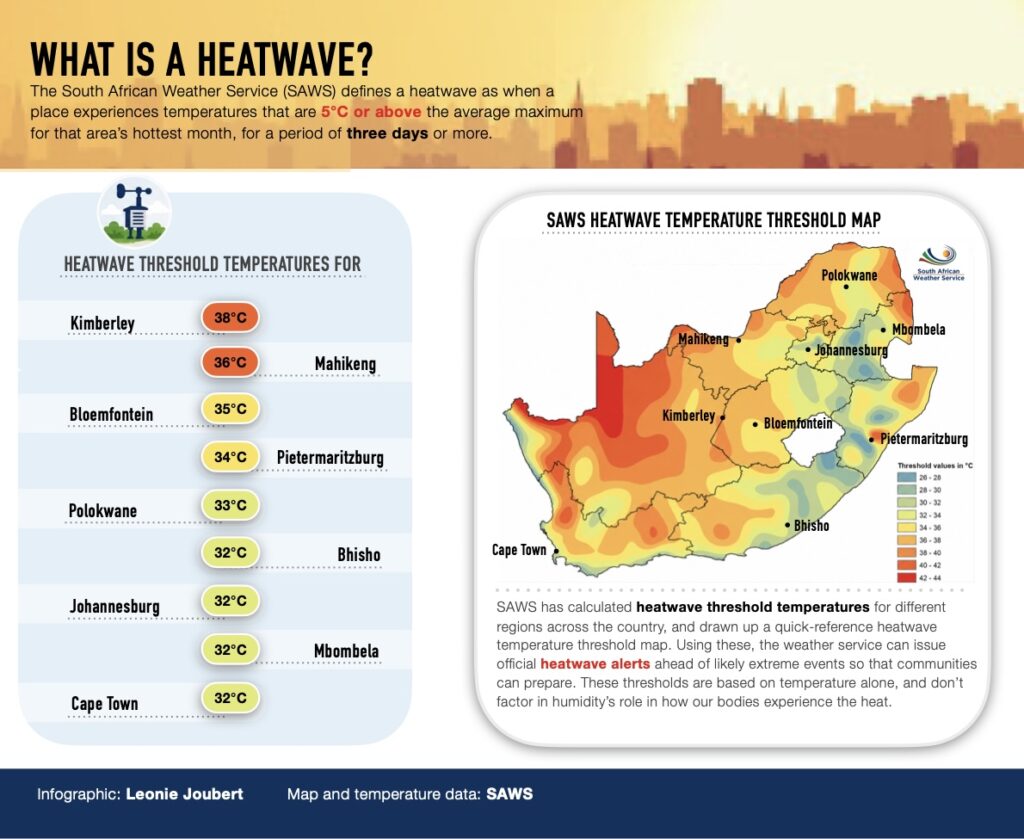
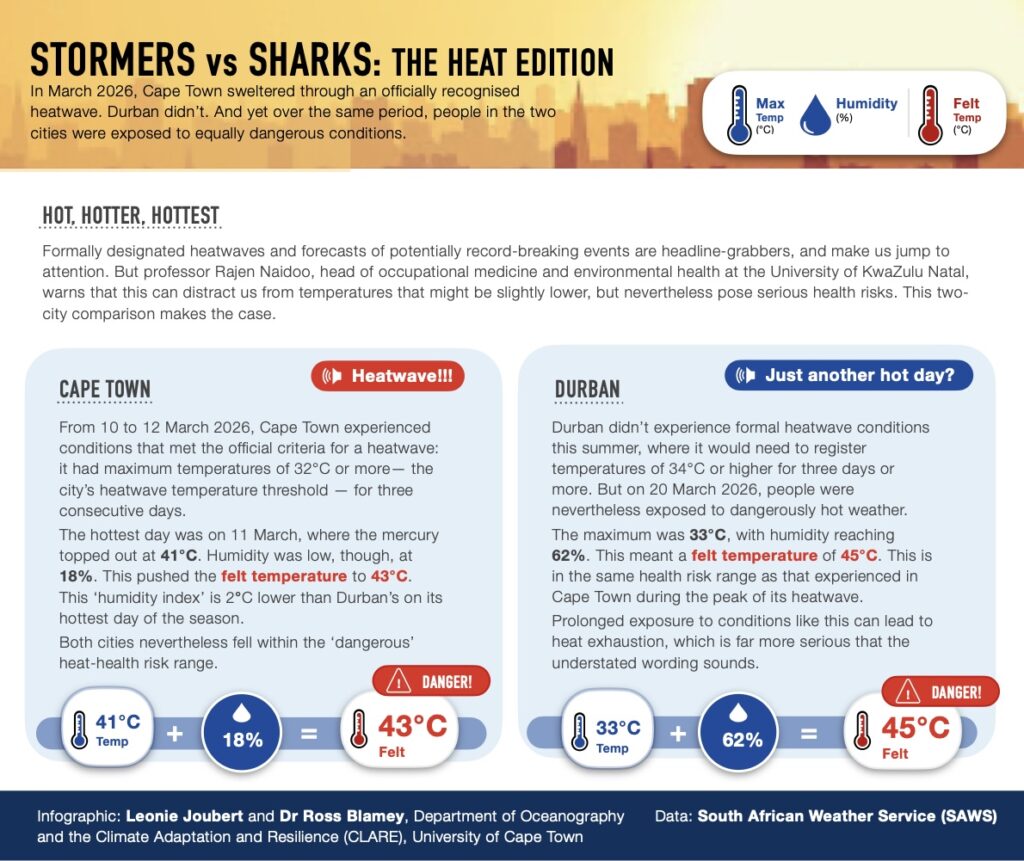
Durban didn’t experience any formal heatwave conditions this summer, according to climatologists — for that, the city would need to register temperatures of 34°C or higher for three days or more — but people were nevertheless exposed to dangerously hot weather at times. The most sweltering day came in early autumn: the Ballito weather station, about 50km north of the inner city, registered a maximum of 33°C on 20 March. With the humidity reaching 62%, the felt temperature  would have been 45°C, well into the range for developing symptoms of heat exhaustion for those not able to find ways to shelter from the heat.


But densely built-up inner city areas like Warwick Junction are heavily tarred, paved and concreted over. Surfaces like this trap heat, making conditions in these heat islands 5°C to 10°C hotter than a city’s leafier outskirts. 

Women feel the heat more acutely than men, and are more likely to be hurt by income loss because of it. It’s partly their body’s make-up — women don’t shed heat through sweating as efficiently as men do, so will experience health impacts at a lower threshold than men — but also because many work in lower-paying and informal heat-exposed jobs, such as farming, street trading, garment making, or care work, according to the US-based non-profit HERA. The organisation recognises the greater risk that lower-income and self-employed women face because of extreme heat, both to their health, and their income, and works in various Global South countries to help them become more heat-resilient.

The first line of defence for traders who are exposed to the elements in this way, local occupational health expert from the University of KwaZulu Natal professor Rajen Naidoo says, is to put in heat-buffering solutions — think in terms of shelter, water, and rest — with the city responsible for most of the necessary infrastructure. 

Once that’s in place, though, a novel form of income protection insurance might be something that could encourage women to shut up shop during the worst of a heat event, without fear of her family going hungry.

Bathroom breaks 

“This is the piss wall,” says Patrick Ndlovu, cheeks dimpling with humour as he points out the face-brick wall with its makeshift urinal along a stretch of pavement not far from the stall holders. 

Hand-sprayed lettering barks a command to passers-by in isiZulu. The sentence is poetic and gritty: two layers of paint, florid green over black; some ee cummings flare to the grammar, which doesn’t bother with capital letters. 

There’s no polite way to tell the urinal’s users that this is no place for solids. 

“If you defecate here,” Ndlovu translates delicately, “if caught, you will be compelled to take it away.”

The wall is topped with coils of barbed wire and some medieval-looking spikes overlooking a riot of off-duty minibus taxis getting soaped down on the pavement. 

At first glance, these facilities look pretty grim. The air is thick with the smell of urine being alchemised into vapour in the mid-morning heat. The two 25-litre water containers — each with a shoulder cut away to create a pee bucket — are working overtime. One’s overflowing, the other’s getting there. But it’s much better than it used to be, according to Ndlovu, who is the co-founder of the urban renewal non-profit Asiye eTafuleni. The organisation has been working here for nearly two decades, supporting informal traders to know their rights and legitimise their place in the city’s economy. 

At a most practical level, that means sorting out the lavatory situation. 

Warwick Junction’s broken-down municipal toilet block has been barred and bolted for six years, with the city giving no indication of why it hasn’t been repaired, or if it will be. For the many thousands of people who pass through this rabbit warren daily, or ply their trade in and around the market, this means that when their bladders call, they have little option but to go al fresco. 

This is easier said than done if you’re a woman, which matters during summer. Many women traders say they hold back on drinking water during the day because they don’t want to have to deal with the inevitable consequences. 

Between beach brollies and a makeshift sprinkler, fruit trader Nomusa Luthuli protects herself and her stock from the sun which can pummel the delicate plums she’s selling today. Picture: Leonie Joubert

This will lead to dehydration. When the body’s heat-stressed, it puts extra strain on the kidneys, leaving the body’s clean-up system overloaded with salts and toxins but with too little water to do the job. The upshot: higher risk of urinary tract infection, but also longer-term kidney damage. 

In principle, a key solution to a heat-resilient trading community here is simple: get clean drinking water coming in, and black water flushing out. In a sentence: restore the municipal ablution block. 

The eThekwini municipality did not respond to a request for clarity on why the public amenities at Warwick Junction aren’t working, why they haven’t been repaired, or if there are plans to do so.

Until such a time, Ndlovu and his team have been experimenting with low-cost outdoor urinals, knocked together from materials you can pick up at a local hardware store — PVC piping, wooden planks, buckets, shade cloth. Men, at least, have a discrete nook to relieve themselves. They’re asked to pay R2 for the convenience, but no sweat if they can’t, says Ndlovu. 

But what about the women? 

There’s a nondescript plywood walk-in booth near Dlamini’s clothing stall. It’s the size of an average wardrobe, and the only thing telling a passer-by that it’s the women’s facility is the universal sign on the door: a stick-figure illustration of a person in a dress. 

There’s no comfortable sit-down loo with flushing water inside, or even a dry-toilet system. But it’s a private, dignified place for a woman to relieve herself over a small bucket, the contents of which she’ll toss down the nearest storm water drain. 

The next step is to recruit what the Asiye eTafuleni team calls urine entrepreneurs — most likely people living rough in the neighbourhood who are keen to make a bit of cash — to empty the urinal buckets into nearby stormwater drains for a small fee. 

It’s one small part of the shade-water-rest triage that’s necessary to make these traders more heat-resilient in an ever hotter world. 

“Back in five minutes” 

Besides drinking plenty of water during hot weather, traders like Dlamini should do one more thing that they’re not likely to: take a break.  

Because: no work, no pay.

But what if they have income protection insurance that paid out if conditions get hot enough — dangerous enough— that they need to close their stalls for a few hours? Allowing them to stay safe without foregoing the food they need to put on the table that night.  

HERA is piloting something like this in India, Sierra Leone, Pakistan, Thailand and the USA, using philanthropic money, buy-in from local insurance companies, and small premiums paid by traders. Founder and CEO Kathy Baughman McLeod reckons it could work for Warwick Junction traders, too.

“Women in a market in Freetown, Sierra Leone, lose 60% of their income to heat,” says Baughman McLeod. “Whether that’s their own illness, if foot traffic is down, or (when their stock) has gone bad.” 

For the price of roughly one day’s takings — in Sierra Leone, that’s around R130; for Dlamini, it might be R200 — the woman will get paid out the equivalent of a day’s earnings for every day that conditions are hot enough to be recognised as dangerous. It’s an index-based insurance, meaning they’re guaranteed to get a paid out purely on the basis of a heat event occurring. No site-visits or assessments to verify the impact of the heat event. 

The threshold temperature that triggers a heat-event payout is site-specific.  

For traders like those in Durban, this could be calculated based on the city’s own weather station data — it has several — and satellite imagery. Given the Warwick traders operate in an urban heat island, the trigger temperature would need to be calculated to accommodate that, too. Ideally an on-site weather station would give the most accurate measurements of temperature and humidity in the market complex. Some of the HERA pilot initiatives are also drawing on biometric data from traders themselves, using digital fitness trackers which allow a correlation between weather data and the physical markers of women’s heat stress. 

The current insurance structure is event-based. Once a triangulation of different weather data registers that the trigger temperature has been reached, the insurance company partners will guarantee the payout, usually within 10 days or less.  

“But we want to go to forecast-based payouts,” says Baughman McLeod. “If we know it’s going to be hot and humid, and the trigger (conditions) are predicted for, say, five days from now, then half or all of the payout (will be made) in advance. The trigger is the forecast, not the actual event.”

A forecast-based approach would also give women early warning of an approaching extreme event so they can plan stock purchases, make alternate childcare arrangements, and change their operating hours.

Making a plan 

The income insurance isn’t a silver bullet, says Baughman McLeod. The heat resilience triage needs to start with heat-buffering solutions — think in terms of shelter, water, and rest — with the city responsible for most of the necessary infrastructure and various social protections.

The eThekwini municipality says it recognises heat stress as a pressing issue. It has various climate-focused plans, strategies and working groups in place, and has a range of partnerships such as with the World Resources Institute and the C40 Cool Cities network which aim to coordinate climate responses. Although it’s unclear what the timelines are for these solutions materialising in this part of the inner city. 

Until such a time as the city brings the shelter, water, and resting options, the old South African maxim — ’n boer maak ’n plan — is alive and well amongst these stallholders. Thandazile Nyathi sells beef and chicken braaied over open coals at her stand not far from Dlamini’s clothing stall. BBQ sauce, shisanyama spice, plain salt, curry. Loads of sides — rice, phuthu (a stiff porridge from maize meal), beans, spinach, samp, cabbage.  

She trades from a makeshift shelter on a pavement where taxis roar past nearby. Her work-around for not having a fridge?

“You buy your food in the morning, and sell it all in one day,” she says. 

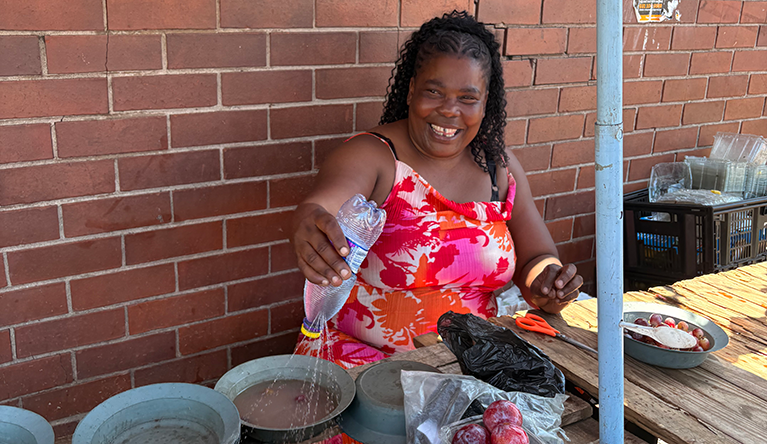
Nomusa Luthuli has some beach brollies that she puts up over her fruit stand when the sun gets hot and high. Soft fruits, like today’s plums, go pap quickly in the heat. Her solution: a repurposed 500ml cool drink bottle, with a few holes punctured on one side, makes a sprinkler system. A few squirts every now and then to cool things down, and her stock will likely have of a longer life. 

This article is from Story Ark – tales from southern Africa’s climate tipping points, an award-winning collaboration with the Stellenbosch University School for Climate Studies, Henry Nxumalo Foundation, and the Pulitzer Center. 

Wild Coast’s amaMpondo want greater part in management of ancestral lands  

Nkosi Sonjica has a permit to catch fish here as his lineage has for generations. He also ferries tourists across the Mtentu River mouth. Picture: LEONIE JOUBERT

Nkosi Sonjica has a permit to catch fish here as his lineage has for generations. He also ferries tourists across the Mtentu River mouth. Picture: LEONIE JOUBERT

LEDE: Development is contested at South Africa’s newly minted RAMSAR wetland on the Wild Coast. The story of a Pondoland fisherman shows that while the bull elephants tussle, it’s the grass that gets trampled.  

Nalo Danca was so engrossed in working his fishing line at the Strandloper River mouth on the Wild Coast one November day last year that it took him a while to clock that the person locking him in a choke-hold from behind might be law enforcement. 

He’d say that he was fishing in his backyard, just as the amaMpondo have been doing for longer than recorded history. He’d also say that customary fishermen like him don’t need a permit to cast their lines here, and that he was doing so in a designated fishing spot.  

The ranger who had him in the choke-hold would say that he was poaching in a nature reserve, finish and klaar. 

Danca is from Nyavini village, just across the Mtentu River that marks the northern boundary between communal amaMpondo land on the Wild Coast and the Mkhambathi Nature Reserve. He’s not the first fisher from here to find himself in hot water. 

Local farmer, agro-ecology trainer and tour guide Siyabonga Ndovela catches up with admin on Signal Hill, one of the few spots within walking distance of his home next to the Mtentu River mouth where there’s phone reception. This village arguably needs connectivity more than tarred roads. Picture: LEONIE JOUBERT

But his case comes just as the reserve is declared a RAMSAR wetland. Last week , government officials jetted in to this remote piece of Wild Coast where they joined local leaders and communities to celebrate the declaration of South Africa’s 31st UNESCO-recognised wetland of international importance, the first for the Eastern Cape province. 

Officials spoke with one voice of Pondoland’s untapped potential. They spoke of how the UNESCO world heritage accreditation will boost tourism and stoke the local economy. They called for private investment in the infrastructure needed to support development. 

What was missing from the celebrations was recognition that for the amaMpondo, development means the preservation of their heritage, and their role in keeping this stretch of coastline as relatively untouched as it is. They say they are the original conservation managers, whose relationship with the coastal habitat is what has made Mkhambathi a reserve worthy of international recognition, and kept the entire Pondoland coastline the biodiversity haven that is is. 

They’ve been tending to its sour veld grasslands, coastal forests and fish-rich estuaries since before the Pondoland marine protected area (MPA) was declared in 2004, the Mkhambathi Nature Reserve established in 1977, or South Africa was even a country. 

The amaMpondo want development, but in a way that allows their customs to continue. They want inclusive law-making and governance that allows them to continue to be the custodians of the land. 

New N2: road to riches or ruin for untouched Wild Coast?

It’s 66 years since it happened, but Nozilayi Gwalagwala still remembers clearly how the helicopters hovered above the grass next to her family’s rondavels, the pah-pah-pah-pah-pah of the blades, how she gripped her infant son — not 24 hours old, not yet named — how the police threw her husband into a military truck and sped away.

Centenarian Nozilayi Gwalagwala’s family survived the Pondoland Revolt of 1960. The younger generation is bringing the same spirit of resistance to deal with mining and other extractive developments in their ancestral lands. Picture: LEONIE JOUBERT

It was just before Christmas in 1960, six months after the Ngquza Hill massacre where police killed 11 men and gunned down countless others in what was the climax of the Pondoland Revolt, Of the many arrested that day, 30 were executed by hanging in Pretoria. 

Government had declared a state of emergency and police where back to round up the last of the trouble makers who were boycotting tax impositions and resisting puppet chiefs. Gwalagwala’s husband was amongst them. 

After that, Gwalagwala named her son Gunyazile, because he was born during a time when the “authorities forced the people”. 

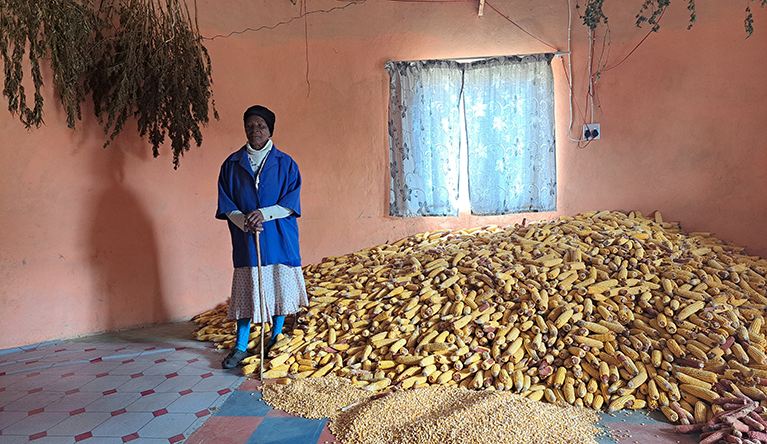
This year, she turns 100. Her larder brims with home-grown maize drying on the cob, green beans, and a few bushels of the cannabis, a staple in these parts. Her generation is recognised by heritage authorities for holding the line against the apartheid state back then. Subsequent generations say they’re bringing the same spirit to protecting their ancestral lands today, by keeping extractive mining and similar industrial developments at bay and preserving the kind of relationship with the environment that Gwalagwala’s generation handed to them. 

The centenarian’s home looks down onto the red dunes of Xolobeni, whose titanium-rich sands kicked off a two-decades long battle first to keep Australian company Mineral Commodities Ltd (MRC) out, then to stop marine prospecting by oil giant Shell, and push back against SANRAL’s proposed N2 highway development that locals fear will upend their culture and economy. 

Xolobeni’s dunes and its untouched Sikombe River mouth — a stone’s throw from the Mkhambathi reserve — would already be irreversibly changed without the amaMpondo’s determination to favour light-touch tourism as the economic driver, rather than the irreparable damage caused by mining.

All the dignitaries at the RAMSAR wetland launch spoke of Pondoland’s untapped potential. They called for private sector investment to support this. But the contested development agendas were writ large, with questions remaining about what kind of investors will get the nod, and whose development agenda the toll road will serve.

“Inclusive economic growth and job creation can go hand-in-hand with conserving biodiversity,” said DFFE deputy minister Narend Singh. “In recognition of the importance of Mkhambathi, (DFFE has) committed R17-million toward improvements to infrastructure and visitor access in the reserve.”

But Singh was frank that the DFFE can only prevent disruptive development inside the reserve.

The N2 toll road will upgrade the existing highway between East London and Mthatha, along with the R61 that runs from Mthatha to Port St Johns and to Lusikisiki. From here, a stretch of new highway nearly 100km in length will cut directly through Pondoland’s communal lands, to Port Edward. 

The amaMpondo fear that the easy access of the highway will bring more people, city ways that will disrupt local customs, crime, and brothels. With the highway comes the filling stations, the KFCs, the small supermarkets, and the bigger supermarkets.    

“We cannot stop development,” Singh said in response to these concerns. “As long as it doesn’t impact on this protected area.” 

Outside of the reserve, all bets are off. 

“We appreciate the employment,” said Lwandile Gcume, representing acting amaMpondo king Daluxolo Sigcau at the event. “But we seek equity. We are the owners of the land, therefore we must be treated as such.” 

He pointed to Norway, which he said has a strong economy because of draws on its marine economy and gas resources.

“Why can’t it be the same for us?”

Ten years ago, long before the DFFE began applying for Mkhambathi’s RAMSAR accreditation, a local environmental defender warned that the N2 highway was a trojan horse for damaging extractive industries. 

“It satisfies the needs for mining, and because we have rejected the mining, we definitely do not want it now,” said Sikhosiphi Bazooka Radebe, who at the time was the chair of the Amadiba Crisis Committee (ACC). Radebe was later gunned down outside his home in what many believe was an assassination linked with his role in pushing back against the titanium prospectors. His murder wasn’t fully investigated, his killers have not been identified, and locals say that the N2 highway development continues to fuel internal community divisions. 

The toll road may be a fait accompli, but the fate of the amaMpondo culture and ancestral lands is not, according to some die-hards. 

“We still have hope,” said Valumsindo Fana, a retired migrant miner. “We have our traditional council. If that gets strengthened and works, if the council listens to the voices of the people, we might manage what (development) comes.”

Youngsters who want to grow tourism here fear the development trajectory already favours influential and wealthy tourism investors over smaller and less influential operations, referencing to the ultra-elite lodge in Mkhambathi Nature Reserve. 

Out of bounds 

Meanwhile fishers like Danca, with little political, economic or social power, are disproportionately punished for their conduct here, argues Sinegugu Zukulu, director of the civil society group Sustaining the Wild Coast. Zukulu and fellow activist with the ACC Nonhle Mbuthuma, jointly received the prestigious Goldman Environmental Prize in 2024 for their efforts to stop Shell’s offshore prospecting.  

Whether or not Danca was breaking the law when the rangers nabbed him depends on which of two pieces of marine law have the final word. 

Many fishing communities and civil society organisations lobbying for their rights look to a 2018 Supreme Court ruling which said that coastal communities engaging in customary fishing practices do not need a permit, even in the most heavily protected marine areas. 

The Department of Forestry, Fisheries, and Environment (DFFE) disagrees, saying the Marine Living Resources Act (MLRA) does require them to have a permit. 

But the provisions getting such a permit shows how big the gulf is between the air-conditioned offices of city bureaucrats and the realities on the ground in places like Pondoland.

The original MLRA only provided for three categories of fishers: big commercial operations, recreational fishing, and subsistence fishing. It didn’t recognise the thousands of bread-and-roses fishers like Danca: people who draw their livelihood from catching some fish for the pot, and selling some so they have cash for school fees, taxi fare, airtime, and the likes. 

A 2014 MLRA amendment corrected this, and now includes a category for small-scale fishing. Fishers first have to apply to the minister to be recognised as falling into this category. Then communities must set up co-operatives, which must be registered businesses, and which then receives a group permit. A fisher like Danca must join his local co-op to get a permit. 

For fishers who can’t get a licence in this way, some resort to the recreational fishing permit. But this doesn’t allow them to sell their catch, they’re only available through a post office, and a person must pay a fee for each permit application. 

After canvassing many Pondoland fishers, it soon became clear how inaccessible this is for them.  

How do off-grid, barely literate communities handle the red tape of business management when they don’t make sense of its provisions, and struggle to understand complicated forms. Many can’t get online because they don’t have a smart phone, spare cash to buy data, or even get a few bars of phone signal because the networks are so patchy. There are very few working post offices left in this part of a province where it can take three hours to drive 100km and there aren’t many taxis running to town.

Human rights attorney Wilmien Wicomb with the Legal Resource Centre has spent at least a decade lobbying for better realisation of small-scale and customary fishers’ rights. The key sticking point, she explains, is that while the MLRA allows for the DFFE minister to recognise the rights of such fishers, fishers don’t automatically get those rights. They must first apply for recognition — which is more than just a legal technicality. In practice, it’s prohibitively inaccessible for fishers like Danca.  

None of this mattered in his moment of arrest, though. For Danca, what followed was a tussle that had the lanky 27-year-old punched in the face, pinned to the ground, and pepper strayed even after he’d been restrained. By Danca’s telling, even the second ranger present could see that he was swatting at his captor to defend himself, not as an attack. Danca says the second ranger tried to talk his colleague down from what appeared to be an excessive use of force. 

In response to these allegations, the Eastern Cape Parks and Tourism Agency (ECPTA) said that according to the available information, Danca wasn’t assaulted.

“Minimum force, including the use of pepper spray, was applied in response to resistance during the arrest process. At this stage, there is no evidence to support claims of excessive force or misconduct by officials,” said ECPTA’s Oyanga Ngalika.

Ngalika also said that permits are required for this kind of fishing in the protected area, that allocated spots are marked with signs, and that the reserve conducts “awareness and education engagements with surrounding communities to ensure understanding of access conditions and conservation requirements”.

When Danca and his friends set out with their fishing rods that morning, the plan was to catch a few fish to sell in the village for a bit of much-needed cash. 

The eight bream in his bag would have fetched about R2,000. 

Instead, this catch kicked off a three month ordeal: arrest, a month in jail, costly bail, repeated court delays, legal fees to a sometimes tardy lawyer, and, ultimately, an admission of guilt fine. The final bill: around R10,000. That’s roughly the value of a cow, a small fortune in this rural economy. 

Why not let him off with a warning, asks Zukulu? Why punish individuals like him so severely, when illegal fishing vessels regularly trawl in this marine protected area? The punishment simply doesn’t match the crime, and even the question of it being a crime is up for debate, according to Zukulu and others. 

Danca can’t make sense of the opaque and brutalising legal process or its outcome. He understands that the R1,000 fine was an above-board way to make the whole affair go away. He didn’t realise that he was admitting guilt and that he now has a criminal record.

The fourth horseman: extreme heat, a killer in informal settlements

The government’s build-back-better approach to disaster relief is to provide building materials that are intended to be temporary. But homes in informal settlements are anything but short-lived. Pic: Leonie Joubert

Of the disasters that sweep through the Dakota informal settlement in south Durban, fire is feared most. Flood is the great leveller on lower ground. Wind gnaws at exposed homes. Heat, though, is stealthy and lethal. Research from this muggy East Coast neighbourhood shows how hellish shack life can be when temperature and humidity spike. 

Putting up a shack is common sense: wooden planks for the frame; some well-placed nails; doors and windows, obviously; clad it with metal sheets or whatever’s on hand.  

Jomo Sakhile looks puzzled when he’s asked about this. It’s not rocket science, his face seems to say, gesturing to the corrugated metal roof and wall panels of his new home. These still gleam like an unpolished mirror. The pine planks smell faintly of resin.  

His previous home was destroyed by fire two months early, shortly before dawn in early July 2025. Sakhile and his family — his mother and brother — had to stay at a friend’s place for about a month, but once the disaster response kicked in and the city delivered emergency materials, he got to rebuilding. They had a new home within days. 

The trick, the lean 29-year-old says, is that you don’t want to make the structure too sturdy.

“It’s dangerous if you make it strong. Sometimes, when the shack is burning and you can’t find the key, you have to knock the wall off.”

Loose planks pop off easily. There are enough chilling memories from around here, stories of others who haven’t been able to get out in time.  

Luck and elevation protected the Sakhile family from the April 2022 floods. This now infamous event swallowed up homes, up to their roofs in places, in lower-lying parts of the Dakota informal settlement in Isipingo, south Durban. Their suffering didn’t make the news. What did, though, was the Toyota factory, a stone’s throw from here, which shut down production for four months following the event.

The land outside the Sakhiles’ front door is still surprising roomy. Many neighbours haven’t rebuilt yet after the fire. 

It wasn’t like this on the morning of the blaze.

“Fire!” he heard his mother shout in the dark. “There’s fire!”

Sakhile dashed outside to check. It still seemed some distance away. 

“I told them don’t panic,” he recalls. They grabbed the essentials: identity documents, a few clothes. 

After that, they didn’t know what to take. It was bedlam outside. Fear. Confusion. People jostling in the tiny alley between the shacks that pressed in on all sides. People were trying to lug stuff up the hill to dump it safely on the beach.

Fire engines arrived but couldn’t tame the thing. The flames eventually arrived at the Sakhile home. They saw their house burn. 

“It was scary. At least no one was hurt.” 

Floods and fires like these are headline-grabbers. But there’s another kind of unnatural disaster that stalks here, invisibly: extreme heat. Not long before Sakhile and his family lost their home to the inferno, he took part in a study that drew contours to this stealthy killer. A summer’s worth of temperature and humidity readings in homes like this show just how hellish it can be to live in a shack made from materials better suited to a working oven. 

South Africa’s human settlements policy aims to build back better following disasters like this. But the people of Dakota informal settlement know first hand: it’s more complicated than simply handing out more materials to make the same flimsy, uninsulated homes that are intended to be temporary, yet are anything but that.

Hot, hotter, hellish 

Spring is here, and its a tshirt-and-flipflops kind of day. Thokozile Cebekhulu is lit dimly by sunlight edging in through her bedroom window. There’s a bare bulb overhead, not far from where a digital sensor sat earlier in the year, logging the temperature and humidity from a roof beam every half-hour.  

Sakhile had one in his home, too. 

Some 19 families took part in the study, which ran from early December 2024 until June 2025. Each day, they recorded a daily voice dairy to capture how they’d experienced conditions. 

This data was then compare with weather data captured at the nearest meteorological station, Ballito, about 70km up the coast. 

Researchers at the University of Cape Town are still crunching the numbers for a study that’s part of the multi-country and pan-African programme Palm-Trees project, run by the Climate Adaptation and Resilience (CLARE), Although a preliminary scan shows just how much hotter conditions are inside these homes, compared with what local weather stations will record. 

The fourth day of January 2025 turned out to be the hottest day that summer. Where the Ballito met station measured a top temperature of 34.5°C at lunchtime, Cebekhulu’s bedroom got to 39.8°C just after noon, and Sakhile’s maxed out at 45.2°C. Across the summer, the Dakota homes were close to 10°C hotter than conditions recorded at Ballito. But it was the humidity that made things feel even worse. While Ballito’s weather might have felt like a great day for the beach, for many, for someone in Dakota, it could have amounted to medical emergency.  

Durban’s notoriously muggy climate meant that high water vapour in the air pushed Ballito’s discomfort index — the how-does-it-feel temperature — up to 48.6°C. But conditions in Cebekhulu’s bedroom would have felt as though it was 53°C; Sakhile’s, 56°C. This isn’t just unbearable. It’s potentially life threatening.  

[Red Alert will expand on the health implications of this kind of heat in a future article.] 

Cebekhulu’s home is a little misleading. It’s made of materials that are more sturdy and insulating than Sakhile’s. The walls are bricks and cement. Part of the roof: thickish asbestos sheets. The wooden beams look solid as pillars. 

And yet during the previous summer, the digital sensor showed that the temperature inside her home wasn’t much more forgiving than Sakhile’s.

“There was a difference between the hottest homes and the coolest homes,” explains Laura Washington, director of the gender-focused civil society organisation Project Empower, which has worked with the Dakota community for years and did this data capture for the University of Cape Town CLARE crew. “But we found on hot days, the temperatures were extreme for everybody. They were still all hot.”

There pros and cons to each of the materials typically used for informal homes like these, they found. Bricks and cement are first prize, but expensive. They’re risky, too: if you don’t own the land, or the structure, why sink good money into if you may be forced out? Wood insulates, but can harbour disease-causing moulds; it rots; it burns easily. Metal lets in the cold and the heat as if it were an open door; it stays mould-free; but damp dissolves it to rust. Asbestos has been off the cards since it was banned back in 2008. Tarpaulins cast shade, but the air becomes stiflingly humid under their cover. 

Suggestions of tech solutions like heat-reflective paint and living, green roofs are as out of reach as something from science fiction in a community where homes don’t have working taps or toilets. Tree planting to give the original and best air conditioning — the cooling effect of plant life breathing — is the most obvious solution. But as many residents say: if there is a patch of open land next to your house, you’re more likely to put up another shelter, which you can rent out. Tree shade can’t earn anyone a passive income. 

Building back better? 

Ziphi Nduli (57) isn’t so sure about her new house: when it’ll be finished, or how long it’ll last. Her previous home was made of boards, planks, and asbestos. The new one will be like Sakhile’s — planks and metal sheets — and she didn’t have any say in this. 

“The new homes are fine. The problem is the corrugated iron, because we are close to the sea, which may cause rust,” Nduli says through a translator. “The house I had previously was stronger because it was built of boards.”

She didn’t lose her previous home in the recent fire, though.

After the 2022 floods, the storm water system drainage around Toyota’s Prospecton Road factory needed an urgent overhaul. The multinational had run up R4.5 billion repair bill on the plant, and suffered an addition R2 billion in lost business while it was offline. 

Stormwater repairs began soon after the flood, but then things got more complicated. In late 2025 Toyota’s insurer Tokio Marine & Nichido Fire Insurance began legal proceedings to sue the eThekwini municipality, Transnet, and the KwaZulu Natal (KZN) Department of Transport for R6.5 billion, claiming negligence to maintain infrastructure. 

Things also got messy for some Dakota families. Many in the lower lying areas had already suffered serious flood damage to their homes. But they were living just a city block from the factory and directly above the drainage infrastructure that needed repairing. 

The solution: move the families for a spell, put them up in temporary container housing set up in a nearby parking lot, dismantle their homes, repair the drains, put up brand new shacks made of metal and planks. 

This is the home that Nduli was waiting fo when Daily Maverick visited her in September 2025r, and she had no idea how much longer she’d have to live in the stark curtainless container room, from where she ran a small creche. 

It’s not immediately clear which government bodies are responsible for various aspects of the stormwater upgrade, the new homes, or the temporary housing for those in transit. Daily Maverick asked the eThekwini municipality and Toyota South Africa for clarity: how much the various upgrades and repairs are costing, who is footing the bill for which parts of it, and whether Toyota South Africa has contributed to their neighbour’s post-flood recovery. 

Both the municipality and Toyota South Africa were cagey, erroneously using sub judice principles relating to the civil suit to avoid responding. 

When it comes to replacing informal homes after events linked with extreme weather, the KZN human settlements department gets its mandate from the national department of human settlements, the Disaster Management Act of 2002, and the National Disaster Management Framework. The provincial departments 2023 disaster management policy, and a recent revision, state that it must give families temporary building material. It doesn’t specify what materials though, but offers corrugated sheets and poles as examples. Materials must be enough to support shelters of 9m² to 30m², not cost more than R12,000, and should be able to last around five years. The municipality has to buy and distribute materials, and claim the cost back from the national department. 

Materials must be fire-rated to South African Bureau of Standards approved quality, but there’s no mention that they must be suited to hold back the dangers of extreme heat. There’s also no stipulation about including insulation as a must-have, or suggestions on how to build shade or other cooling technologies such as heat-reflective paint. 

Extreme heat is often regarded as a silent killer, because it doesn’t have the attention-grabbing scenes of floods or fires. Media often headline them with beach-day suggestions. Fatalities hide behind mortality data that show heart or kidney failure, respiratory distress, or even deaths of despair. 

Now heat events are being recognised as the clear and present danger that they already are, according to a study released last month by the Academy of Science of South Africa which shows why it has emerged as a “defining climate-related health challenge for the SADC region”.

For a city like eThekwini, and communities like Dakota, the recommendation to gear up for extreme heat events, according to University of KwaZulu Natal (UKZN) occupational and environmental health expert Prof Rajen Naidoo, is three-fold: think in terms of shelter, water, and rest. 

[The Red Alert series will investigate what shelter, water and rest mean in different informal work and living contexts, against the backdrop of the health threats linked with extreme heat.]

Crushed

For the Shezi family, it wasn’t a case of lightning striking twice, but three times. First, the 2022 floods destroyed the home they’d lived in for roughly 15 years. Like refugees, they camped out in a nearby hall for several months along with so many neighbours, until they’d rebuilt. This second house got dismantled when the drain repair work happened. 

Lufuno Shezi, the Project Empower community worker who helped lead the indoor temperature monitoring for the CLARE researchers, is pragmatic when she remembers how she, her daughter, two brothers — one who is disabled — and her father had to decamp in temporary accommodation again until their metal-and-wood home was done. 

Lufuno Shezi shows where the digital sensor was installed. Shezi, a long-time Dakota resident who helped lead the temperature monitoring research, lost her home twice to weather events, and once to the city’s stormwater upgrades. Pic: Leonie Joubert

When the third strike hit, it wasn’t the fire. It came from the least likely threat in an informal settlement that so desperately needs more trees for shade. 

Last month, on the first Friday of March, Durbanites received a level four weather alert. A powerful storm was inbound. 

“It was extremely windy,” Shezi recalls. 

The next evening, she and her family were pottering around when they heard someone at their door. 

“There was a man passing, he saw that the tree is about to fall,” she says. The tree in question: a mostly useless conifer that stood tall, cast little shade, and was better suited for Christmas decorations. 

There was a cracking sound coming from its roots. 

“The tree,” the passer-by said, “it’s going to fall anytime!”

Within a minute of them getting outside, the tree began to topple. There was little they could do but watch it come crashing down. 

“It fell right on top of the roof and destroyed all of the house,” Shezi says. 

Just seven months earlier, the 26-year old sat in her bedroom with Daily Maverick to explain the work and the community she knows so well. 

Now that bedroom had been crushed like a tin can. 

“We just have one room left. We’ve contacted disaster management and human settlements but until this day they haven’t arrived with materials to help us.”

Government funding is the final hurdle to unleash the weevil to control pine weeds

1. The cone pine (Pinus pianister) is one of the most aggressive invaders in the Western Cape. Photo: Supplied
The cone pine (Pinus pianister) is one of the most aggressive invaders in the Western Cape. Photo: Supplied

Putting up a shack is common sense: wooden planks for the frame; some well-placed nails; doors and windows, obviously; clad it with metal sheets or whatever’s on hand.  

Jomo Sakhile looks puzzled when he’s asked about this. It’s not rocket science, his face seems to say, gesturing to the corrugated metal roof and wall panels of his new home. These still gleam like an unpolished mirror. The pine planks smell faintly of resin.  

His previous home was destroyed by fire two months early, shortly before dawn in early July 2025. Sakhile and his family — his mother and brother — had to stay at a friend’s place for about a month, but once the disaster response kicked in and the city delivered emergency materials, he got to rebuilding. They had a new home within days. 

The trick, the lean 29-year-old says, is that you don’t want to make the structure too sturdy.

“It’s dangerous if you make it strong. Sometimes, when the shack is burning and you can’t find the key, you have to knock the wall off.”

The government’s build-back-better approach to disaster relief is to provide building materials intended to be temporary. But homes in informal settlements are anything but short-lived. Pic: LEONIE JOUBERT

The government’s build-back-better approach to disaster relief is to provide building materials intended to be temporary. But homes in informal settlements are anything but short-lived. Pic: LEONIE JOUBERT

Loose planks pop off easily. There are enough chilling memories from around here, stories of others who haven’t been able to get out in time.  

Luck and elevation protected the Sakhile family from the April 2022 floods. This now infamous event swallowed up homes, up to their roofs in places, in lower-lying parts of the Dakota informal settlement in Isipingo, south Durban. Their suffering didn’t make the news. What did, though, was the Toyota factory, a stone’s throw from here, which shut down production for four months following the event.

The land outside the Sakhiles’ front door is still surprising roomy. Many neighbours haven’t rebuilt yet after the fire. 

It was a brazier that set off the fire that swept through Dakota informal settlement in July 2025. Jomo Sakhile has rebuilt his home with sheet metal and wood about a month later.

It was a brazier that set off the fire that swept through Dakota informal settlement in July 2025. Jomo Sakhile has rebuilt his home with sheet metal and wood about a month later. 

It wasn’t like this on the morning of the blaze.

“Fire!” he heard his mother shout in the dark. “There’s fire!”

Sakhile dashed outside to check. It still seemed some distance away. 

“I told them don’t panic,” he recalls. They grabbed the essentials: identity documents, a few clothes. 

After that, they didn’t know what to take. It was bedlam outside. Fear. Confusion. People jostling in the tiny alley between the shacks that pressed in on all sides. People were trying to lug stuff up the hill to dump it safely on the beach.

Fire engines arrived but couldn’t tame the thing. The flames eventually arrived at the Sakhile home. They saw their house burn. 

“It was scary. At least no one was hurt.” 

Floods and fires like these are headline-grabbers. But there’s another kind of unnatural disaster that stalks here, invisibly: extreme heat. Not long before Sakhile and his family lost their home to the inferno, he took part in a study that drew contours to this stealthy killer. A summer’s worth of temperature and humidity readings in homes like this show just how hellish it can be to live in a shack made from materials better suited to a working oven. 

South Africa’s human settlements policy aims to build back better following disasters like this. But the people of Dakota informal settlement know first hand: it’s more complicated than simply handing out more materials to make the same flimsy, uninsulated homes that are intended to be temporary, yet are anything but that.

Hot, hotter, hellish 

Spring is here, and its a tshirt-and-flipflops kind of day. Thokozile Cebekhulu is lit dimly by sunlight edging in through her bedroom window. There’s a bare bulb overhead, not far from where a digital sensor sat earlier in the year, logging the temperature and humidity from a roof beam every half-hour.  

Sakhile had one in his home, too. 

Some 19 families took part in the study, which ran from early December 2024 until June 2025. Each day, they recorded a daily voice dairy to capture how they’d experienced conditions. 

This data was then compare with weather data captured at the nearest meteorological station, Ballito, about 70km up the coast. 

Researchers at the University of Cape Town are still crunching the numbers for a study that’s part of the multi-country and pan-African programme Palm-Trees project, run by the Climate Adaptation and Resilience (CLARE), Although a preliminary scan shows just how much hotter conditions are inside these homes, compared with what local weather stations will record. 

The fourth day of January 2025 turned out to be the hottest day that summer. Where the Ballito met station measured a top temperature of 34.5°C at lunchtime, Cebekhulu’s bedroom got to 39.8°C just after noon, and Sakhile’s maxed out at 45.2°C. Across the summer, the Dakota homes were close to 10°C hotter than conditions recorded at Ballito. But it was the humidity that made things feel even worse. While Ballito’s weather might have felt like a great day for the beach, for many, for someone in Dakota, it could have amounted to medical emergency.  

Durban’s notoriously muggy climate meant that high water vapour in the air pushed Ballito’s discomfort index — the how-does-it-feel temperature — up to 48.6°C. But conditions in Cebekhulu’s bedroom would have felt as though it was 53°C; Sakhile’s, 56°C. This isn’t just unbearable. It’s potentially life threatening.  

[Red Alert will expand on the health implications of this kind of heat in a future article.] 

Cebekhulu’s home is a little misleading. It’s made of materials that are more sturdy and insulating than Sakhile’s. The walls are bricks and cement. Part of the roof: thickish asbestos sheets. The wooden beams look solid as pillars. 

And yet during the previous summer, the digital sensor showed that the temperature inside her home wasn’t much more forgiving than Sakhile’s.

“There was a difference between the hottest homes and the coolest homes,” explains Laura Washington, director of the gender-focused civil society organisation Project Empower, which has worked with the Dakota community for years and did this data capture for the University of Cape Town CLARE crew. “But we found on hot days, the temperatures were extreme for everybody. They were still all hot.”

There pros and cons to each of the materials typically used for informal homes like these, they found. Bricks and cement are first prize, but expensive. They’re risky, too: if you don’t own the land, or the structure, why sink good money into if you may be forced out? Wood insulates, but can harbour disease-causing moulds; it rots; it burns easily. Metal lets in the cold and the heat as if it were an open door; it stays mould-free; but damp dissolves it to rust. Asbestos has been off the cards since it was banned back in 2008. Tarpaulins cast shade, but the air becomes stiflingly humid under their cover. 

Suggestions of tech solutions like heat-reflective paint and living, green roofs are as out of reach as something from science fiction in a community where homes don’t have working taps or toilets. Tree planting to give the original and best air conditioning — the cooling effect of plant life breathing — is the most obvious solution. But as many residents say: if there is a patch of open land next to your house, you’re more likely to put up another shelter, which you can rent out. Tree shade can’t earn anyone a passive income. 

Building back better? 

Ziphi Nduli (57) isn’t so sure about her new house: when it’ll be finished, or how long it’ll last. Her previous home was made of boards, planks, and asbestos. The new one will be like Sakhile’s — planks and metal sheets — and she didn’t have any say in this. 

“The new homes are fine. The problem is the corrugated iron, because we are close to the sea, which may cause rust,” Nduli says through a translator. “The house I had previously was stronger because it was built of boards.”

She didn’t lose her previous home in the recent fire, though.

After the 2022 floods, the storm water system drainage around Toyota’s Prospecton Road factory needed an urgent overhaul. The multinational had run up R4.5 billion repair bill on the plant, and suffered an addition R2 billion in lost business while it was offline. 

Stormwater repairs began soon after the flood, but then things got more complicated. In late 2025 Toyota’s insurer Tokio Marine & Nichido Fire Insurance began legal proceedings to sue the eThekwini municipality, Transnet, and the KwaZulu Natal (KZN) Department of Transport for R6.5 billion, claiming negligence to maintain infrastructure. 

Things also got messy for some Dakota families. Many in the lower lying areas had already suffered serious flood damage to their homes. But they were living just a city block from the factory and directly above the drainage infrastructure that needed repairing. 

The solution: move the families for a spell, put them up in temporary container housing set up in a nearby parking lot, dismantle their homes, repair the drains, put up brand new shacks made of metal and planks. 

This is the home that Nduli was waiting fo when Daily Maverick visited her in September 2025r, and she had no idea how much longer she’d have to live in the stark curtainless container room, from where she ran a small creche. 

It’s not immediately clear which government bodies are responsible for various aspects of the stormwater upgrade, the new homes, or the temporary housing for those in transit. Daily Maverick asked the eThekwini municipality and Toyota South Africa for clarity: how much the various upgrades and repairs are costing, who is footing the bill for which parts of it, and whether Toyota South Africa has contributed to their neighbour’s post-flood recovery. 

Both the municipality and Toyota South Africa were cagey, erroneously using sub judice principles relating to the civil suit to avoid responding. 

When it comes to replacing informal homes after events linked with extreme weather, the KZN human settlements department gets its mandate from the national department of human settlements, the Disaster Management Act of 2002, and the National Disaster Management Framework. The provincial departments 2023 disaster management policy, and a recent revision, state that it must give families temporary building material. It doesn’t specify what materials though, but offers corrugated sheets and poles as examples. Materials must be enough to support shelters of 9m² to 30m², not cost more than R12,000, and should be able to last around five years. The municipality has to buy and distribute materials, and claim the cost back from the national department. 

Materials must be fire-rated to South African Bureau of Standards approved quality, but there’s no mention that they must be suited to hold back the dangers of extreme heat. There’s also no stipulation about including insulation as a must-have, or suggestions on how to build shade or other cooling technologies such as heat-reflective paint. 

Extreme heat is often regarded as a silent killer, because it doesn’t have the attention-grabbing scenes of floods or fires. Media often headline them with beach-day suggestions. Fatalities hide behind mortality data that show heart or kidney failure, respiratory distress, or even deaths of despair. 

Now heat events are being recognised as the clear and present danger that they already are, according to a study released last month by the Academy of Science of South Africa which shows why it has emerged as a “defining climate-related health challenge for the SADC region”.

For a city like eThekwini, and communities like Dakota, the recommendation to gear up for extreme heat events, according to University of KwaZulu Natal (UKZN) occupational and environmental health expert Prof Rajen Naidoo, is three-fold: think in terms of shelter, water, and rest. 

[The Red Alert series will investigate what shelter, water and rest mean in different informal work and living contexts, against the backdrop of the health threats linked with extreme heat.]

Crushed

For the Shezi family, it wasn’t a case of lightning striking twice, but three times. First, the 2022 floods destroyed the home they’d lived in for roughly 15 years. Like refugees, they camped out in a nearby hall for several months along with so many neighbours, until they’d rebuilt. This second house got dismantled when the drain repair work happened. 

Lufuno Shezi, the Project Empower community worker who helped lead the indoor temperature monitoring for the CLARE researchers, is pragmatic when she remembers how she, her daughter, two brothers — one who is disabled — and her father had to decamp in temporary accommodation again until their metal-and-wood home was done. 

When the third strike hit, it wasn’t the fire. It came from the least likely threat in an informal settlement that so desperately needs more trees for shade. 

Last month, on the first Friday of March, Durbanites received a level four weather alert. A powerful storm was inbound. 

“It was extremely windy,” Shezi recalls. 

The next evening, she and her family were pottering around when they heard someone at their door. 

“There was a man passing, he saw that the tree is about to fall,” she says. The tree in question: a mostly useless conifer that stood tall, cast little shade, and was better suited for Christmas decorations. 

There was a cracking sound coming from its roots. 

“The tree,” the passer-by said, “it’s going to fall anytime!”

Within a minute of them getting outside, the tree began to topple. There was little they could do but watch it come crashing down. 

“It fell right on top of the roof and destroyed all of the house,” Shezi says. 

Just seven months earlier, the 26-year old sat in her bedroom with Daily Maverick to explain the work and the community she knows so well. 

Now that bedroom had been crushed like a tin can. 

“We just have one room left. We’ve contacted disaster management and human settlements but until this day they haven’t arrived with materials to help us.”

Leonie Joubert is on a mobile journalism project investigating how the climate crisis is unfolding on our doorstep, in our lifetime. Story Ark – tales from southern Africa’s climate tipping pointsis an award-winning collaboration with the Stellenbosch University School for Climate Studies and the Henry Nxumalo Foundation.  This story first appeared in Daily Maverick.

Magical thinking vs the laws of physics — why science journalism can’t save us (Part 1)

Pic: Desmond Thompson

Pic: Desmond Thompson

Pic: Desmond Thompson

Journalism needs its reporting beats. It keeps the daily news cycle tidy: the politics reporter, the economics desk, the health writer, the current affairs person, sport, the entertainment slot.

But there are two downfalls to this, seen recently at the World Conference of Science Journalists (WCSJ) which took place on African soil for the first time last December.

One: the journalistic beat means we report in silos.

Two: we rank these beats by importance, with politics, economics and even sport arguably being the apex beats. The environment beat – a subset of the science beat – is often the nice-to-have, the charity case that gets the newsroom leftovers after the apex beats have taken the lion’s share of column inches and newsroom budgets.

There were plenty of issues on the WCSJ programme that fall into the traditional environment beat.

What was missing, though, was a recognition that the underlying problem that’s driving all our traditional environmental issues is the current global economic model. It isn’t just science journalists who fail to join the dots. Journalists across all beats haven’t made the connection, and they haven’t for decades.

This means we’re failing at our singular mandate as the Fourth Estate: that of informing the public discourse with evidence-based, vetted ideas to support a healthy democracy.

Magical thinking vs the laws of physics

Climate collapse, biodiversity loss, acidifying oceans, industrial-scale farming taking chunks out of Amazonian rainforests, collapsing fish stocks, spreading desertification, an unequal disaster response after extreme weather events – these are all the symptoms of a diseased economic system that is at odds with the very evidence-based consensus that science journalists prefer to work with.

We’re reporting on the symptoms of the diseases, but not the disease itself.

The disease, in this case, is an economic system that cashes in on profit, but externalises the cost of the damage caused by extraction and pollution.

It’s an economic system that’s based on magical thinking: that we can have infinite growth on a finite planet.

Science journalism isn’t reporting this. Indeed, few journalistic beats are. We’re reporting on those who play by the rules of the economic game, we aren’t challenging the rules of the game itself.

We need to align our economics with the laws of physics but that’ll only happen when we internalise the full cost of something. Hashtag: true cost accounting.

Take a bottle of Coke. Its final price tag should include not just the materials used to make the plastic bottle and its carbonated, sugary contents. It should also include the cost of the damage caused by the carbon pollution resulting from growing, harvesting and processing the sugar, or the cost of moulding the single-use plastic bottle that’ll deliver the beverage for a one-off hit of dopamine and then get discarded into the environment where it will never break down and rejoin the nutrient cycle.

The price tag of that bottle of Coke should include the cost of treating the health fallout resulting from years of exposure to the sugary drink: treatment for someone’s diabetic erectile dysfunction, gangrenous toe or lost eyesight.

With those costs internalised by the economic reframing, the bottle of Coke and its short-lived dopamine hit become unaffordable.

It’s no secret: we can’t have infinite growth

We have known for half a century that we can’t have infinite growth on a finite planet. When the Club of Rome released its Limits to Growth report in 1972, based on modelling by economists at the Massachusetts Institute of Technology, they made it clear: if we continued with our industrial-scale consumption and pollution, we’d find ourselves smashing through planetary boundaries round about now.

Sure enough, here we are: blasting past the 1.5°C increase in global average temperature that would have kept us inside a climate safe zone. Worse still, we’re set for a 3°C rise at our current rate of carbon pollution. If this were a person, a fever of 1.5°C above the healthy normal body temperature of 37°C would have us reaching for medical treatment; a fever of 3°C above that would mean convulsions and a trip to the ER.

Yet most journalism merely reports on how to treat the seizures. It doesn’t report on how to rid the body of the infection itself.

Reporting on this society-wide issue isn’t just something that should be left to the financial reporters. Every one of us should be drawing it into our reporting, regardless of the beat. Again, this isn’t about aligning with an economic ideology. It’s about aligning with the laws of physics.

Physics is catching up with us, and showing us with each new extreme weather shock that it has no truck with magical thinking. We’ve turned the heat up under the kettle, and now the water’s coming to a boil. Put another way: we don’t have to believe in gravity; gravity still has a hold on us. Science journalists should be the first to point this out.

Microplastics critique is a damp squib, not a bombshell exposé

plastic bag

What is a lethal dose of plastics poisoning? We don’t know yet, but some day we will.

Last week, The Guardian framed a recent critique of early-stage studies into the extent of microplastics in the human body as a “bombshell”, and one study in the field as “a joke”.

The broader field of research that’s being challenged here is young. It’s trying to establish the extent to which tiny shards of plastics are collecting in human tissue, mostly in our livers, kidneys, arteries, blood, hearts, placental tissue and even our brains. The Guardian’s supposed exposé raises red flags about the methods used for collecting and testing samples, particularly those relating to blood and brain samples. It concludes that the findings are too error-prone to be taken seriously.

The Guardian’s reporting here is misleading, and only serves to confuse the public.

Just as science needed time to quantify the harms of long-term tobacco use, we need time to measure the extent to which microplastics are accumulating in our bodies and what the public health consequences will be.

Yes, this is an emerging field of research, and should be subject to the same scientific rigour and journalistic critiques as any other. But this fast-evolving area must be communicated responsibly, and with the public good in mind.

Dismissing the first-round findings of such a greenfields area of scientific research as “scaremongering” will also play into the hands of those stalling global efforts to settle on a UN Environment Programme plastics pollution treaty.

As we’ve seen with communicating other complex areas of science – carbon pollution driving climate collapse; food-like products polluting our bodies with the “oil spills” of obesity, diabetes and the supposedly self-inflicted cancers of lifestyle – the public often reaches for simple truths and silver-bullet solutions amid the often confusing messages that come through with early-stage scientific findings.

How many readers will now dismiss the whole field of research, and slip into the kind of hopeful denialism that many of us default to when we’re overwhelmed by the consequences of big polluting systems that seem too enormous for us to change?

The “bombshell” term that The Guardian introduces into the article comes from the chemist Roger Kuhlman, who previously worked at the Dow Chemical Company – the kind of company that might benefit from downplaying the public health risks of microplastics in our bodies.

A more appropriate expert to approach for comment on this issue would be someone schooled in public health, with a more intimate knowledge of the biology at work, and no vested interests.

Consider the less-sensational, but more responsible framing by Dr Stephanie Wright, associate professor of environmental toxicology at the School of Public Health, Imperial College London. Yes, this field of research is young, she says in an interview with the BBC in 2025. Yes, the tech for measuring the build-up of microplastics in human tissue is prone to error. But this merely shows how urgently we need to speed up the work and get more robust results.

Why dismiss some researchers’ work as “a joke”? Another sensational – dare I say, click-bait – term that doesn’t work in the service of a well-informed public.

Wright’s more measured framing is to introduce into our discourse the fact that we need to consider what the possible toxicity from microplastics pollution in our bodies could be. Like all toxins, she argues, how damaging it is is dose-dependent. Dose, in this case, depends on how much plastic is in our tissue, which polymers, their size and surface area, how hazardous these are, and how long they remain in the body.

Yes, there are big gaps in knowledge here. But until we’ve filled these gaps, she urges us towards taking a precautionary approach.

The Guardian’s reporting informs public understanding and policy response at a global level. How the publication frames a matter as important as this will inform policymakers here in Africa.

Even well-informed people find it hard to understand a field as complex as this. How much more so for those who may not have the technical or scientific background to appreciate how scientific consensus evolves from greenfields studies to textbook knowledge?

The scientific method is a tool to help understand the world. It has steps built into it to tease out observer bias and wishful thinking, and it has self-correcting measures to help us go from emerging, rough-grained knowledge to solid theory. Journalism has similar processes for vetting evidence and self-correcting.

Communicating this evolving knowledge needs to be done with skill and care. Yes, let’s call for good science, but let’s not throw shade on early science in a way that’s inaccurate, misleading, and harms the public good.

Keep it clean — plastics pollution is a public health issue

This opinion article is in response to Environment Minister Dion George’s announcement on 6 November 2025 of his intention to regulate single-use plastics and bring about waste management reform.

Imagine we’re having this conversation in the smokers’ lounge. Yes, with that tarry fog catching in your throat, and your delicate pink lung tissue soaking it all up. 

Imagine our kids are in here with us. 

While we’re here, let’s consider this one simple question: what is a lethal dose of plastic poisoning?

Today, we know something about passive smoking. That’s why we don’t light up in the car with the kids, the way our folks did when we were little. 

Because of legislation from our Health Department, based on evidence-based science relating to the health impacts of passive smoking, this form of pollution is kept to discrete places. You and I can decide if we want to go into the smokers’ corner or not.  

But when it comes to inhaling plastics pollution, we can’t see it, we can’t taste it, we can’t smell it. Many of us don’t even know it’s there. But it is.

The evidence is telling us that airborne micro-plastics are pretty much everywhere: we’re turning the entire planet into a smokers’ lounge. A smokers’ lounge that none of us can leave – not even our kids.

It’s not just about picture-postcard beaches 

Environment Minister Dion George’s announcement to tackle single-use plastics with decisive regulations is a step in the right direction. But the Health Department needs to come on board because this new form of pollution isn’t just about keeping tourists on our beaches or sparing fish from a dystopian diet of the all-you-can-eat plastics buffet swirling about in our rivers and oceans.  

Plastics never break down. They seem to disappear, but really they just get milled down into particles so small that we forget they’re there. These microscopic pieces are in our water, our food, and in the air we breathe. 

Now they’re turning up in our livers, our kidneys, placental tissue and breast milk, and our testes. They’re in our blood, our bone marrow, our arteries and our hearts. They’re now so small that they can even slip through our body’s most sophisticated defence: the blood-brain barrier.

While they’re sitting there, they’re leaching out the toxic chemicals that are baked into their DNA. 

Manufacturers have thousands of different chemicals that they can add to plastics so that the final product holds its shape, can tolerate some temperature changes, is colour-stable and fire-resistant. We know many of these are cancer-causing, and can mess with our endocrine systems. 

By exposing ourselves to this form of pollution, we’re running an uncontrolled experiment – one that none of us connected – in which our bodies are the lab rats. 

With any poison, how dangerous it is depends on the dose. The dose, in this case, depends on what kind of plastics are in our bodies, which organs they’re trapped in, how long they stay there, and how efficient our system is at flushing it away. 

Lots of question marks. 

We may not know, yet, what a lethal dose of plastics poisoning is. But we will, soon enough. 

Closing the tap on plastics pollution 

In the 70 years since industrial-scale plastics pollution started, some of this waste has ended up fossilising in landfills. Some has been burned. Nearly six billion metric tonnes of it has spilled out of the waste system and become pollution in the environment. Even though we can’t see it, it’s still there, and now it’s washing up inside our bodies like toxic sludge on a beach. 

The same thing will happen with future plastics pollution as we continue business as usual: much of it will wash up in our children’s and grandchildren’s bodies.

The most recent UN effort to finalise a global plastics treaty failed, leaving us rudderless at a global level. More than half of the countries at the September meeting in Geneva wanted a robust agreement that would reduce the amount of virgin plastics entering the value chain, and ban many of the toxic chemicals that are added during manufacture. But this effort was thwarted by a few petrostates, such as Russia and Saudi Arabia. 

If a global unilateral agreement won’t steer us onto the right course, then it is up to individual states to put their hands on the tiller and realise our constitutional right to a healthy, safe environment, both inside and outside our bodies. 

Making this happen needs more than just the Environment Department at the helm. Our body’s health and a healthy environment are as inseparable as inhaling is from exhaling. We need both to live. 

Let’s imagine ourselves back inside that smokers’ lounge for a few more minutes, as we contemplate this issue. Only, in this imaginary case, there is no outside to escape to once we’ve had a lungful.

>