Of the disasters that sweep through the Dakota informal settlement in south Durban, fire is feared most. Flood is the great leveller on lower ground. Wind gnaws at exposed homes. Heat, though, is stealthy and lethal. Research from this muggy East Coast neighbourhood shows how hellish shack life can be when temperature and humidity spike.
Putting up a shack is common sense: wooden planks for the frame; some well-placed nails; doors and windows, obviously; clad it with metal sheets or whatever’s on hand.
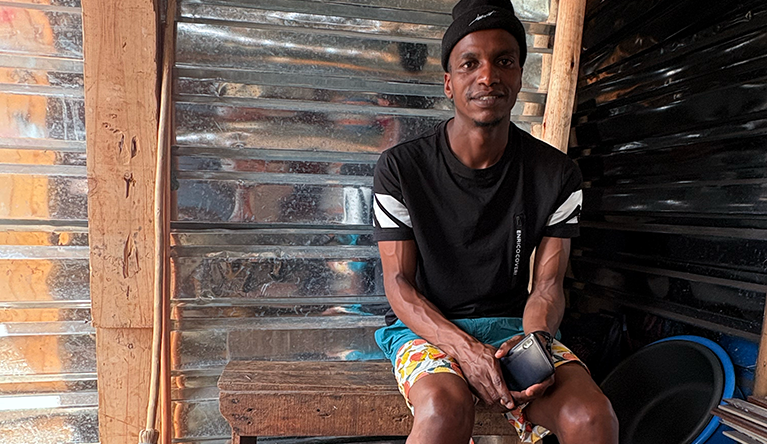
Jomo Sakhile looks puzzled when he’s asked about this. It’s not rocket science, his face seems to say, gesturing to the corrugated metal roof and wall panels of his new home. These still gleam like an unpolished mirror. The pine planks smell faintly of resin.
His previous home was destroyed by fire two months early, shortly before dawn in early July 2025. Sakhile and his family — his mother and brother — had to stay at a friend’s place for about a month, but once the disaster response kicked in and the city delivered emergency materials, he got to rebuilding. They had a new home within days.
The trick, the lean 29-year-old says, is that you don’t want to make the structure too sturdy.
“It’s dangerous if you make it strong. Sometimes, when the shack is burning and you can’t find the key, you have to knock the wall off.”
Loose planks pop off easily. There are enough chilling memories from around here, stories of others who haven’t been able to get out in time.
Luck and elevation protected the Sakhile family from the April 2022 floods. This now infamous event swallowed up homes, up to their roofs in places, in lower-lying parts of the Dakota informal settlement in Isipingo, south Durban. Their suffering didn’t make the news. What did, though, was the Toyota factory, a stone’s throw from here, which shut down production for four months following the event.
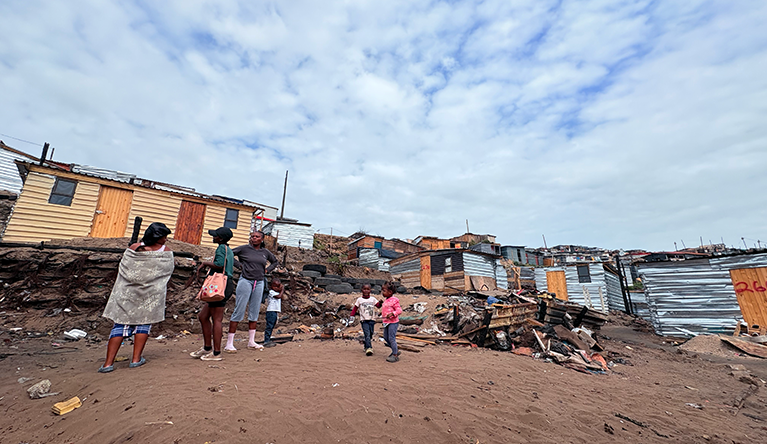
The land outside the Sakhiles’ front door is still surprising roomy. Many neighbours haven’t rebuilt yet after the fire.
It wasn’t like this on the morning of the blaze.
“Fire!” he heard his mother shout in the dark. “There’s fire!”
Sakhile dashed outside to check. It still seemed some distance away.
“I told them don’t panic,” he recalls. They grabbed the essentials: identity documents, a few clothes.
After that, they didn’t know what to take. It was bedlam outside. Fear. Confusion. People jostling in the tiny alley between the shacks that pressed in on all sides. People were trying to lug stuff up the hill to dump it safely on the beach.
Fire engines arrived but couldn’t tame the thing. The flames eventually arrived at the Sakhile home. They saw their house burn.
“It was scary. At least no one was hurt.”
Floods and fires like these are headline-grabbers. But there’s another kind of unnatural disaster that stalks here, invisibly: extreme heat. Not long before Sakhile and his family lost their home to the inferno, he took part in a study that drew contours to this stealthy killer. A summer’s worth of temperature and humidity readings in homes like this show just how hellish it can be to live in a shack made from materials better suited to a working oven.
South Africa’s human settlements policy aims to build back better following disasters like this. But the people of Dakota informal settlement know first hand: it’s more complicated than simply handing out more materials to make the same flimsy, uninsulated homes that are intended to be temporary, yet are anything but that.
Hot, hotter, hellish
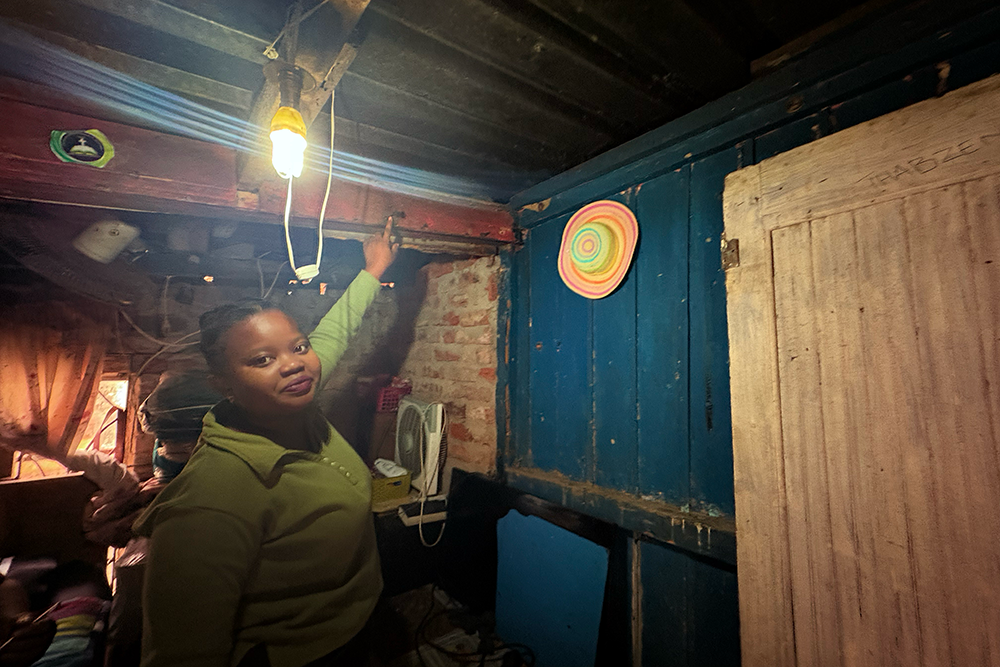
Spring is here, and its a tshirt-and-flipflops kind of day. Thokozile Cebekhulu is lit dimly by sunlight edging in through her bedroom window. There’s a bare bulb overhead, not far from where a digital sensor sat earlier in the year, logging the temperature and humidity from a roof beam every half-hour.
Sakhile had one in his home, too.
Some 19 families took part in the study, which ran from early December 2024 until June 2025. Each day, they recorded a daily voice dairy to capture how they’d experienced conditions.
This data was then compare with weather data captured at the nearest meteorological station, Ballito, about 70km up the coast.
Researchers at the University of Cape Town are still crunching the numbers for a study that’s part of the multi-country and pan-African programme Palm-Trees project, run by the Climate Adaptation and Resilience (CLARE), Although a preliminary scan shows just how much hotter conditions are inside these homes, compared with what local weather stations will record.
The fourth day of January 2025 turned out to be the hottest day that summer. Where the Ballito met station measured a top temperature of 34.5°C at lunchtime, Cebekhulu’s bedroom got to 39.8°C just after noon, and Sakhile’s maxed out at 45.2°C. Across the summer, the Dakota homes were close to 10°C hotter than conditions recorded at Ballito. But it was the humidity that made things feel even worse. While Ballito’s weather might have felt like a great day for the beach, for many, for someone in Dakota, it could have amounted to medical emergency.
Durban’s notoriously muggy climate meant that high water vapour in the air pushed Ballito’s discomfort index — the how-does-it-feel temperature — up to 48.6°C. But conditions in Cebekhulu’s bedroom would have felt as though it was 53°C; Sakhile’s, 56°C. This isn’t just unbearable. It’s potentially life threatening.
[Red Alert will expand on the health implications of this kind of heat in a future article.]
Cebekhulu’s home is a little misleading. It’s made of materials that are more sturdy and insulating than Sakhile’s. The walls are bricks and cement. Part of the roof: thickish asbestos sheets. The wooden beams look solid as pillars.
And yet during the previous summer, the digital sensor showed that the temperature inside her home wasn’t much more forgiving than Sakhile’s.
“There was a difference between the hottest homes and the coolest homes,” explains Laura Washington, director of the gender-focused civil society organisation Project Empower, which has worked with the Dakota community for years and did this data capture for the University of Cape Town CLARE crew. “But we found on hot days, the temperatures were extreme for everybody. They were still all hot.”
There pros and cons to each of the materials typically used for informal homes like these, they found. Bricks and cement are first prize, but expensive. They’re risky, too: if you don’t own the land, or the structure, why sink good money into if you may be forced out? Wood insulates, but can harbour disease-causing moulds; it rots; it burns easily. Metal lets in the cold and the heat as if it were an open door; it stays mould-free; but damp dissolves it to rust. Asbestos has been off the cards since it was banned back in 2008. Tarpaulins cast shade, but the air becomes stiflingly humid under their cover.
Suggestions of tech solutions like heat-reflective paint and living, green roofs are as out of reach as something from science fiction in a community where homes don’t have working taps or toilets. Tree planting to give the original and best air conditioning — the cooling effect of plant life breathing — is the most obvious solution. But as many residents say: if there is a patch of open land next to your house, you’re more likely to put up another shelter, which you can rent out. Tree shade can’t earn anyone a passive income.
Building back better?
Ziphi Nduli (57) isn’t so sure about her new house: when it’ll be finished, or how long it’ll last. Her previous home was made of boards, planks, and asbestos. The new one will be like Sakhile’s — planks and metal sheets — and she didn’t have any say in this.
“The new homes are fine. The problem is the corrugated iron, because we are close to the sea, which may cause rust,” Nduli says through a translator. “The house I had previously was stronger because it was built of boards.”
She didn’t lose her previous home in the recent fire, though.
After the 2022 floods, the storm water system drainage around Toyota’s Prospecton Road factory needed an urgent overhaul. The multinational had run up R4.5 billion repair bill on the plant, and suffered an addition R2 billion in lost business while it was offline.
Stormwater repairs began soon after the flood, but then things got more complicated. In late 2025 Toyota’s insurer Tokio Marine & Nichido Fire Insurance began legal proceedings to sue the eThekwini municipality, Transnet, and the KwaZulu Natal (KZN) Department of Transport for R6.5 billion, claiming negligence to maintain infrastructure.
Things also got messy for some Dakota families. Many in the lower lying areas had already suffered serious flood damage to their homes. But they were living just a city block from the factory and directly above the drainage infrastructure that needed repairing.
The solution: move the families for a spell, put them up in temporary container housing set up in a nearby parking lot, dismantle their homes, repair the drains, put up brand new shacks made of metal and planks.
This is the home that Nduli was waiting fo when Daily Maverick visited her in September 2025r, and she had no idea how much longer she’d have to live in the stark curtainless container room, from where she ran a small creche.
It’s not immediately clear which government bodies are responsible for various aspects of the stormwater upgrade, the new homes, or the temporary housing for those in transit. Daily Maverick asked the eThekwini municipality and Toyota South Africa for clarity: how much the various upgrades and repairs are costing, who is footing the bill for which parts of it, and whether Toyota South Africa has contributed to their neighbour’s post-flood recovery.
Both the municipality and Toyota South Africa were cagey, erroneously using sub judice principles relating to the civil suit to avoid responding.
When it comes to replacing informal homes after events linked with extreme weather, the KZN human settlements department gets its mandate from the national department of human settlements, the Disaster Management Act of 2002, and the National Disaster Management Framework. The provincial departments 2023 disaster management policy, and a recent revision, state that it must give families temporary building material. It doesn’t specify what materials though, but offers corrugated sheets and poles as examples. Materials must be enough to support shelters of 9m² to 30m², not cost more than R12,000, and should be able to last around five years. The municipality has to buy and distribute materials, and claim the cost back from the national department.
Materials must be fire-rated to South African Bureau of Standards approved quality, but there’s no mention that they must be suited to hold back the dangers of extreme heat. There’s also no stipulation about including insulation as a must-have, or suggestions on how to build shade or other cooling technologies such as heat-reflective paint.
Extreme heat is often regarded as a silent killer, because it doesn’t have the attention-grabbing scenes of floods or fires. Media often headline them with beach-day suggestions. Fatalities hide behind mortality data that show heart or kidney failure, respiratory distress, or even deaths of despair.
Now heat events are being recognised as the clear and present danger that they already are, according to a study released last month by the Academy of Science of South Africa which shows why it has emerged as a “defining climate-related health challenge for the SADC region”.
For a city like eThekwini, and communities like Dakota, the recommendation to gear up for extreme heat events, according to University of KwaZulu Natal (UKZN) occupational and environmental health expert Prof Rajen Naidoo, is three-fold: think in terms of shelter, water, and rest.
[The Red Alert series will investigate what shelter, water and rest mean in different informal work and living contexts, against the backdrop of the health threats linked with extreme heat.]
Crushed
For the Shezi family, it wasn’t a case of lightning striking twice, but three times. First, the 2022 floods destroyed the home they’d lived in for roughly 15 years. Like refugees, they camped out in a nearby hall for several months along with so many neighbours, until they’d rebuilt. This second house got dismantled when the drain repair work happened.
Lufuno Shezi, the Project Empower community worker who helped lead the indoor temperature monitoring for the CLARE researchers, is pragmatic when she remembers how she, her daughter, two brothers — one who is disabled — and her father had to decamp in temporary accommodation again until their metal-and-wood home was done.
Lufuno Shezi shows where the digital sensor was installed. Shezi, a long-time Dakota resident who helped lead the temperature monitoring research, lost her home twice to weather events, and once to the city’s stormwater upgrades. Pic: Leonie Joubert
When the third strike hit, it wasn’t the fire. It came from the least likely threat in an informal settlement that so desperately needs more trees for shade.
Last month, on the first Friday of March, Durbanites received a level four weather alert. A powerful storm was inbound.
“It was extremely windy,” Shezi recalls.
The next evening, she and her family were pottering around when they heard someone at their door.
“There was a man passing, he saw that the tree is about to fall,” she says. The tree in question: a mostly useless conifer that stood tall, cast little shade, and was better suited for Christmas decorations.
There was a cracking sound coming from its roots.
“The tree,” the passer-by said, “it’s going to fall anytime!”
Within a minute of them getting outside, the tree began to topple. There was little they could do but watch it come crashing down.
“It fell right on top of the roof and destroyed all of the house,” Shezi says.
Just seven months earlier, the 26-year old sat in her bedroom with Daily Maverick to explain the work and the community she knows so well.
Now that bedroom had been crushed like a tin can.
“We just have one room left. We’ve contacted disaster management and human settlements but until this day they haven’t arrived with materials to help us.”
The cone pine (Pinus pianister) is one of the most aggressive invaders in the Western Cape. Photo: Supplied
Putting up a shack is common sense: wooden planks for the frame; some well-placed nails; doors and windows, obviously; clad it with metal sheets or whatever’s on hand.
Jomo Sakhile looks puzzled when he’s asked about this. It’s not rocket science, his face seems to say, gesturing to the corrugated metal roof and wall panels of his new home. These still gleam like an unpolished mirror. The pine planks smell faintly of resin.
His previous home was destroyed by fire two months early, shortly before dawn in early July 2025. Sakhile and his family — his mother and brother — had to stay at a friend’s place for about a month, but once the disaster response kicked in and the city delivered emergency materials, he got to rebuilding. They had a new home within days.
The trick, the lean 29-year-old says, is that you don’t want to make the structure too sturdy.
“It’s dangerous if you make it strong. Sometimes, when the shack is burning and you can’t find the key, you have to knock the wall off.”
The government’s build-back-better approach to disaster relief is to provide building materials intended to be temporary. But homes in informal settlements are anything but short-lived. Pic: LEONIE JOUBERT
Loose planks pop off easily. There are enough chilling memories from around here, stories of others who haven’t been able to get out in time.
Luck and elevation protected the Sakhile family from the April 2022 floods. This now infamous event swallowed up homes, up to their roofs in places, in lower-lying parts of the Dakota informal settlement in Isipingo, south Durban. Their suffering didn’t make the news. What did, though, was the Toyota factory, a stone’s throw from here, which shut down production for four months following the event.
The land outside the Sakhiles’ front door is still surprising roomy. Many neighbours haven’t rebuilt yet after the fire.
It was a brazier that set off the fire that swept through Dakota informal settlement in July 2025. Jomo Sakhile has rebuilt his home with sheet metal and wood about a month later.
It wasn’t like this on the morning of the blaze.
“Fire!” he heard his mother shout in the dark. “There’s fire!”
Sakhile dashed outside to check. It still seemed some distance away.
“I told them don’t panic,” he recalls. They grabbed the essentials: identity documents, a few clothes.
After that, they didn’t know what to take. It was bedlam outside. Fear. Confusion. People jostling in the tiny alley between the shacks that pressed in on all sides. People were trying to lug stuff up the hill to dump it safely on the beach.
Fire engines arrived but couldn’t tame the thing. The flames eventually arrived at the Sakhile home. They saw their house burn.
“It was scary. At least no one was hurt.”
Floods and fires like these are headline-grabbers. But there’s another kind of unnatural disaster that stalks here, invisibly: extreme heat. Not long before Sakhile and his family lost their home to the inferno, he took part in a study that drew contours to this stealthy killer. A summer’s worth of temperature and humidity readings in homes like this show just how hellish it can be to live in a shack made from materials better suited to a working oven.
South Africa’s human settlements policy aims to build back better following disasters like this. But the people of Dakota informal settlement know first hand: it’s more complicated than simply handing out more materials to make the same flimsy, uninsulated homes that are intended to be temporary, yet are anything but that.
Hot, hotter, hellish
Spring is here, and its a tshirt-and-flipflops kind of day. Thokozile Cebekhulu is lit dimly by sunlight edging in through her bedroom window. There’s a bare bulb overhead, not far from where a digital sensor sat earlier in the year, logging the temperature and humidity from a roof beam every half-hour.
Sakhile had one in his home, too.
Some 19 families took part in the study, which ran from early December 2024 until June 2025. Each day, they recorded a daily voice dairy to capture how they’d experienced conditions.
This data was then compare with weather data captured at the nearest meteorological station, Ballito, about 70km up the coast.
Researchers at the University of Cape Town are still crunching the numbers for a study that’s part of the multi-country and pan-African programme Palm-Trees project, run by the Climate Adaptation and Resilience (CLARE), Although a preliminary scan shows just how much hotter conditions are inside these homes, compared with what local weather stations will record.
The fourth day of January 2025 turned out to be the hottest day that summer. Where the Ballito met station measured a top temperature of 34.5°C at lunchtime, Cebekhulu’s bedroom got to 39.8°C just after noon, and Sakhile’s maxed out at 45.2°C. Across the summer, the Dakota homes were close to 10°C hotter than conditions recorded at Ballito. But it was the humidity that made things feel even worse. While Ballito’s weather might have felt like a great day for the beach, for many, for someone in Dakota, it could have amounted to medical emergency.
Durban’s notoriously muggy climate meant that high water vapour in the air pushed Ballito’s discomfort index — the how-does-it-feel temperature — up to 48.6°C. But conditions in Cebekhulu’s bedroom would have felt as though it was 53°C; Sakhile’s, 56°C. This isn’t just unbearable. It’s potentially life threatening.
[Red Alert will expand on the health implications of this kind of heat in a future article.]
Cebekhulu’s home is a little misleading. It’s made of materials that are more sturdy and insulating than Sakhile’s. The walls are bricks and cement. Part of the roof: thickish asbestos sheets. The wooden beams look solid as pillars.
And yet during the previous summer, the digital sensor showed that the temperature inside her home wasn’t much more forgiving than Sakhile’s.
“There was a difference between the hottest homes and the coolest homes,” explains Laura Washington, director of the gender-focused civil society organisation Project Empower, which has worked with the Dakota community for years and did this data capture for the University of Cape Town CLARE crew. “But we found on hot days, the temperatures were extreme for everybody. They were still all hot.”
There pros and cons to each of the materials typically used for informal homes like these, they found. Bricks and cement are first prize, but expensive. They’re risky, too: if you don’t own the land, or the structure, why sink good money into if you may be forced out? Wood insulates, but can harbour disease-causing moulds; it rots; it burns easily. Metal lets in the cold and the heat as if it were an open door; it stays mould-free; but damp dissolves it to rust. Asbestos has been off the cards since it was banned back in 2008. Tarpaulins cast shade, but the air becomes stiflingly humid under their cover.
Suggestions of tech solutions like heat-reflective paint and living, green roofs are as out of reach as something from science fiction in a community where homes don’t have working taps or toilets. Tree planting to give the original and best air conditioning — the cooling effect of plant life breathing — is the most obvious solution. But as many residents say: if there is a patch of open land next to your house, you’re more likely to put up another shelter, which you can rent out. Tree shade can’t earn anyone a passive income.
Building back better?
Ziphi Nduli (57) isn’t so sure about her new house: when it’ll be finished, or how long it’ll last. Her previous home was made of boards, planks, and asbestos. The new one will be like Sakhile’s — planks and metal sheets — and she didn’t have any say in this.
“The new homes are fine. The problem is the corrugated iron, because we are close to the sea, which may cause rust,” Nduli says through a translator. “The house I had previously was stronger because it was built of boards.”
She didn’t lose her previous home in the recent fire, though.
After the 2022 floods, the storm water system drainage around Toyota’s Prospecton Road factory needed an urgent overhaul. The multinational had run up R4.5 billion repair bill on the plant, and suffered an addition R2 billion in lost business while it was offline.
Stormwater repairs began soon after the flood, but then things got more complicated. In late 2025 Toyota’s insurer Tokio Marine & Nichido Fire Insurance began legal proceedings to sue the eThekwini municipality, Transnet, and the KwaZulu Natal (KZN) Department of Transport for R6.5 billion, claiming negligence to maintain infrastructure.
Things also got messy for some Dakota families. Many in the lower lying areas had already suffered serious flood damage to their homes. But they were living just a city block from the factory and directly above the drainage infrastructure that needed repairing.
The solution: move the families for a spell, put them up in temporary container housing set up in a nearby parking lot, dismantle their homes, repair the drains, put up brand new shacks made of metal and planks.
This is the home that Nduli was waiting fo when Daily Maverick visited her in September 2025r, and she had no idea how much longer she’d have to live in the stark curtainless container room, from where she ran a small creche.
It’s not immediately clear which government bodies are responsible for various aspects of the stormwater upgrade, the new homes, or the temporary housing for those in transit. Daily Maverick asked the eThekwini municipality and Toyota South Africa for clarity: how much the various upgrades and repairs are costing, who is footing the bill for which parts of it, and whether Toyota South Africa has contributed to their neighbour’s post-flood recovery.
Both the municipality and Toyota South Africa were cagey, erroneously using sub judice principles relating to the civil suit to avoid responding.
When it comes to replacing informal homes after events linked with extreme weather, the KZN human settlements department gets its mandate from the national department of human settlements, the Disaster Management Act of 2002, and the National Disaster Management Framework. The provincial departments 2023 disaster management policy, and a recent revision, state that it must give families temporary building material. It doesn’t specify what materials though, but offers corrugated sheets and poles as examples. Materials must be enough to support shelters of 9m² to 30m², not cost more than R12,000, and should be able to last around five years. The municipality has to buy and distribute materials, and claim the cost back from the national department.
Materials must be fire-rated to South African Bureau of Standards approved quality, but there’s no mention that they must be suited to hold back the dangers of extreme heat. There’s also no stipulation about including insulation as a must-have, or suggestions on how to build shade or other cooling technologies such as heat-reflective paint.
Extreme heat is often regarded as a silent killer, because it doesn’t have the attention-grabbing scenes of floods or fires. Media often headline them with beach-day suggestions. Fatalities hide behind mortality data that show heart or kidney failure, respiratory distress, or even deaths of despair.
Now heat events are being recognised as the clear and present danger that they already are, according to a study released last month by the Academy of Science of South Africa which shows why it has emerged as a “defining climate-related health challenge for the SADC region”.
For a city like eThekwini, and communities like Dakota, the recommendation to gear up for extreme heat events, according to University of KwaZulu Natal (UKZN) occupational and environmental health expert Prof Rajen Naidoo, is three-fold: think in terms of shelter, water, and rest.
[The Red Alert series will investigate what shelter, water and rest mean in different informal work and living contexts, against the backdrop of the health threats linked with extreme heat.]
Crushed
For the Shezi family, it wasn’t a case of lightning striking twice, but three times. First, the 2022 floods destroyed the home they’d lived in for roughly 15 years. Like refugees, they camped out in a nearby hall for several months along with so many neighbours, until they’d rebuilt. This second house got dismantled when the drain repair work happened.
Lufuno Shezi, the Project Empower community worker who helped lead the indoor temperature monitoring for the CLARE researchers, is pragmatic when she remembers how she, her daughter, two brothers — one who is disabled — and her father had to decamp in temporary accommodation again until their metal-and-wood home was done.
When the third strike hit, it wasn’t the fire. It came from the least likely threat in an informal settlement that so desperately needs more trees for shade.
Last month, on the first Friday of March, Durbanites received a level four weather alert. A powerful storm was inbound.
“It was extremely windy,” Shezi recalls.
The next evening, she and her family were pottering around when they heard someone at their door.
“There was a man passing, he saw that the tree is about to fall,” she says. The tree in question: a mostly useless conifer that stood tall, cast little shade, and was better suited for Christmas decorations.
There was a cracking sound coming from its roots.
“The tree,” the passer-by said, “it’s going to fall anytime!”
Within a minute of them getting outside, the tree began to topple. There was little they could do but watch it come crashing down.
“It fell right on top of the roof and destroyed all of the house,” Shezi says.
Just seven months earlier, the 26-year old sat in her bedroom with Daily Maverick to explain the work and the community she knows so well.
Now that bedroom had been crushed like a tin can.
“We just have one room left. We’ve contacted disaster management and human settlements but until this day they haven’t arrived with materials to help us.”
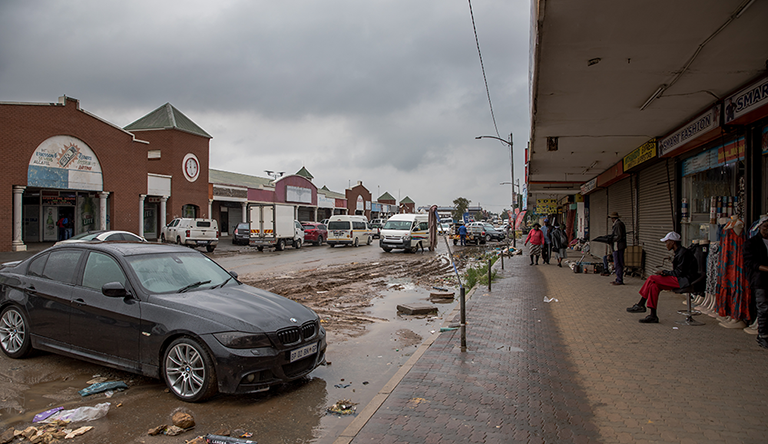
Potholes scar Union Street in Vereeniging and dirt obscures what remains of the tarmac. Once thriving shops now struggle to survive. Photo: Nathalie Bertrams
Sebokeng, Gauteng – Cold November day and Toto Street is going to mud. A Seventh Day Baptist Church at the east end of the one kilometre street, a T-junction at the west. Township houses, some with brick walls, others with wire fences. General dealer at an intersection where rocks threaten tyres and rain dilutes sewage. A block north, Kgokare Secondary. The school’s concrete slat fence is topped with broken razor wire.
Maselo Lemphane’s backyard house on Toto Street is dark, electricity being expensive. Pot of pap on an old stove. Her baby daughter stares from a bedroom doorway.
“Can’t say it was a nice job. You’re working with water eight to five,” Maselo, wrapped in a red bathrobe, says about her former job as a valet at a panelbeater.
“Doesn’t matter which season it is, you see the weather conditions, it’s raining. But if the clients want the car, they’re like ‘Gou, gou. Kom, kom! Roer julle gat!’ You have to work no matter what. You have to.”
The panelbeater went into liquidation in 2024.
“Everything changed,” Maselo says of her retrenchment. “The food, the insurance. My policies lapsed. Then my mother died. After, we even struggled to give her a simple, dignified funeral. Like, yoh, it strained a lot. Everything changed. Everything.”
Her voice softens a tone or two as she says “everything” one more time.
Almost 30 years old, single and searching in vain for a job, she’s raising two kids and looking after her three siblings. About the social grant lifeline, Maselo says “it is there to help and it does assist. It can only afford a portion of food. That cannot even take up to the whole month till we wait for another payment.”
Asked about life on Toto, she looks to the left as if she was standing in the middle of the street. “Yoh, there’s a lot of social problems here. There is a lot. People are struggling, especially here in Sebokeng. There’s a lot of struggles behind all, most of the closed doors. Most of them.”
Toto isn’t just some heartache road in Zone 7. It is Sebokeng, one of the main townships in South Africa’s rusting industrial heartland, the Vaal Triangle. All that Sebokeng is, Toto embodies.
“There’s always retrenchments in the firms, in the companies,” Maselo says of the Vaal’s future. “So, we’re going to struggle more. That’s what I see. More. This unemployment thing that we’re crying about now, it is definitely going to get worse.”
The official unemployment rate for the Emfuleni Municipality – which has a population close to a million spread across the industrial cities of Vereeniging and Vanderbijlpark and the large townships of Sebokeng, Evaton, Boipatong, Bophelong, Tshepiso and Sharpeville – is 56.2%. For young people it’s more than 60%.
And it’s not like life is easy for those with work. Vincent Ndemande, born in 1981, also lives on Toto Street. A black-and-white photo of his father (Vincent credits a lot to his father’s stern upbringing) stares down from his living room wall. Vincent’s position as a chef isn’t permanent and his employer has just lost a big client.
“We are asking ourselves that when we’re waking up in the morning, going to work, what will happen?” he says.
His posture shifts when he says: “I want to tell you straight-up. You see all of this… this is torment, guys. I wake up each and every morning. I don’t want to look like someone who’s just going to work to help others to work and end up with nothing. There’s never been enough.
“But there’s enough in our government. They told themselves there’s never been enough in their pockets.”
Vereeniging, established in 1892, sits 11.5km to the southeast of Toto. The city is on the Gauteng bank of Vaal River. The Lethabo coal-fired power station dominates the skyline from the Free State side. ArcelorMittal’s Vereeniging steelworks were set to close at the end of December 2025 and 3,500 people faced losing their jobs.
Delta Marine, a couple of blocks from Vereeniging’s crumbling main drag, is as dark as Maselo’s small house. Pleasure boats, the kind used to fish the Vaal River, rise up from the showroom floor’s deep shadows. A generator throbs in the workshop where boats are built and repaired. The municipality decided to end the dispute over meter readings and unilaterally cut the power.
Sonja Theron (68), the co-owner of Delta Marine, has spiky black hair, nail art and a tattoo around her wrist. She stands behind the counter with a pile of paperwork and her despair over the water and power problems radiates.
“I’ve come to a point,” she says, “where I want to say to the municipality, you know what, stick your stuff up your, wherever, in your ear. I feel they are still stealing… I just think that the corruption is sky, sky, sky-high.”
The company is a family affair. Sonja and her husband bought Delta Marine in 1996 and orders flowed. Their son designs the boats. But business in 2025 has been the worst in 28 years and Sonja’s depression and panic attacks won’t go away.
“We are,” she says, “literally living from hand to mouth.”
The downturn started in the 2000s when the allure of boating on the Vaal diminished because of sewage pouring into the river. Apartheid-era infrastructure run down in seemingly nihilistic greed. Things went to hell the city over after Covid.
Delta Marine used to employ 25 people before the pandemic, today 15 and tomorrow is uncertain.
“If we make it, I don’t know,” Sonja says as two customers listen in to the conversation. “I hope so because we’ve sold our caravan, we’ve done this, we’ve done that to try and just keep going for our son’s sake. But we are going to come to a point where we haven’t got much more to sell.”
And what of the Vaal Triangle’s future?
“I say my knees have got patches on already from praying and asking God, please just give us an outcome. Give us an outcome on this whole situation that we are in. It’s gone down to ground level.”
It was never supposed to make money
To get to the Vaal Teknorama Museum in Vereeniging, you turn off the main road, past an open piece of land piled with building rubble and right into the museum’s long, tree-lined driveway. Some of the guardhouse’s windows are papered over.
Once through the gate, there’s ample parking, take your pick. A couple of old artillery pieces rust on the huge front lawn, along with an ancient tank and a steam engine from 1938. At the museum entrance there’s an ox wagon and a plaque informing that the last apartheid president, FW de Klerk, inaugurated the Teknorama in 1990 as a celebration of the Vaal’s industrialisation.
Inside, the museum is dark and not much is going on. The staff won’t talk on record but do allow us access to the archive.
Chaos, shambles. A book of original photos from the South Africa War rests haphazardly on a shelf. Random reports on pre-1994 government events. There doesn’t seem to be much in the way of chronological ordering. Somewhere along the way someone took some kind of a stab at documenting the liberation Struggle in the region. The card catalogue itself belongs in a display case.
But the Teknorama isn’t just yet another government building neglected to long ruin. The wave of heavy industrialisation that really kicked off from World War 2 to the 1980s, what the museum is supposed to display, is exactly what makes the Vaal different from all the other areas in South Africa where local government has collapsed.
Since the early 1900s the Vaal has been an engine of wealth and job creation. The place where things are manufactured and minerals beneficiated. What happens in the Vaal matters for the entire country. Where the Vaal goes, the country follows.
Much of the industrialisation of the Vaal Triangle comes down to one man, Hendrik van der Bijl. In 1922, and as the founding chairperson, Van der Bijl was pivotal to the formation of Escom, which had the dual mandate of providing cheap electricity to industry and breaking the stranglehold of the Victoria Falls Power Company, a subsidiary of a Cecil John Rhodes company. The Victoria Falls Power Company was expropriated with compensation in 1948.
Van der Bijl also founded the state-owned South African Iron and Steel Industrial Corporation (Iscor) in 1925 and a ferro-alloys company, the African Metals Corporation, in 1937. He was heavily involved in the 1940 creation of the Industrial Development Corporation.
What Van der Bijl laid the foundations for was a state-owned industrial nexus in the Vaal Triangle that wasn’t driven towards profit but rather the distinct political goals of uplifting Afrikaners and solidifying Christian nationalism. The steel, mines, power and petrochemicals were strategic enterprises rather than companies obsessed with the bottom line.
The original and partial privatisation of Iscor came about in 1989, four years after De Klerk’s government defaulted on sovereign debt. Iscor’s captive iron mines were split from the steel side in 2001 and became Kumba Resources, which Anglo American now owns. Iscor was sold to the global steelmaking giant ArcelorMittal in 2004.
Kabelo Ramokhathali has been in the metals sector for almost 25 years. He started as a general worker and then became a drill operator. After 10 years as a shop steward at MacSteel (last year, the company issued a Section 189 notice of retrenchments) he moved into local organising and eventually became the Numsa regional secretary for Sedibeng.
“When I joined the industry in 2001,” Kabelo says from across his desk at Numsa’s Vanderbijlpark office, “I must say now the rate of unemployment was very low. And it was not difficult for any individual to get a job at that time. You would resign or be dismissed from one company and get the job next door. At that time, we also, as workers, had to make a choice: which company do we prefer?”
The choice is no longer there and Kabelo is busy trying to deal with the ongoing wreckage. Above and beyond the Vereeniging steelworks’s impending closure, ArcelorMittal has given notice of retrenchments at its Vanderbijlpark steel mill: coking ovens are shuttering and many formerly full-time workers are on shifts.
Kabelo points out that Numsa’s membership across companies and industries in the Vaal has, since Covid, dropped from 25,000 to about 17,500.
“ArcelorMittal now, their main objective is to maximise profit,” Kabelo says. “So they have moved away from that objective of Iscor. Because Iscor, their sole intention was not necessarily to maximise profit, but to ensure that there is stability… ArcelorMittal does not care about what the community is going to benefit, the economy of the Vaal.”
ArcelorMittal strenuously refused Daily Maverick’s request for an interview.
Solidarity’s office is 9km down the road from the Vanderbijlpark steel mill. Both Willie Venter, the deputy general secretary of the union, and Johan Venter, a network organiser, came up through the ranks, working their way across the steel industry and into labour relations. Johan has lived in the Vaal his whole life and is just about to retire.
Solidarity used to have 67,000 members in the Vaal Triangle, back when the state owned the mills. Today, membership is down to 6,000, with 1,500 of those at the Vanderbijlpark mill. Johan started working in the industry in 1981 and distinctly remembers the mid-1990s and 2000s.
“Ja, the infrastructure was well, water supply was well,” he says. “ArcelorMittal employed much more people than they employ now. And then afterwards it just tumbled. You can see how the town looks now. I mean, you came through it. You can see how the roads look and everything.”
Willie points out that the long steel that has come out of ArcelorMittal’s Newcastle and Vereeniging plants – the high-quality kind necessary for railways and the automotive industry – is a strategic commodity, a position that Kabelo and Johan share.
“It makes sense,” Willie says, “that in years gone by, places or companies like Iscor had to produce without necessarily having the expectation of making huge profits.”
When Numsa and Solidarity are in alignment, you know something is up. For Numsa, the only way to save the long steel industry is for the government to nationalise it. For Solidarity, the industry has to be taken out of the hands of a multinational interested only in profit and taken over by patriotic South Africans.
Both unions warn of horrific downstream implications, a widening ripple of unemployment and loss of skills. They are equally frustrated with the government.
“Because, while they are wasting time,” Kabelo says of the government, “the moment they wake up there will be no ArcelorMittal. Because the speed that ArcelorMittal is moving is actually more than 100km/h, while the government is moving with 10km/h.”
For Johan, the government is “talk and talk and talk and in the end nothing happens”, while Willie stresses: “Don’t forget about the urgency around these matters. I think that’s also one thing that government forgets about. We don’t have decades to find solutions.”
Non-unionised workers also don’t have time for the government to get itself in order.
The Sebokeng train station was looted to nothing during Covid. Even though the line still doesn’t run and workers remain without affordable transport, the station’s been revamped. Weeds push up from the paving stones.
Thirty-seven-year-old Bongani Mokoena* worked at a garage for 11 years before joining a steel manufacturer as a general worker. Later he was able to, as he puts it, set the broom aside and become a specialist machine operator earning R51.80 an hour. With overtime that’s R8,000 to R10,000 a month. Unfortunately, his relationship with the company has ended.
“I’ve done some asking around,” he says, “with a couple of friends from around the metal industry and they’re telling me that, dude, we don’t get jobs any more.”
As for those recently matriculated, Bongani states that “it’s bad. You’d be very lucky if you get a spot in retail.”
Like the unionists over at Solidarity and Numsa, he has problems with the government’s behaviour.
“You find countries where you see that people are living on a template. That you go to school, you get a job, you earn a living so that you can pay Mr Who who sells bread and Mr Who can pay Miss Who who sells veggies. It goes around the community like this and everybody is safe. But here in South Africa we don’t have that. We are being ruled by corruption.”
After 1994 and on a wider level, the Vaal Triangle has experienced a massive clash of economic philosophies. Down at the foundation of the National Party’s industrialisation project was a form of economics now long forgotten: volk socialism.
The basic premise of the economic philosophy is that the state bends the entire economy to uplift the volk (i.e. Afrikaners) and doesn’t shy away from using protective tariffs, exploitation of non-volk labour and high levels of subsidisation to enable industry to meet the state’s totalitarian social goals. Volk socialism isn’t communism or capitalism, it’s a contra-revolution to both.
When De Klerk blessed the Teknorama, it was the successful implementation of volk socialism that was extolled.
Instead of using a largely state-owned or state-controlled industry to achieve the social end of uplifting the entire country, the ANC decided after liberation to privatise the industrial base. What used to exist in a highly protected and subsidised industrial ecosystem now had to be profitable in a competitive globalised marketplace. The government’s role was to provide good governance and basic infrastructure like electricity, roads, water and schools.
The ANC made a large bet: if the privatisation of heavy industry succeeded, downstream businesses would flourish and jobs would be created. The wager was lost and downtown Vereeniging knows it.
Union Street
Faatema Patel, a pharmacist, used to work at the Sedibeng hospital 20 years ago and is now at Taxido Chemist on Union Street in Vereeniging. The street is severely potholed and dirt obscures the tarmac. Pavement stones missing en masse. The taxi rank is about a two-minute walk from Taxido and just beyond the Jika Ma Jika Sports Bar. Finalisation of the rank’s upgrade remains delayed.
Six weeks to go before the steel mill closes.
Over coffee in a nearby mall, Faatema explains that most of Taxido’s business is cash, it also has medical scheme clients and many are from ArcelorMittal and downstream businesses. Chronic illness is common among her clients.
“January is a big month for pharmacies because that’s when your medical (scheme savings) are all reinstated,” Faatema says. She’s worried that Taxido will take a hit in January 2026.
Come the new year, Faatema foresees that many of the soon-to-be retrenched workers are “going to find themselves in the public health system, which really is struggling. I mean, we see it every day. We see patients from public health every day that come to us looking for medication that is just not available in the public health sector.”
The education system is also likely to suffer. The loss of income means that children will move from private and semi-private schools to overcrowded public schools where the possibility of falling through the system is very real.
“You already have children seeping through the cracks. That’s where your drugs come in,” Faatema points out.
From township to affluent suburb, Vaal residents complain about drugs – nyaope in particular – and how they are tearing the social fabric apart. Selina Marilitsi has lived in the same small house on Toto Street for her entire 44 years. She used to be a cleaner at the Samancor smelter north of Vereeniging.
The smelter provided manganese alloys for the steel industry but closed down in 2020 and Selina hasn’t had a job since. Grants and selling snacks like chips and disco pops somehow get her husband, ailing mother and children through the month.
When industry closes, working-class jobs go and don’t come back. This is not a world where cleaners are upskilled to coders. The fallout is intergenerational.
Selina predicts that life will be difficult for the retrenched mill workers. She says “the money you are going to get is not going to be enough. You can start a small business but it’s not going to be enough.”
Her greatest concern is her two boys, both at school.
“We don’t want drugs,” she says as the rain continues and damp seeps through. “Drugs are killing our kids. We want our kids to go to school and get education and work for their parents. We ask that this gets fixed.”
Taxido Chemist has stopped selling over-the-counter codeine meds because of a constant stream of teenage boys wanting to buy, often with the excuse that their younger brother is ill.
“When socioeconomic circumstances degrade or worsen,” Faatema says, “it is one of the things that come out of that. You have a higher level of alcohol dependency coming out of it, drug dependency coming out of it.”
Vereeniging feels forgotten, the buildings shabby. Muhammed Desai* has a small fabric shop, another downstream business. He’s been open for 35 years.
“On a day like Friday, at 11 o’clock, we are standing and chatting,” he says. “It was never like that before. I had six staff, and (now) I have one. That one I can do without too because there (aren’t) any customers. Lack of money coming to the workers has spiralled so badly that there just, frankly, isn’t money on the streets.”
Property owners along Union Street and across the CBD have been hurled into a trap worthy of the devil himself. Buildings were bought as long-term investments when the local economy thrived. The subsequent and intertwined curses of companies shutting down and municipal services evaporating resulted in a collapse in rents and property prices, leaving building owners no way to recoup their investments.
Muhammed says his landlord has “been nice to me and given me a reduction basically to keep my doors open”.
Sonja Theron and her husband are in the same predicament. Back when times were good, they bought a building, a block and a half east of Union Street, to house Delta Marine and earn an income from renting out the upper sections. Now, no one wants to buy the property, their asset has become retirement-destroying debt and renters aren’t ever going to come. Sonja lets her remaining workers stay in the building for free.
The issue of debt isn’t limited to business owners. It falls on the working class. Falls hard. Vincent Ndemande, the chef living on Toto Street, explains what’s happening to households as the Vaal’s economy shrinks:
“A lot of people now, they’re working days. Others, they’re working short shifts. You used to get the salary that will provide your family and pay some debts and whatever. And now, you can’t. Now you end up (taking) some loans. And now you’re always in deep debt at the end of the month.
“Because that debt, guys, I want to tell you that to feed your family is a hard thing. As a father, as a mother. Sometimes we end up looking at each other like a bad person, as enemies towards our children.”
ArcelorMittal’s Vereeniging steelworks closed at the end of December 2025 and, two months later, Faatema has her answer: January for Taxido Chemist was terrible, down 20%. Her husband’s pharmacy in Vanderbijlpark has a strong middle-class base, a lot of folks belonging to medical schemes and many from ArcelorMittal, and his business plummeted by 30%. Faatema’s father-in-law is an egg wholesaler, 80% of his customers are township retailers, and December was his worst single month to date.
Klasie Havenga Street
A man dressed in workman blue with reflective stripes marches out of the November rain and into the Emfuleni municipal building on Klasie Havenga Street in Vanderbijlpark. He’s way pissed off. The municipality hasn’t paid electrical workers and, just to the right of the entrance to the building, an official is trying to talk to a room full of workers. Ten different types of unholy hell going on in there.
The CBD is on the other side of Klasie Havenga – named after the leader of the Afrikaner Party, which went into coalition with the National Party in 1948 – and the city centre could double as the set for a post-apocalyptic film, if the end of the world had struck in the late 1970s.
Emfuleni now has a coalition and members of the DA caucus figure the mayor’s office is the best place for a chat. Beyond the topic of the day, the decline of the Vaal and the municipality, the composition of the meeting participants is interesting in and of itself.
In attendance are Duncan Mthembu, the head of the DA caucus, Tumelo Mashigo, the caucus’s researcher, and Dalene Venter, a ward councillor. There seems to be a shift, like the Vaal just might make the DA a bit more representative of the nation.
“I know that the decline,” Duncan says, “of Emfuleni in particular started from the year 2002. That was the decline of the institution itself where it kept on going down.”
Dalene is hyper-focused on the local. She speaks of daily water reports on the Vaal Dam and a vital water pipeline. Of sewage bubbling up in a hospital theatre and closing a school for a week. Of an exploding substation. When a major pothole appeared in an intersection, Dalene wheeled out in her chair and made a video. Exactly the kind of attention to detail you want from a ward councillor, which is probably why her constituents have kept her in power for the past quarter of a century.
Duncan speaks to broader issues.
“I think the most important thing for us,” he says, “is to look at the relationship between the decline of the economy as well as the decline of the municipality. Because when you speak about the decline as well, it is caused also by national factors.”
The national decline, according to him, kicked off around 2009 and ArcelorMittal’s problems began in 2012.
Load shedding started in 2007 and was a product of former president Thabo Mbeki’s botched privatisation drive. Mbeki made a rare apology at the end of 2007: the lack of investment into Eskom, which was slated for privatisation, was the root cause of the outages.
When combined with State Capture, the result was constantly decreasing electricity supply and ever-increasing prices. According to the Energy Intensive Users Group of Southern Africa, Eskom’s average electricity price in 2008 was 19.9c/kWh. In 2024, it rose to 165.43c/kWh.
At the heart of Van der Bijl’s industrialisation project was cheap electricity, dedicated rail transport, protected markets and captive mines for the likes of Iscor. Knock those things out, either via privatisation or simple neglect, and the inherited industrial nexus becomes uncompetitive as Chinese imports flood in.
Over the past two decades, manufacturing and heavy industry sectors have been contracting and the South African economy is simplifying to raw materials exports, services and agriculture. The job losses in manufacturing have been enormous.
“From 2008 until 2015,” writes Andrés Fortunato, a Harvard Growth Labs researcher, “the industry of fabricated metal products lost around 34,500 jobs at an annual rate of -6%, while structural metals lost 21,000 jobs at a -4% annual rate.”
Twenty percent of all manufacturing jobs were lost during Covid and employment in heavy industry remains below pre-Covid levels. The metals, metal products, machinery and equipment sectors continue to contract: metals production shed 40,000 jobs (a 15% decline) from 2024 to 2025. During the last three months of 2025 another 61,000 jobs were lost in the manufacturing sector overall.
From 2008 to date, close to 600,000 have been lost in the manufacturing sector. More losses are coming: for example, Transalloys, which operates the country’s last remaining manganese smelter, issued retrenchment notices at the end of 2025, citing prohibitively high electricity costs.
Given the state of the economy and the condition of the Emfuleni Municipality, Duncan and Tumelo smell blood in the water. They reckon the DA can get enough votes in the 2026 local elections to control whatever coalition comes up. So, naturally, there is a fair amount of electioneering in the conversation.
Best, then, to speak to the ANC. To a Struggle stalwart who was in positions of power in the Vaal throughout a fair chunk of the decline. He’s living in the most unusual of suburbs, a place at odds with the national standard, over in Vereeninging.
Roshnee
The Teknorama, located in the Vereeniging suburb of Duncanville, was built upon a crime scene. While museum displays were filled with photos and artefacts celebrating volk socialism’s industry, the building’s bricks rejoice in the Group Areas Act.
Duncanville used to be Top Location, a 16,000-strong multicultural community of Africans, Indians, Coloureds, whites and Chinese. The first recorded Chinese immigrant to South Africa was the convict Wancho in 1660 and Chinese immigrants entered the Transvaal in the late 1800s. When Mahatma Gandhi took on the government, the Transvaal Chinese Association threw their lot in with him. Association members were subjected to mass arrests in 1909.
The government began forced evictions in the 1950s. Africans went to the newly created township of Sharpeville. Coloureds to Rust-Ter-Vaal, just north of Vereeniging. Of the eighty Chinese in Vereeniging, most lost their businesses when people were moved to Sharpeville. The relocations finished in 1974 with the Indian community being moved to Roshnee, established in 1967.
Roshnee is 13km from the centre of Vereeniging, and it is a complete anomaly: houses don’t have fences.
Palestinian flags fly and there’s a house with a huge mural depicting a young boy, keffiyeh around his neck, gazing at what looks like the Al-Aqsa mosque. Affluent Roshnee is a tightly knit community that decided to take matters into its own hands. Residents fix potholes and look after their own security and education. If a pipe bursts, they repair it. Within its boundaries, Roshnee has no crime.
Mosque and Friday lunch are Roshnee sacrosancts. Yunus Chamda puts out biriyani and cooldrink. From 1996 to 2000 he was the mayor of the Lekoa-Vaal Metro, the predecessor to Emfuleni. After that he was the speaker of the municipality and then went into administration. Eventually, in 2016, the powers that be asked him to take on the position of Emfuleni municipal manager for eight months.
He left after three months because “you tried your best to run a clean government, but eventually, once you know your influence is not there, then it was time to move forward”.
Problems within the Vaal became apparent to him from 2000. “It was very evident that the economy was declining. I mean, rapidly. I mean, month to month, all the signs of unemployment, of great unemployment, were there.”
He and his team were “running helter skelter” to impress on national and provincial government to intervene, to make serious investments or at least soak up some of the unemployment. The response from national, according to Yunus, was: “Everybody agrees with you. Nobody says, ‘no, no, no, we don’t think it’s a priority’. Everybody agrees with you. Everybody concurs with your data. But it never translated into any real major investments.”
Yunus has a personal regret about his time in politics.
“It’s a pity,” he says “that in my time as the mayor of the Lekoa-Vaal Metro we didn’t see the warning signs at that point, because I would have definitely intervened and had this engagement with Mandela at the time, to seriously look at getting some investments into this area.
“I never enjoyed much of a working relationship with the presidents that followed. I would have been able to approach Mandela in a far more engaging way.”
Asked if he’s left the ANC, he replies: “Well, I just didn’t renew my membership.”
‘I feel lonely’
Perhaps the greatest commonality across the Vaal’s people is a sense of betrayal. That the Vaal had so much potential, the government squandered it and now there’s naught but misery. As Vincent says of the R370 Social Relief of Distress grant: “We ain’t even supposed to get the grant. Instead of getting jobs, we are getting a grant that can just only buy milk and bread.”
Kabelo from Numsa stresses that “even if you have played a part in defeating apartheid, but if you have done something wrong, you should account. It cannot be an excuse that I have done this because of apartheid. So that’s basically it. As the working class, we have been failed.”
He predicts “there will be an uprising at some point where people will say, no, away with the government. I don’t know how they are going to do that. But you can see it going slowly but surely. It’s going there.”
Willie at Solidarity also points to a working class that has been failed, saying that “if I do my part and government does not do theirs, then I feel betrayed. And I think there’s a lot of employees out there that’s lost their jobs the last number of years that should feel betrayed. Their taxes have gone to the salaries of government officials that we are supposed to entrust with finding solutions.”
Over on Union Street and in his fabric shop, Muhammed says: “I feel betrayed because I’m a citizen of the county and I feel that my government hasn’t looked after me. Because they say it’s linked to ANC and mayoral structures and people filling their pockets. And, I mean, I gave my life to this place.”
“I know what they promised,” Bongani says, with Sebokeng’s useless train station mocking from behind his back, “and I know what they still promising and none of that is happening. And it’s scary because I have kids in this broken country.”
But two people, from different ends of the generational spectrum, on Toto Street really encapsulate the righteous fierce wind blowing across the Vaal.
Pizzo Rapudungwane is 68 and his last job was with a garden services company, which maintained the grounds of the steel manufacturer Cape Gate. As a loyal member of the ANC, he was part of the uprising against Bantu education in the Seventies. He was part of the stayaways and boycotts of the Eighties and organised strikes and protests after 1994.
Of the ANC’s 1994 jobs, jobs, jobs campaign, Pizzo says: “Yes, I did believe that they can make jobs. But when time goes on, I see that, no, these people, they are playing with people. There is no jobs. In terms of jobs, we get this thing of retrenchment, company of retrenchment.”
He’s talked politics with people of his generation, and according to him the old are the only demographic still voting ANC. “They said to me, ANC have given them grant. ANC have given them houses. I said, ‘no, those things, they’re supposed to be there’.”
In 2010, he left the ANC because of violence within the party. “If you are talking too much, like me,” Pizzo explains, “because I was an activist of making strikes at the company, then I saw them killing people inside. But it was an internal thing that they didn’t want people to see it. So I said, no, let me get out from this.”
Now he votes DA.
And how does it feel to leave the ANC?
“I feel lonely,” he answers, “because everything that I do for them, I was doing with great impact so that the country must be in a good state. But now I see that the country is falling down, you see, because everything is not correct.”
On the other side of the street, Maselo relates how she used to be the deputy secretary of the EFF for Ward 37, which encompasses Zone 7. She left the party because “I saw myself that I’m running for nothing. There’s no better change at all.”
She points out that young people are plugged in via social media; they see the news and know what’s going down.
“What we’re noticing,” she says, “is that all the political parties seem like they are fighting against each other, not to improve South Africa, but for their personal own benefits and stuff. From one party to another, I see no difference. For me, like, they’re all the same.”
Young people, according to her, don’t take voting seriously anymore. “Because whenever a person goes and votes, we only vote for a better future. You see, a better government and stuff. But is it happening? No.”
Will she vote? There’s force in her voice. “I haven’t given up on voting. What I gave up has being an active member of politics. But I’m always practising my right, which is to vote. That one I will never, never let go.”
This story first appeared in Daily Maverick. It is also available in Vreme, a Serbian magazine, in Serbian, Dutch and Russian.
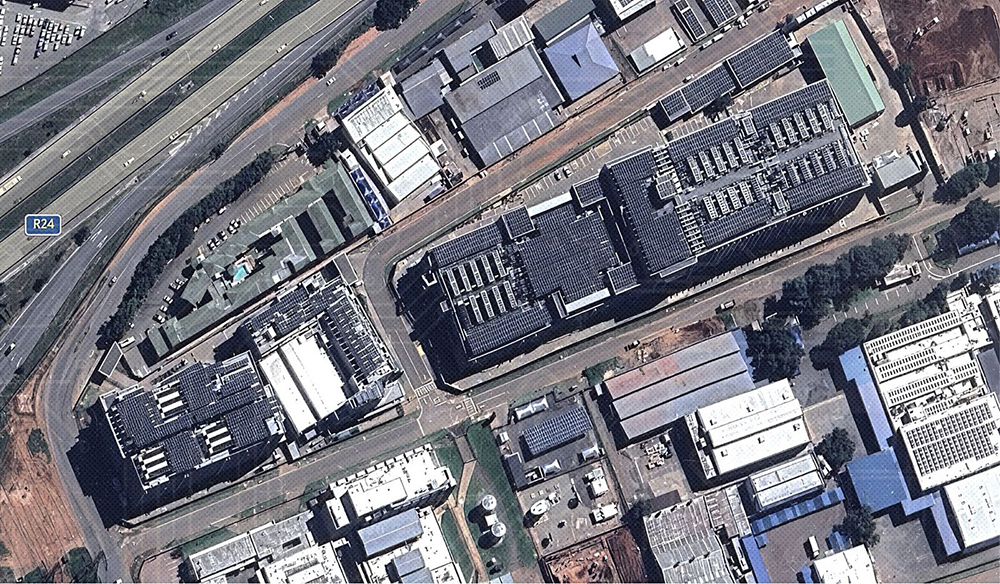
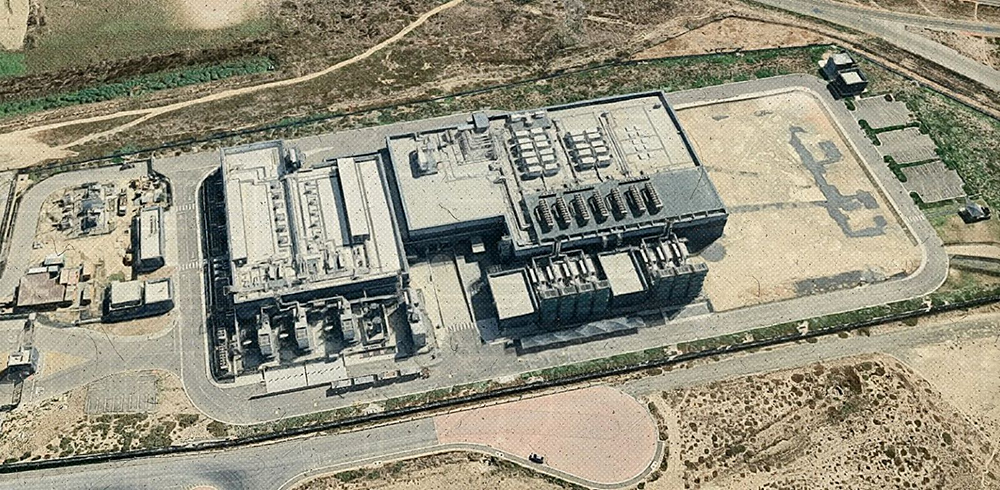
Drive past the nondescript, high-security compounds in Isando or Brackenfell, and you wouldn’t guess that inside, the air is freezing, the noise is minimal, and the money is printing faster than a national mint in a debt crisis.
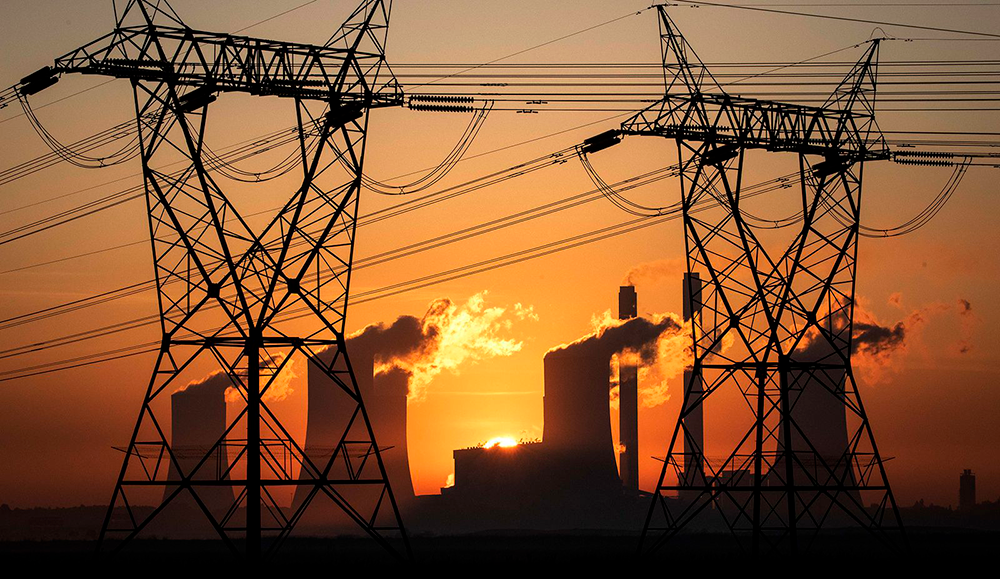
While the average South African factory and ferrochrome smelter is begging Eskom for scraps of power, these data centres have, effectively, privatised their own slice of the national grid.
AWS started the direct investment in renewable energy trend with a 10MW solar plant near Kathu in the Northern Cape in 2021, powering their Cape Town operations. Teraco upped the ante by building a 120MW solar PV facility in Free State, while other companies chose long-term power purchase agreements.
Vantage Data Centers secured 87MW for Waterfall City from SolarAfrica, while Africa Data Centres (ADC) broke ground on a 12MW solar farm near Bloemfontein with Distributed Power Africa to cover the 6MW expansion on its CPT1 site in Cape Town and future Johannesburg sites.
City of Cape Town spokesperson Luthando Tyhalibongo has confirmed the metro supports wheeling arrangements for such “high-energy consumers to offload demand from the local grid.”
But while data centre operators tout solar credentials through these wheeling deals and on-site solar – rooftop solar is not sufficient to meet the demand of these power-hungry, silent factories. Instead, those panels atop the physical buildings are relegated to aircon, electric fence and interior lighting duty.
The immediate backup to keep the chatbots chatting is fossil fuel. And with the rise of AI, the power thirst is becoming unquenchable.
“Data centres are no longer just a technology story – they are an energy story,” NJ Ayuk, of African Energy Chamber fame, was quick to point out in a recent press release framing how these AI factories are reshaping Africa’s energy landscape.
There is even serious talk of nuclear. Dr Yves Guenon, chairman of the French South African Chamber of Commerce and Industry, explained how this burgeoning industry is stretching global nuclear capacity thin.
“International investors are hunting for clean, reliable electrons… Solar plus battery storage simply cannot guarantee for 24/7 AI training clusters.”
In the meantime, to guarantee the 99.999% uptime sold to clients, operators rely on vast fleets of diesel generators.
Cutting environmental corners
There is only one publicly available National Environmental Management Act (Nema) filing that reveals how data centre operators sometimes use Section 24G rectification as a way to legalise expansions made without prior environmental authorisation. ADC made the mistake at their Midrand campus on Old Pretoria Road.
The unfortunate poster child for data centre rules skirting
The original ADC infrastructure dates back to before Nema’s requirements. However, as the facility expanded, adding more diesel generators and fuel storage to keep up with increasing demand and reliability standards, these upgrades triggered environmental listing notices that weren’t authorised at the time.
The situation escalated in 2021 when ADC installed four additional 2.5MW generators, pushing their total backup power capacity over the 10MW threshold. This crossed the line set by Listing Notice 1, Activity 37, requiring environmental authorisation for such activities.
Realising this, ADC submitted a Section 24G application to retroactively legalise their expanded operations. The process comes with an administrative fine (potentially up to R5-million under the Nema amendments) though the exact amount paid is rarely disclosed publicly.
This case highlights a regulatory mismatch with the realities of South Africa’s unstable grid.
Data centres often start with modest backup power and fuel storage, but as load shedding worsens and uptime demands rise, incremental upgrades push them over compliance thresholds.
Many operators only discover their non-compliance after the fact, prompting Section 24G applications to regularise their operations and avoid delays to critical infrastructure.
Tyhalibongo confirms that the high volumes of diesel required for backup power trigger mandatory Environmental Authorisations from the National Department of Environmental Affairs, before any storage.
Skipping this step to rush a facility online is a gamble operators may be willing to take, choosing to pay the fine later rather than delay the “go-live” date.
A City whistleblower brought the ADC CPT1 campus expansion in Diep River, Cape Town, to Daily Maverick’s attention. There are no updated plans for the additional cooling infrastructure and backup generators on record.
In response to the concerns regarding the ADC CPT1 campus expansion, Africa Data Centres confirmed that the project followed all required regulatory processes. The company stated that the 6MW expansion was authorised under an Environmental Authorisation (EA) granted on 2 March 2020 (Ref: 16/3/3/1/A6/21/2040/19), which specifically includes the additional backup generators and storage tanks.
Building plans for the expansion were subsequently applied for in March 2022 and received official approval on 25 August 2022 (Approval No: 97617445), with construction commencing shortly thereafter in September 2022. Consequently, ADC said, no Section 24G application was necessary, as all work was performed under pre-existing approvals rather than retrospectively.
The algorithmic displacement
The most uncomfortable question is what these buildings do to the South African worker. Proponents argue they are GDP multipliers. “If we can guarantee that they will have electricity… they will create job[s] not in nuclear, they create job[s] in the data centre,” argues Guenon.
But walk into a modern data centre and you will be struck by how empty it is. Once the construction crews from WBHO or Stefanutti Stocks leave, the facility runs on automation. Remote services allow a technician in Seattle to reboot a server in Cape Town without a local engineer ever touching it.
The real threat, however, isn’t inside the data centre, it’s what comes out of it.
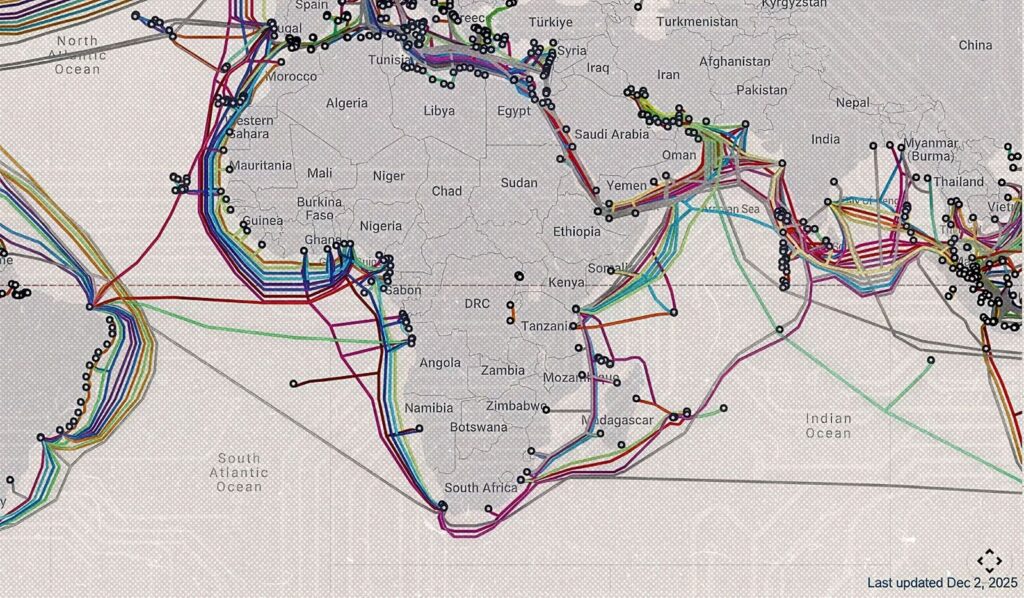
South Africa has successfully positioned itself as the digital gateway to Africa. The subsea cables landing all along our coastline have plugged us into the global main vein. The investment numbers are intoxicating for a government desperate for good news.
Apart from land-based data centres, the global flow of information is also supported by an extensive network of submarine data cables stretching across the world. (Source: submarinecablemap.com)
As one industry insider told us, it’s the perfect business. “The tenants never sleep, they never complain, and they never move out. You just have to keep feeding the beast.” T
he question is whether we are the masters of this beast, or just its food source.
Like with most things, it’s a real estate play
To understand who benefits, you first have to understand the business model. Companies like Teraco (majority-owned by US giant Digital Realty), Vantage Data Centres, and ADC are not really ICT companies. They are specialised landlords.
The industry jargon is colocation. In English: they build a fortress, secure a massive grid connection from Eskom (or the City), install military-grade cooling, and then rent out white space to whoever can pay.
Metropol bylaws – specifically in the City of Cape Town – inadvertently confirm this unglamorous reality. Tyhalibongo gave a written response to Daily Maverick, explaining that the city classifies these hi-tech facilities merely as business premises or even warehouses; “buildings used primarily for the storage of goods”.
Whether those goods are pallets of car parts or endless racks processing petabytes of data, the zoning logic is the same. This regulatory loophole allows these power-hungry giants to spring up anywhere a warehouse is permitted, from heavy industrial zones to the urban development edge, often bordering residential areas.
But the real estate market is not confined to rent per square metre. There are markets built on top of the assets in the power arbitrage and the ecosystem.
AWS Data Centre Interior. (Image: AWS)
“We are in the business of providing space and power,” ADC CEO Adil El Youssefi said in response to Daily Maverick questions about the underlying business model following the announcement of thousands of Nvidia chips coming to the continent in ADC facilities.
The Cassava Technologies subsidiary operates as the continent’s largest network of interconnected, neutral facilities, effectively serving as the infrastructure backbone for Africa’s digital economy.
But the Nvidia deal shifts the goalposts of neutrality somewhat for the data centre provider, with the related incentive to sell hardware capacity as a service.
But as AI demands soar, that model is shifting. His big boss, Strive Masiyiwa (chairman of Cassava Technologies, which is ADC’s holding company), calls the new breed of facilities “AI Factories” (to be fair, Nvidia CEO Jensen Huang started calling them that last year).
“It costs a lot of money to buy a GPU and it takes more than a GPU to build an AI factory,” Masiyiwa said when announcing the new deals with Nvidia, Google and OpenAI on the opening morning of Africa Tech Festival 2025. “We have to build cooling systems of the type we haven’t seen before.”
While traditional property yields struggle, data centre investors are eyeing internal rates of return (IRR) of between 25% and 40%. Digital Reality’s 2022 purchase of Teraco was priced so high that it implies a tiny annual yield of just 3.5%. Decoded into normal English, it means the market doesn’t see Teraco as a simple landlord, but as a dominant, utility-like monopoly that is essential to the economy – like Eskom.
So, who gets rich?
If you check your pension statement, the answer might be you, but only slightly. The lion’s share is heading offshore.
The market has two main players. On one end, you have the hyperscalers like Amazon Web Services (AWS), Microsoft (the Azure cloud business, to be exact), and Google. They build their own cloud compute regions, or, as is more frequently the case, lease massive halls. On the other hand, you have operators like Teraco and Vantage.
Teraco, the dominant player, is 55% owned by Digital Realty, a New York-listed Real Estate Investment Trust (REIT) valued at over $40-billion. When you pay your cloud subscription, a fraction of that flows back to Manhattan.
Local capital is desperate for a slice of the pie. With South Africa’s traditional infrastructure (rail and ports) collapsing, data centres have emerged as one of the few investable infrastructure asset classes left.
The latest evidence of this shift came at the end of January, when the Competition Commission recommended the unconditional approval of Stanlib Infrastructure Fund II’s acquisition of a major stake in Cassava’s Africa Data Centres. The deal sees Stanlib, a heavyweight in local asset management, taking joint control of the South African operations of the ADC network, with the option of full control in the future.
“Our base case is that we never sell,” Louw explained.
Pension funds are pouring billions into these concrete boxes because they view them as modern toll roads. Just as Sanral collects fees for every truck on the N1, these funds collect rent for every bit of data passing through the big grey buildings. They are banking on what Louw described as a “hockey stick growth curve” that will eventually flatten out into a steady, utility-like dividend yield.
The only problem is that nobody knows exactly where on that curve we currently are.
This article was made possible in part through support from the Henry Nxumalo Foundation.
‘Considering how much data is stored in data centres, it is ironic how little data there is available about how they operate.’ — former Imperial College London researcher David Mytton, February 2021.
Electricity and water are two of South Africa’s most vital – and increasingly scarce – public resources. For good reason, their use is subject to strict regulation in terms of the National Water Act and the Electricity Regulation Act.
So any potential threats to the country’s water and energy security need to be considered seriously and subjected to wide public scrutiny and transparency.
And yet, several municipalities, Eskom and some government departments appear reluctant to play open cards in releasing information about the volumes of power and water demanded by current and planned data centres at the heart of the digital and Artificial Intelligence revolution.
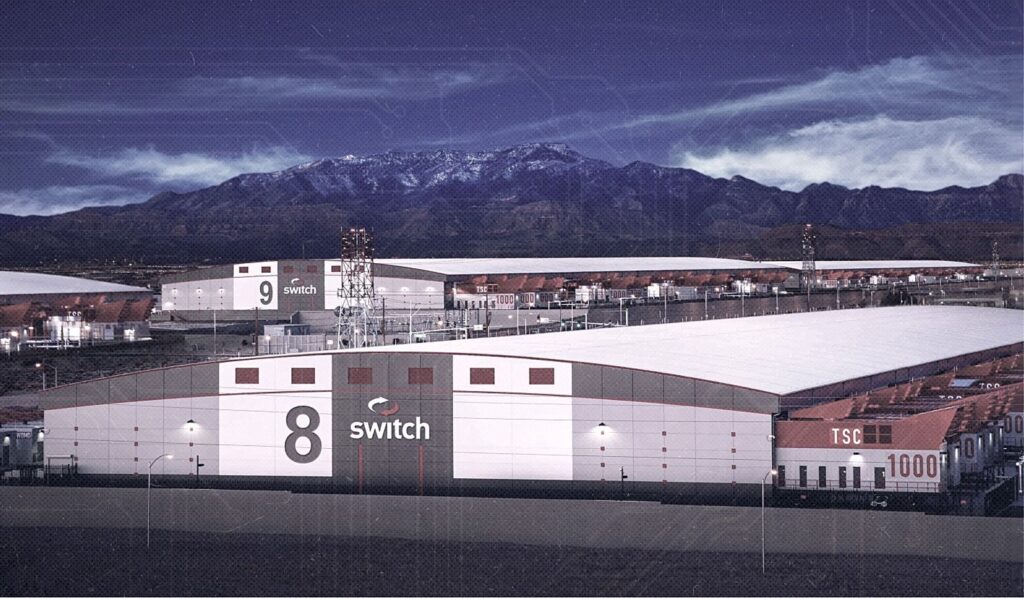
Security staff monitor operations inside a major data centre in Nevada, US. (Image: Switch)
As we have shown in this investigation, data centres have become a significant consumer of both power and water at a global level (In parts of the United States, data centres suck away up to 25% of electricity at a state level. More than 20% of Ireland’s electricity and 7% of Singapore’s power are needed to fuel these energy-intensive data hubs).
Though current power and water demand from local data centres still appears to be low in comparison to bigger global players, no official statistics are readily available at a national or local level in South Africa – apart from the self-reported information provided by some (but not all) data centre companies in their annual sustainability reports.
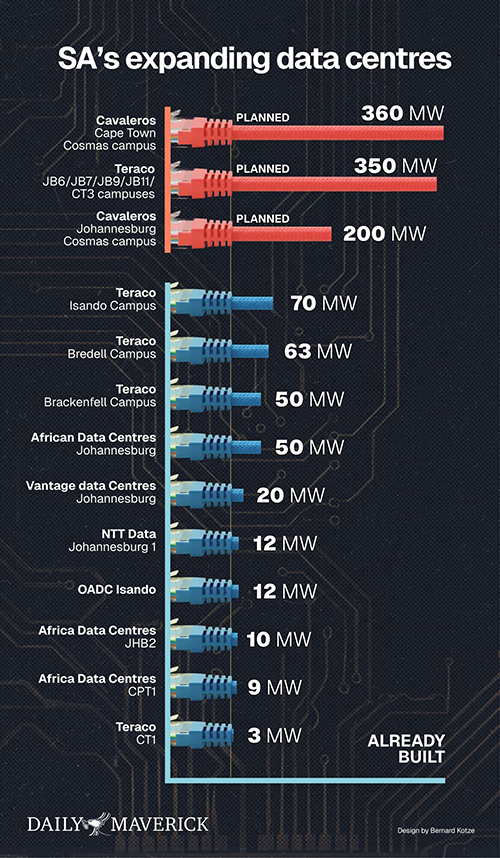
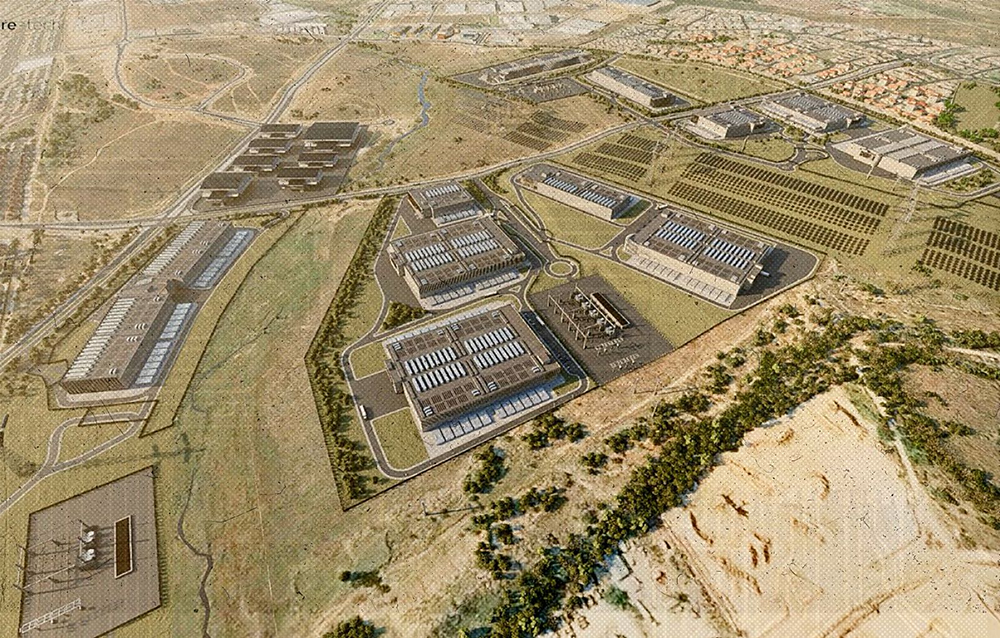
Our Power Guzzlers series has also highlighted plans by at least two companies to significantly expand or build new data capacity in Johannesburg and Cape Town, cities that have both experienced the economic and social trauma of water stress and load shedding over recent years.
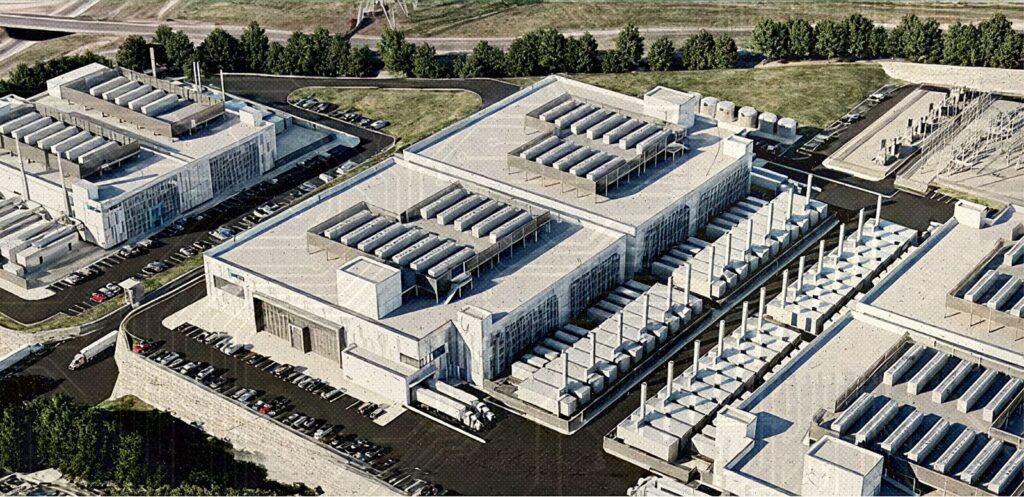
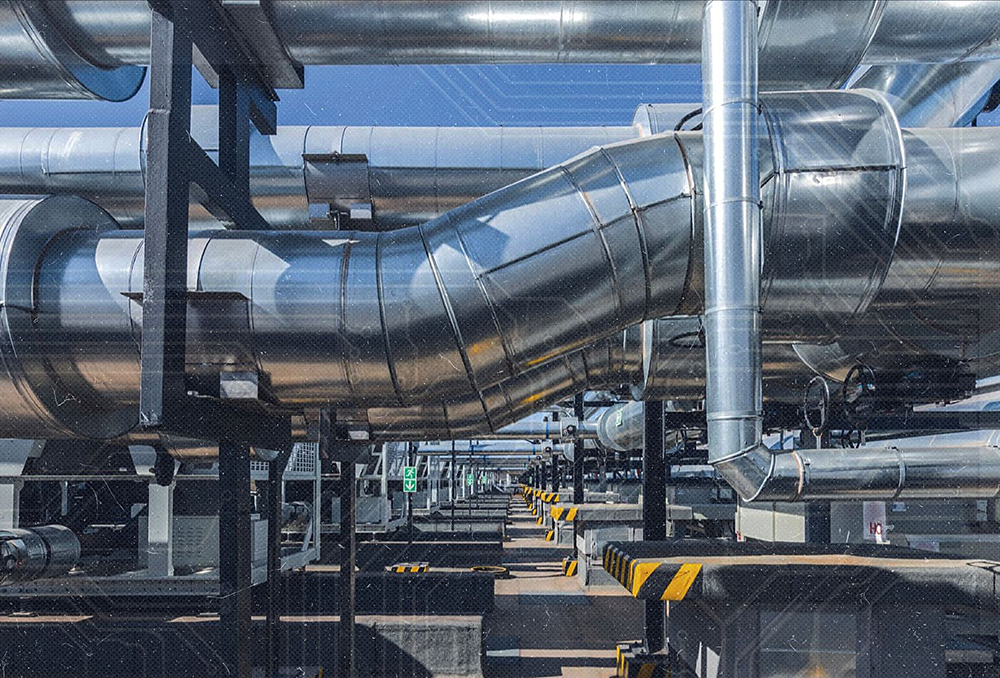
Part of the extensive network of water- and air-cooling pipes on the roof of the Teraco JB4 data centre campus in Isando, Johannesburg. (Image: Teraco)
Hoping to get a better understanding about power and water consumption at a more local level, Daily Maverick journalists began sending questions to Eskom and several municipalities in July 2025.
Six months later, however, most of our questions remained unanswered – ignored, evaded or blocked on the basis that such information is “confidential” in terms of the Protection of Personal Information Act (Popia) – even though water and most electricity supplies are public resources.
Eskomdid not provide us with any data on current and predicted electricity use by data centres, simply noting that it was “closely monitoring both global and local developments in the data centre industry, including the anticipated increase in energy demand driven by advancements in Artificial Intelligence”.
“While specific volumes cannot be quantified at this stage, these trends are being carefully considered and integrated into Eskom’s long-term system planning to ensure that the national grid remains reliable, flexible and well positioned to support future economic growth.”
Power demand from data centres was being accommodated from existing generation and network capacity, and the utility was “engaging with industry stakeholders to ensure this growth is effectively planned for and integrated into the broader electricity system”.
In response to follow-up questions, Eskom said it was “unable to provide any customer-specific information”
“In terms of the Protection of Personal Information Act, Eskom is legally obligated to protect the personal information of its customers and may not disclose identifiable data to third parties, including the media. While we remain committed to transparency, we cannot release information that may compromise customer privacy or the integrity and security of the electricity supply system.”
Part of the giant 650 MW ‘Citadel’ data centre in Nevada, US. (Image: Switch)
At a municipal level, we received either no, or mostly incomplete answers.
The City of Johannesburg and the City of Ekurhuleni, while acknowledging our questions, have provided no responses whatsoever since 31 July and 18 November, respectively.
The City of Tshwane provided a 2025 spreadsheet of water meter readings for five (unnamed) commercial properties in the city, but refused to provide any data on electricity consumption on the basis that this was “private customer data”. Releasing this data without the explicit consent of the account holders would amount to a breach of their privacy, it believed.
“For each of the identified data centres, the city undertook the necessary network upgrades to support their connection needs. The most notable intervention was the upgrade of the Kosmosdal A Substation to accommodate the NTT Johannesburg 1 Data Centre in Centurion,” a spokesperson said.
“The city follows a comprehensive planning model that evaluates current capacity, analyses consumption trends, forecasts future growth, and increasingly incorporates the impact of alternative and embedded generation sources on the network.”
On water use, the city said: “Our review does not show unusual consumption patterns, although some accounts reflect high usage consistent with commercial activity.”
Several data centre operators, including the Vantage group, are planning expansion or new centres across South Africa. (Image: Vantage website)
The City of Cape Town seems to be adopting a more cautious approach towards wooing more data centres.
Noting that the city’s energy directorate “may not comment on any customer information or business plans”, a spokesperson indicated that Cape Town was reviewing current investment incentive schemes for data centres.
“When the City’s Investment Facilitation Branch (IFB) and Energy teams meet with new prospective data centres, we encourage them to look for sites where there is sufficient electricity supply. This allows existing investments to be maximised, while ensuring the connection to the load can be done in the shortest possible time.
“Our Investment Incentives Policy is currently under review and going forward the revised policy does not provide any financial support specifically for data centres. However, our IFB remains ready to support businesses in bringing data centres to Cape Town while maintaining the highest sustainable standards.”
The Ethekwini municipality did not provide any information on the cumulative volumes of water or electricity used by data centres in Durban, even after Daily Maverick submitted a formal application in terms of the Promotion of Access to Information Act (Paia). That refusal is now under appeal.
The City said it was unable to provide answers because it did not keep records of data centres operating in the city and did not measure the collective consumption of these facilities.
However, the City acknowledged that “This is an area that requires further research, including understanding electricity demand and other potential impacts, to inform future policy development.”
Similar barriers to obtaining information on data centres have also emerged in the United States and elsewhere – including special incentive schemes and non-disclosure agreements between municipalities and data companies.
One example was the The Dalles city council in Oregon, which tried to sue a local newspaper to prevent the release of information on how much water was provided by the city to a large Google data centre. It argued that this was a “trade secret”.
However, The Dalles city council later agreed to release the data and abandon a 13-month legal fight to keep this information secret. The Oregonian newspaper said the affair raised questions about governments’ willingness to defer to large companies on matters of transparency and major public interest.
Apart from land-based data centres, the global flow of information is also supported by an extensive network of submarine data cables stretching across the world. (Source: submarinecablemap.com)
Back in South Africa, the Department of Water and Sanitation said it could not provide any information on purified water use by data centres because municipalities were responsible for supplying potable water for domestic and industrial use.
However, data centres could also apply to the department for (raw) water use licenses.
“The Department has received two water use license applications, in the Western Cape and Johannesburg areas, for raw water for their cooling systems. Information from both applications indicate a combined demand of about 5,000 m3/annum.
“The water is sourced from groundwater resources (boreholes). Based on the information from the two applications, the conclusion we draw is that the demand for data centres is relatively small and it is authorised by way of a General Authorisation, which deals with low-risk economic activities. The applicants make use of highly efficient cooling systems, mindful of the fact that South Africa is a water-scarce country.”
“Based on the existing water demand, the Department is of the view that their increased water demand will be met without negatively impacting the existing groundwater resources.”
Electricity and Energy Minister Kgosientsho Ramokgopa was asked what specific plans were in place to ensure that further growth of data centres did not threaten power supply to the national grid. He said most data centres were embedded within the legal jurisdiction of licensed electricity distribution entities, which were responsible for such power supply.
“ Self-generation is also permissible in law and is subject to jurisdictional rules.”
Asked to provide data on cumulative power volumes supplied to data centres, a spokesperson said the national Electricity and Energy Department developed policies for the sector, but queries on “operational matters” should be directed to municipalities or Eskom.
On the risk of power price increases, the minister said affordability was an issue that affected all users and the government “has plans in place to ensure sufficient supply of electricity and to meet projected demand”. DM
* Additional reporting by Lindsey Scheepers, Julia Evans, Kristin Engel and Ethan van Diemen
This article was made possible in part through support from the Henry Nxumalo Foundation.
The hidden impacts of AI data centres on water, climate and future power costs
Data centres have a gargantuan appetite for electrical power. But many also consume large volumes of water and generate substantial carbon emissions. Are the full environmental and financial costs being adequately measured or controlled?
To protect computer chips and other sensitive equipment from overheating, large volumes of water and cold air are pumped through data centres across the world.
But the water used for cooling purposes is just one part of a bigger story.
Unless they are powered by low-carbon or renewable energy sources, data centres indirectly use even larger volumes of water during the process of coal mining and burning fossil fuels to generate power.
Yet, at both a global and South African level, there is still relatively little information available about the full impacts of the data centre explosion on the world’s diminishing freshwater resources or human-driven climate change.
Powerlines lead from Eskom’s Lethabo coal-fired power station in the Free State on 13 April 2023. (Photo: EPA / Kim Ludbrook)
Former Imperial College London researcher David Mytton reported in 2021 that data centres used relatively little water in the US compared with farming, power generation and other uses. However, less than a third of data centre operators were even measuring water consumption at that time, and the sector has since expanded rapidly.
More crucially, says Mytton, it is essential to measure and monitor the full water demand on a location-specific scale – especially with hyperscale projects such as the xAI “Colossus” data centre in Memphis.
A more recent report by the US-based Environmental and Energy Study Institute notes that the water consumption of about 5,426 data centres in the US is already affecting local communities.
Northern Virginia, considered the world capital for data centres, has more than 300 operational data centres, collectively consuming nearly 7.5 billion litres of water in 2023, a 63% increase from 2019.
Water pours from the Vaal Dam in Gauteng during a controlled release in April 2025. Concern is growing about the impact of data centres on water security. (Image: Department of Water and Sanitation)
The institute suggests that some of the larger data centres can consume up to 19 million litres per day, equivalent to the water use of a town of 10,000 to 50,000 people.
One example comes from the town of Bessemer in Alabama, site of a proposed hyperscale data centre. Inside Climate News reported last year that it could consume more than seven million litres of water per day – equivalent to a third of the available water supplied by the local water utility company.
Water use by a Google data centre in The Dalles, Oregon, has nearly tripled in the past five years, and the company’s data centres are now reported to consume more than a quarter of all the water used in this city.
Officials at the International Monetary Fund believe electricity use by the global data centre sector already equals that of Germany or France (see graph), suggesting that indirect water use by the sector is even more substantial.
Electricity consumption by data centres in the United States is climbing rapidly. (Source: 2024 United States Data Center Energy Usage Report)
Where does the water go?
The International Energy Agency (IEA) estimates that the total water consumption of data centres in 2023 was about 560 billion litres. Of this, roughly two-thirds (373 billion litres) was due to indirect water consumption (energy generation) and only a quarter (140 billion litres) from direct consumption (mainly for cooling data centres). The remainder of the water (about 8%) was used in the manufacture of computer chips and other hardware.
In his study – based on sustainability reports from major tech companies, scientific data on carbon emissions and water use per kilowatt-hour of electricity – De Vries-Gao concluded that previous water consumption estimates by the IEA significantly underestimate indirect water use by data centres and is probably a factor of three to four higher than the official estimate.
He also says that several major tech companies currently do not publish AI-specific figures on the energy and water use of their systems. Therefore, stricter reporting requirements are needed to ensure full transparency.
Similar concerns over transparency have been raised by Alyse Coakley, a policy research assistant at Tulane University in Louisiana. This was partly because water consumption within data centres is often reported using the Water Use Effectiveness metric, often excluding the much larger volumes from electricity generation.
Part of the extensive network of water- and air-cooling pipes on the roof of the Teraco JB4 data centre campus in Isando, Johannesburg. (Image: Teraco)
Yet sections of the AI and data sector industry have sought to play down such impacts and also resist moves towards tougher monitoring and regulation.
Last year, OpenAI chief Sam Altman asserted that the average ChatGPT query uses the equivalent of one-fifteenth of a teaspoon of water – in sharp contrast to research cited in a Washington Post investigation that generating a 100-word email with GPT-4 required water equivalent to “a little more than one bottle”.
Responding to pressure from European Commission regulators to tighten control on data centres, a major industry group has also criticised plans for new minimum performance standards to conserve energy and water.
The Climate Neutral Data Centre Pact argues that the new standards would focus mainly on the largest operators, excluding smaller facilities. Another industry body, Cloud Infrastructure Service Providers in Europe, recently warned the commission that “burdensome” water use regulations might push operators into other regions.
Closer to home, several South African based data centres are also facing closer scrutiny over their increasing consumption of both water and electricity.
While coal mining and power generation consumed about 7% of water at a national level in 2013, the impacts are more pronounced at a local level. In 2018, power accounted for up to 37% of water use in the Upper Olifants catchment and the largest share of water in the coal-rich Waterberg region.
More nukes, price hikes and ‘beautiful’ coal
An International Monetary Fund working paper last year suggests that electricity prices in the US alone could rise by 8.6% if companies do not adopt renewable sources to power their data centres. Carbon emissions from AI-driven data centre growth could also lead to a 5.5% rise in US carbon emissions over the next five years.
However, any significant switch to renewable energy – in the US at any rate – seems unlikely given that President Donald Trump has signed an executive order titled “Reinvigorating America’s Beautiful Clean Coal Industry” and a second order to “streamline” permit approvals for big data centres.
When it comes to powering data centres, coal-burning is ‘beautiful’, according to Donald Trump. (Source: The White House)
These pressures from corporate America and other developed nations are likely to ripple outwards into the Global South, according to Lydia Powell and Akhilesh Sati, researchers at the Observer Research Foundation in New Delhi.
Powell and Sati doubt that AI will create a utopian world that is wealthy, environmentally sustainable and equal – nor a converse scenario of a mostly poor, dirty and unequal world
“Companies, rather than countries, have a greater influence on locating data centres, as control of the data economy is almost entirely in private hands.”
Due to increasing pressure to reduce carbon emissions, they suggest data centre expansion could lead to a new form of “climatalogical imperialism” in which developing countries provide the Global North with more land, energy and greenhouse gas emission space to support the data economy.
Researchers from the International Monetary Fund and other groups project that electricity consumption by data centres could equal the current power use of large countries such as Russia by 2030. (Source: IMF)
They note that the Paris Treaty climate goals require halving data centre emissions by 2030, implying a more aggressive shift to low-emission power.
But renewable energy supplies from wind and solar were intermittent and could not always match real-time peak demand of data centres. As a result, the growth of data centres could lead to a lock-in of fossil fuels – or the re-emergence of nuclear energy as a “clean” power source.
They further note that nearly 60% of the electricity supply in Virginia – home to the largest concentration of data centres in the world – is derived from natural gas, and 30% from nuclear power.
“The development of data centres and AI services is shifting influence on critical decision-making on issues such as the choice of energy source from countries to corporations,” they caution, noting that nuclear energy is emerging as a more dependable energy source for some data centres in the US.
“In the US alone, big tech companies have signed new contracts for more than 10GW of possible new nuclear capacity in 2024, and Goldman Sachs sees potential for three plants to be brought online by 2030.” DM
Next: Clouds of secrecy. Why such silence and evasion over the water and electricity impacts of SA data centre growth?
This article was made possible in part through support from the Henry Nxumalo Foundation.
Major SA data centre expansion plans emerge, set to more than double current power demand
South Africa is on the cusp of a hyperscale data-centre boom that could add another 1,000 MW to national electricity demand, driven by massive expansion plans from Teraco and newcomer Cavaleros, alongside Microsoft’s growing cloud and AI footprint.
Just over the past few months, plans for significant “hyperscale” expansion projects in South Africa have emerged that would push current IT power load to well over 1,200 MW – which is equivalent to just over one stage of Eskom load shedding (1,000 MW).
The two biggest expansion projects on the cards involve the Teraco Group (currently the largest data centre provider in SA with an IT load of nearly 190 MW) and the Johannesburg newcomer, the Cavaleros Group.
Whereas Teraco is a colocation operator (renting out data centre space to about 670 customers), the new Cosmas Data City project by Cavaleros is believed to be linked mainly to the Microsoft Corporation, which recently announced a multibillion-rand investment to expand its cloud and AI infrastructure in SA.
In a joint announcement by President Cyril Ramaphosa and Microsoft President Brad Smith, the US multinational confirmed a further investment of R5.4-billion (in addition to its previous investment of R20.4-billion over the past three years) to establish SA’s first “enterprise- grade” data centres in Johannesburg and Cape Town.
President Cyril Ramaphosa and Microsoft President Brad Smith announce a multi-billion investment AI and cloud expansion project in SA in March 2025. (Image: Microsoft)
However, neither Cavaleros or Microsoft would confirm (or deny) whether they had entered a business relationship to develop the two Cosmas Data City developments – by far the biggest data centres in SA and Africa.
A spokesperson for Cavaleros said: “All information relating to occupiers or users is subject to strict non-disclosure agreements,” while Microsoft’s local PR consultants said: “Microsoft does not typically share details about its data centre suppliers and vendors and does not have any new updates to share at this stage.”
Cavaleros said the two new centres would be built in phases, but did not provide any timelines on commencement or completion schedules.
An artistic impression of the giant 200 MW Cosmas Data City project proposed to be built in the Samrand area north of Johannesburg by the Cavaleros property group. (Image: Cavaleros Group)
Meanwhile, a Teraco document listing current capacities and future expansion plans suggests that the company is targeting 500 MW in total data centre capacity. This would include 290 MW of new capacity in Johannesburg and a further 60 MW in Cape Town, but no timelines have been given.
Other players hoping to expand include Vantage Data Centres, which aim to provide a 100 MW load at two data campuses in Johannesburg.
Whereas the current and future expansion plans in SA may seem like small beer when compared with mega projects like Elon Musk’s 2 000 MW “Colossus” AI data centre in Tennessee, US, local energy analyst Chris Yelland points out that they are “not insignificant” – given the risk of possible supply constraints outlined in a recent Eskom energy outlook report.
A satellite image of Teraco’s data centre campus near the OR Tambo Airport in Johannesburg, currently the largest cluster in South Africa. (Image: Google Earth)
Yelland, managing director of EE Business Intelligence, told Daily Maverick that – based on Eskom’s latest risk analysis report – increasing power demand from new large data centres (combined with a possible rollout of electric vehicle charging stations and government subsidies for mothballed metal smelters) would probably lead to constrained electricity supplies by 2029 unless substantial generation capacity was added rapidly.
In a separate analysis piece in Daily Maverick late last year, Yelland said Eskom had also cautioned about a “looming base supply cliff” due to the retirement of certain coal-fired power stations and the expiry of power imports from the Cahora Bassa Scheme. The Eskom power fleet’s energy availability factor (EAF) also remained critical.
Daily Maverick has asked Eskom to provide statistics on current and projected data centre power consumption, without success.
So, in the absence of transparent Eskom statistics and other government sources, the IT peak loads advertised by some data centres gives some indication of their local power use.
A data centre in Ashburn, Virginia, US, where housing developments will soon be walled in by data centres, exemplify the tensions over their unfettered growth. (Photo: Charles A Fazio / Bloomberg via Getty Images)
However, IT loads may not be an accurate yardstick to measure actual electricity consumption by data centres. Researchers at the Lawrence Berkeley National Laboratory in the US note that data centre servers rarely draw the full wattage for which they are rated on specification sheets.
In a report on US Data Center Energy Usage in 2024, Berkeley Lab scientist Dr Arman Shehabi and fellow laboratory researcher called for much greater transparency around data centres.
“Very few companies report actual data centre electricity use and virtually none report it in context of IT characteristics such as compute capacities, average system configurations and workload types. These details are often considered proprietary …”
The IT loads reported by some local data centres also do not appear to take into account the electricity consumed for cooling and other uses. Depending on cooling mechanisms used, this additional electricity use can eclipse the apparent IT load.
How are centres managing growing power and water demand?
In response to questions from Daily Maverick, Cavaleros marketing manager Mikaela Potgieter said electricity supply and detailed power procurement structures were “commercially sensitive and therefore cannot be publicly disclosed”.
On whether it would draw power from Eskom alone or generate its own power (including renewable energy) Potgieter said: “Any planned additional supply will be regulated, and detailed configurations are not publicly disclosed.”
On whether carbon emissions from the two new Cosmas data sites had been estimated, Cavaleros said: “Environmental considerations are addressed through standard regulatory approval processes.”
Regarding direct and indirect water consumption of the two new centres, the company said water systems would be “designed in line with applicable industry standards and regulatory requirements. Further details are subject to strict non-disclosure agreements.”
Teraco, currently the largest data centre operator in SA, appears to have adopted a much more transparent approach.
Teraco, currently the largest data centre operator in South Africa, has several campuses in Johannesburg, Cape Town and Durban. (Source: Teraco)
For example, in its latest sustainability report, Teraco provides detailed statistics on total energy consumption over the past four years, along with estimated greenhouse gas emissions and the percentage of renewable or “clean” energy used to offset carbon emissions and power consumption from the national grid.
The company has begun construction of a 120 MW solar PV project in the Free State and also signed a power purchase agreement to source additional renewable wind energy supplies.
Teraco asserts that it is using “zero water” and closed loop cooling systems to reduce water consumption, but nevertheless reports using more than 34,000 kl during the 2025 reporting period (88% of which came from municipal supplies and the remainder from boreholes and rainwater).
“We are firmly on track to supply 50% of our total energy consumption from clean sources by 2027 and achieve 100% clean energy usage by 2035.
“By monitoring and tracking our water usage, our data centres maintain a low water usage effectiveness (WUE) ratio, using only 0.10 L/kWh in 2023, which is less than half a cup of water per IT kWh.
The company adds that: “We are investing massively to reach our targeted goal of 100% renewable energy by 2035 (considering that SA has a national utility that is largely 85% fossil-fuel-based).”
A satellite image of the Amazon Web Services (AWS) data centre in Atlantic Drive, near Dunoon, Cape Town. (Source: Google Maps)
African Data Centres (which has centres in Johannesburg, Cape Town, Lagos and Nairobi) says it is “committed to achieving carbon neutrality/net zero by 2030 and maximising renewable energy for our pan-African data centre network”.
It has also signed a 12MW power purchase agreement that would increase renewable (wind) energy to over 33% of its South African energy mix through wheeling electricity to three of its local data centres. DM
Growth spurt of data centres could threaten SA’s electricity and water supply
Hype and hope are running high with the spread of artificial intelligence. But is South Africa paying sufficient attention to the risk of a potentially explosive demand for electricity and water by the multitude of data centres at the heart of the AI behemoth?
There are roughly 12,000 data centres scattered around the world, quietly hoovering up huge volumes of electricity, water and mineral resources.
These data centres are the engine rooms of the global IT revolution — cavernous warehouses that house powerful computer servers and networking equipment that store and process the digital data torrent flowing through a multitude of banks, company offices, websites, email and social media platforms.
So far, they only consume around 1.5% of electricity at a global level. But the demand is growing rapidly across the world — an issue that has special relevance for a country still in recovery mode from the social and economic nightmare of load shedding (as well as frequent municipal water supply failures in Johannesburg, Durban and other areas).
Staff monitor data operations from a control room in the massive Citadel data centre in Reno, Nevada. (Image: Switch)
In a recent report titled Energy and AI, the International Energy Agency (IEA) forecasts that data centres are likely to consume more than 4.4% of global electricity supply within the next decade.
That may not sound like a big deal — but viewing global-scale statistics in isolation dilutes the true impacts at a country, city or local dorpie level.
There are also six states in the US where data centres use more than 10% of the electricity supply, with Virginia leading at 25%. In Singapore, more than 7% of national electricity supplies are consumed by data centres.
A chart of global data centre distribution emphasises the dominance of the US. (Source: Visual Capitalist / World Economic Forum)
One of the main reasons for this rapid increase in data centre power and water consumption is the global deployment of AI, which includes applications such as ChatGPT. The IEA says AI-focused data centres are getting much bigger to accommodate increasingly larger models and the growing public demand for AI services.
Whereas the power drawn from a conventional data centre may be around 10-25 megawatts (MW), the larger AI-focused data centres can draw 100MW or more. One example is The Citadel, a hyperscale facility in Nevada, US, that has been designed to draw up to 650MW of power — equivalent to more than 40% of Durban’s current electricity demand.
This Amazon Web Services data centre is one of more than 300 operational data centres in Virginia, US, that collectively consumed nearly 7.5 billion litres of water in 2023, a 63% increase from 2019. (Photo: Lexi Critchett / Bloomberg via Getty Images)
An even bigger 2,000MW centre (aptly named Colossus) is under construction in Memphis, Tennessee, by Elon Musk’s xAI group.
The IEA notes that large data centres can consume as much electricity as 100,000 households.
“The largest currently under construction could consume as much as two million households,” says the IEA.
Little surprise then that some very senior power utility executives in the US and elsewhere are worried about meeting surging demand.
“It’s like you’re driving your car, the ‘check engine’ light is on, and you just don’t want to take it into the shop,” he told Fortune magazine. “I’m telling you on that hottest day or that coldest day, you might have a supply crunch, and people are going to suffer. I’m telling you, you have to fix it now.”
Currently, the largest data centres are in the US, Europe and China, but demand is also rising fast in the developing world. India’s total installed data centre capacity has doubled in only four years, now consuming electricity volumes equivalent to 6.5 million Indian households.
While the US state of Virginia is the global hub for data centres, these energy-hungry facilities are spreading fast across the world. (Source: IEA 2025)
What about South Africa?
Though power consumption from South African-based data centres appears to be relatively low in comparison to the developed world, Eskom and several municipalities have refused to provide Daily Maverick with electricity consumption statistics by local data centres, asserting that the disclosure of such information is prohibited in terms of the Protection of Personal Information Act or that statistics are not available.
Nevertheless, five Teraco data centres in Johannesburg alone have a combined IT power load of more than 130MW (greater than the municipal power demand of a small city such as Mbombela or Kimberley).
Similar concerns about a potential South African resource crunch were raised in a recent opinion piece published by the National Science and Technology Forum. In the opinion piece, Legal Resources Centre attorney Saadiyah Kadwa and candidate attorney Aaron Tifflin note that the latest digital revolution may come with hidden costs.
“All the personal data we generate — every click, message and photo — is stored not in some abstract cloud, but in physical facilities. Despite its fluffy-sounding name, the cloud is not floating somewhere in the sky. It refers to a network of remote servers and infrastructure, maintained by tech giants, that allows data to be accessed over the internet.
“These cloud services are underpinned by physical data centres, which are massive facilities that house the servers, chips and networking equipment required to store and process digital information.”
A typical interior view of a data centre. Because electrical heat generation is so high, further large volumes of electricity and water are needed to keep them cool. (Image: Switch)
And as data centres expand, the electrical demand and other environmental trade-offs remain ill-explored, say Kadwa and Tifflin.
“As the country positions itself as a player in the global AI economy, we must ask: at what cost? Technological advancement must go hand-in-hand with transparency, accountability, and responsible stewardship of our natural resources.” DM