The fence that isn’t: Wildlife, disease and neglect on the SA-Eswatini border

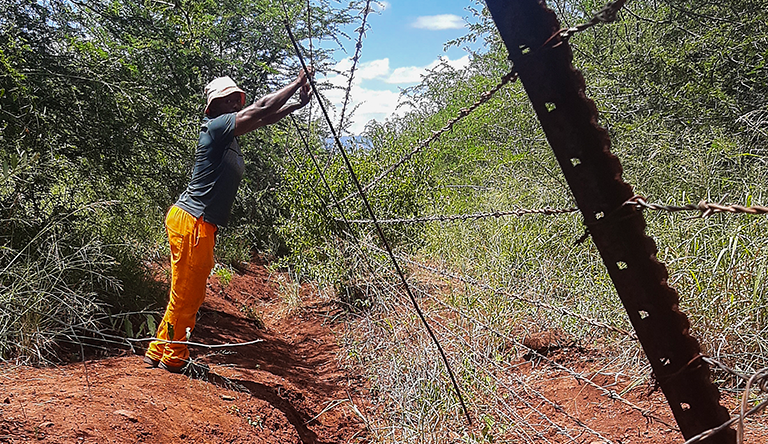
Senzo Dlamini holds the collapsing Eswatini-South Africa international boundary fence at Lavumisa in the southern Shiselweni Region. Photo: Vuyisile Hlatshwayo/SAAJP

Senzo Dlamini holds the collapsing Eswatini-South Africa international boundary fence at Lavumisa in the southern Shiselweni Region . Pic: Vuyisile Hlatshwayo/SAAJP

A cross-border human-wildlife conflict along the southern Eswatini–South Africa border is exacting a heavy toll on rural communities on the Eswatini side – yet authorities continue to neglect the crisis. 

At the centre of the problem is Harloo Private Reserve, a wildlife and hunting reserve situated in the Pongola area of South Africa’s KwaZulu-Natal proving, which uses a veterinary cordon fence as its game fence. Harloo borders Chibini, Mgampondo and Vuvu settlements under the Lavumisa chiefdom in southern Eswatini. 

Wildlife escaping through or under the barrier has led to persistent crop raids and livestock losses, deepening food insecurity, poverty, and the risk of foot-and-mouth disease (FMD) outbreaks in neighbouring Eswatini communities.

The veterinary cordon fence was constructed during the colonial era to control the spread of animal diseases by limiting livestock movement between the two countries. Archived records from 1960s agreements on Swaziland territorial boundaries, reviewed by this reporter, confirm that the fence primarily served disease-control purposes, while also marking the international boundary.

Dr Thembi Ndlangamandla, national focal person for the FMD Unit in Eswatini’s Ministry of Agriculture, confirms that these historical arrangements remain in force. Under a shared-responsibility agreement, South Africa is tasked with constructing and maintaining the fence, while Eswatini is responsible for patrolling it.

“South Africa is tasked with the construction and maintenance of the border fence from Lavumisa westwards to Hebron, while Eswatini must patrol this stretch of land,” she explains.

However, an investigation by this reporter, supported by the Southern Africa Accountability Journalism Project (SA/AJP), revealed that this arrangement largely exists only on paper.

Harloo Private Reserve appears to be in contravention of the Animal Diseases Act (No. 35 of 1984) by altering and using the international boundary fence as a game fence. Section 18(1)(a) of the Act empowers only the director-general of agriculture to erect, alter, or use such a fence to control the movement of livestock and wildlife.

Subsection 7(a) further states that no person may, without written authority from the director-general, remove, alter, or impair the effectiveness of any such fence. Subsection 8 stipulates that any fence erected along international boundaries is deemed to have been established for controlled purposes under the Act.

By repurposing the boundary fence, Harloo Private Reserve has rendered it ineffective for disease control. Wildlife incursions into Lavumisa communities continue unabated, intensifying cross-border human-wildlife conflict and increasing the risk of FMD outbreaks in Eswatini. Bush pigs, jackals and hyenas – linked to crop destruction and livestock losses – have established a presence in the Lavumisa–Nquthu forests along the border.

Manzini-based veterinarian Dr Isaac Magagula explains that bush pigs, which come into contact with buffaloes – the primary carriers of FMD – can transmit the disease to livestock. Hyenas and jackals, although not cloven-hoofed, may contract the virus by feeding on infected carcasses.

“These wild animals must be contained within a secure reserve using a game-proof fence,” Magagula said.

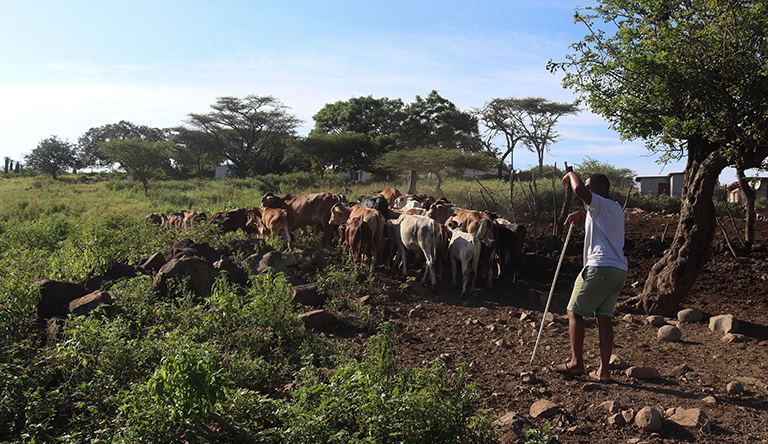
A Mbhamali family member in the Somntongo community in Lavumisa, Eswatini south, tending to the calves which have been separated from the cows to protect them from wild animals that have escaped from Harloo Game Reserve.
Photo: Mefika Ndlangamandla/SAAJP
A Mbhamali family member in the Somntongo community in Lavumisa, Eswatini south, tending to the calves which have been separated from the cows to protect them from wild animals that have escaped from Harloo Game Reserve. Photo Mefika Ndlangamandla/SAAJP

Ndlangamandla added that cattle from the Lavumisa–Hluthi subregion tested positive for the Southern African Territories (SAT 2) strain of FMD, which is endemic to the Pongola area across the border from Harloo Private Reserve.

“We tested many dip tanks in Lavumisa during the outbreak. The first infected animal was detected in this subregion,” she said – evidence, she argued, of the fence’s failure as a disease-control measure.

Somntongo MP Sandile Nxumalo believes the source of infection is clear: wildlife escaping from Harloo Private Reserve in KwaZulu-Natal, an FMD hotspot. He questions why Eswatini’s agriculture minister has not engaged South African authorities over the altered and ineffective boundary fence.

“Our agriculture minister hasn’t visited the area to identify the gaps used by wildlife crossing into Lavumisa. He hasn’t raised the issue of the private reserve as a source of FMD – yet he knows South Africa is the epicentre,” Nxumalo said.

Field visits by this reporter confirmed that Harloo Private Reserve uses the international boundary fence as its game fence. Accompanied by local guides Senzo Dlamini, Thokozani Mbhamali and Thembinkosi Gina, observations revealed a horizontal barbed-wire fence, supplemented only by two strands of electric wire. It lacks the high-tensile structure and jackal-proof netting required to prevent animals from burrowing underneath.

Yet the Ezemvelo KwaZulu-Natal Wildlife fencing requirement for game reserves with buffaloes is a minimum of three strands of electrified fencing running on offsets off the main fencing facing inwards, with a minimum of 5,000 volts throughout the system – no cable or buffer fence required.

Somntongo resident Thokozani Mbhamali questions whether the fence is consistently electrified, citing ongoing incursions by bush pigs, jackals and hyenas.

“The owner only added two electric wires and extra barbed strands. The fence doesn’t stop bush pigs – their thick skin and fat protect them,” he said.

The reserve may also be contravening the Fencing Act (No. 31 of 1963), which recognises jackal-proof fencing as the standard for boundary fences. The law obliges landowners to upgrade inadequate fencing to prevent predator movement.

In addition, Section 17(1) requires landowners to clear vegetation up to 1,524m on either side of the fence line. At Harloo, bushes remain overgrown, obscuring the fence and providing cover for wildlife and illegal hunters.

On human protection, the Ezemvelo KwaZulu-Natal Wildlife fencing guidelines emphasise the need for the protection of people living on the outskirts of game reserves with dangerous game to mitigate human-wildlife conflict. 

When asked to comment on the written authority of Harloo Private Reserve to use the international boundary fence and compliance with the provincial guidelines, Ezemvelo KZN Wildlife manager: communications, Musa Mntambo, declined to comment but advised this reporter to forward his questions to Rudzani Mudau, national co-ordinator for the Lubombo Transfrontier Conservation Area,  because the matter involves an international boundary. 

Efforts to get comment from Mudau on whether the Harloo Private Reserve has written authority to use the international boundary as its game fence remained unanswered by the time of publication.

The Principal Secretary in the Eswatini Ministry of Agriculture, Sydney Simelane, criticises the reserve’s fencing practices, noting the absence of a double-fence system with a buffer zone.

“The owner should have constructed a double fence with a passage between them to prevent animals from crossing directly. This is a serious issue – it is causing hunger and undermining food security for emaSwati trying to improve their livelihoods,” said Simelane.

As government response stalls, affected communities say they feel helpless. In Chibini, Senzo Dlamini showed patches of maize destroyed by bush pigs, pointing to freshly trampled stalks and stripped cobs.

“One wonders whether there will be enough food for my family, given these daily losses. I fear guarding my fields at night,” he said.

Thokozani Mbhamali echoed this distress, describing heavy livestock losses. “I’ve lost 11 calves. Now I separate them from their mothers when grazing. This is devastating – livestock is our food and income,” he said.

Siphiwe Gina, a member of the now-abandoned Phakamani Bomake Community Garden, says women in the area stopped farming after repeated crop raids.

“We used to grow vegetables and maize to feed our families and pay school fees. But the destruction became so frequent it no longer made sense to continue,” she said, gesturing at the overgrown garden.

Efforts by Somntongo MPs Sandile Nxumalo and Dumisani Mbhamali to raise the issue in the 10th and 11th Parliaments have yielded no results.

Interviews with the Minister of Agriculture, Mandla Tshawuka, and Principal Secretary Simelane reveal contradictory positions.

The minister claimed ignorance: “Diplomatic issues are handled through the ministry of foreign affairs. We’ve raised issues like porous fences and livestock theft – but crop raids by South African wildlife have not reached my office,” he said.

Simelane, however, acknowledged awareness, but cited diplomatic constraints.

“We know wildlife from Harloo crosses into Lavumisa and destroys crops and livestock. But this requires engagement through diplomatic channels, which is a slow process,” he said.

Shiselweni regional administrator, Themba Masuku, a former deputy prime minister and United Nations  diplomat, disagrees with the ministry of agriculture’s decision to follow diplomatic channels, because the wild invasions do not only destroy livelihoods but also the economy. He argues that it is wrong to prioritise wildlife over the citizens.

“The country cannot depend on diplomacy when the wildlife poses a serious threat to food security. EmaSwati have a duty to protect the country from wild animals spreading diseases such as FMD, which originates from across the border, destroying our economy. We can’t let our people die of hunger because of the diplomatic ties with Pretoria. We must look for medium to long-term mitigation strategies to the wildlife invasion,” he said.

As bureaucratic delays persist, communities living along the altered boundary fence continue to bear the brunt of the crisis.

MP Nxumalo attributes the situation to a failure of leadership. “The reserve owner is responsible for significant damage, but he operates within a vacuum of leadership. We are facing a leadership crisis,” he said.

Xolile Shongwe, conservation secretary at Eswatini’s Big Game Park National Wildlife Authority, maintains that reserves using boundary fences must ensure they are properly maintained and game-proof.

“It is in the interest of any reserve to keep its fence in good condition—to prevent losses and respect neighbouring communities,” she said.

Attempts to get comment from Harloo Private Reserve owner, Edmond Rouillard, proved futile as he failed to respond to questions emailed on February 9 2026, and a follow-up message on March 4 2026. He was given more than a month to give clarity on the game reserve’s boundary management, wildlife incursions, impact on livelihoods, community engagement and mitigation strategies. 

*This story first appeared in Inhlase

Special-needs kids face extra pay hurdle for schooling

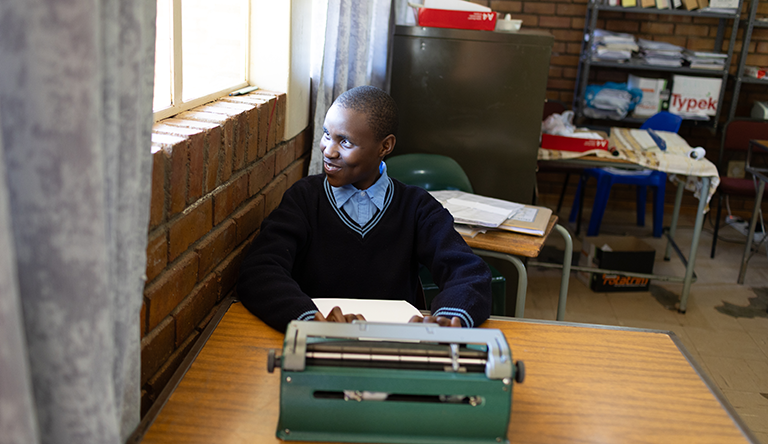
Angel Mashego attends class at the Bosele School for the Blind and Deaf, Monsterlus, Limpopo. Picture: Alaister Russell

Angel Mashego attends class at the Bosele School for the Blind and Deaf, Monsterlus, Limpopo. Picture: Alaister Russell

For many disabled children in South Africa, access to education comes at a price their able-bodied peers do not have to pay.

Public schooling is meant to be free for children in poor communities. Yet the families of children who are blind, deaf or with different disabilities are often forced to spend money on transport, boarding and sometimes school fees to secure a place in a special-needs school.

Because these schools are scarce, many children have ato travel long distances or live in hostels far from home.

Basic education spokesperson Lukhanyo Vanqa said quintile-based funding, which designates certain schools as “no-fee” schools, did not include special- needs schools because their funding depended on the nature of disabilities rather than catchment-area poverty.

But Vanqa said the department acknowledged that these schools had “systemic” issues — which he did not identify — that the directorate of inclusive education was addressing.

Sarah Masuku, from Ekukhanyeni (Kwaggafontein), Mpumalanga, pays for her two blind children’s schooling with their grant money, meaning there is less income available for the household.

“My husband and I are unemployed,” she said. “We have nine children, and the two youngest are blind. Only one of my children does piece jobs as a domestic worker, and she can only buy us sugar or mealie meal. The rest are unemployed. So, we all depend on the two disability grants.”

Masuku says covering school costs for her children has been a burden.

“With the one who just completed matric, we were paying R4,000 per year, or R1,000 per term. The one at Silindokuhle [a special school in eMangweni, Mpumalanga] costs R2,800 per year, and we have to buy 30 rolls of toilet paper, 10 tubes of toothpaste, snacks, 3kg washing powder and provisions. I struggled to pay the R2,800.”

For families living on disability grants, even small fees can become unaffordable. A disability grant was R2,315 a month until this week, when it rose to R2,400. It is intended to help families meet the additional costs of caring for these children — not to pay for access to schooling.

Yet in many cases the grant becomes the only way families can cover the costs of boarding, transport or school fees.

Data collected from special schools showed boarding fees range from about R2,500 to as much as R38,000 a year, depending on the province. Day schooling is sometimes free, but at least one special school surveyed charged day-school fees of up to R17,000 annually.

In some cases, children travel more than 400km to access a suitable school. Even within provinces, journeys can exceed 100km, making daily commuting impossible.

Sometimes, pupils with disabilities have to relocate to neighbouring provinces. This places additional financial pressure on families.

Angel Mashego, 16, and her sister, Princess, 15, attend Bosele School for the Blind and Deaf in Monsterlus, Limpopo, due to a shortage of special schools in Belkop, Mpumalanga, where they live. They travel two hours every term to the school, which charges R2,500 a year.

Angel and Princess Mashego pose for a portrait before the start of the school day at Bosele School for the Blind and Deaf, Monsterlus, Limpopo. Pic: Alaister Russell/SAAJP
Angel and Princess Mashego pose for a portrait before the start of the school day at Bosele School for the Blind and Deaf, Monsterlus, Limpopo. Photo: Alaister Russell/SAAJP

During holidays at home, the sisters live in a mud house with their mother Florence Mdluli, who is partially blind, and their grandmother Martha Mvuleni, who is totally blind.

“We sleep on the floor. When it rains, it comes inside. Our house is falling apart. We eat in the morning and at night only. During the day there is no food. We want a decent home, food, and clothes,” said Angel.

“We wear old clothes given by our aunt. Our uniform is not in good condition.

Our grandmother and mother are not working. If there are no leftovers, we will not eat in the morning. Recently, a wall nearly fell on my mother at midnight, but we managed to save her.”

For many families, the cost of education competes directly with basic survival.

Martha Mvuleni, who is blind, in her room at her home in Belkop Farm, near Mashishing, formerly known as Lydenburg, Mpumalanga. Mvuleni’s granddaughters, Princess and Angel Mashego, attend the Bosele School for the Blind and Deaf in Monsterlus, Limpopo. Pic: Alaister Russell/SAAJP
Martha Mvuleni, who is blind, in her room at her home in Belkop Farm, near Mashishing, formerly known as Lydenburg, Mpumalanga. Mvuleni’s granddaughters, Princess and Angel Mashego, attend the Bosele School for the Blind and Deaf in Monsterlus, Limpopo. Photo: Alaister Russell/SAAJP

The Social Assistance Act says children receiving care dependency grants should not be cared for on a 24-hour basis in state-funded institutions for periods exceeding six months. Yet many pupils with disabilities remain in boarding facilities for extended periods because there are no schools closer to their homes.

The UN Committee on Economic, Social & Cultural Rights states that education should be physically accessible at a reasonably convenient location, such as a neighbourhood school — a standard that is often not met for children with disabilities in South Africa.

Civil society organisations that advocate for the right of poor children to free, quality education are concerned.

“We are worried that children with disabilities have to live in school hostels, away from their families and communities,” said Anjuli Maistry of the Equal Education Law Centre.

“All children, regardless of ability, should be able to access education close to home, and in many cases being unable to do so amounts to differential treatment that could be discriminatory. Compounding this differential treatment is the fact that the parents are forced to pay fees and hostel fees, regardless of their socioeconomic background.”

Jabulane Blose, the CEO of the South African National Deaf Association, said charging children with disabilities puts them at a “structural disadvantage from the outset” and “entrenches inequality in access to basic education”.

“Many families of children with disabilities already face significantly higher costs related to disability-specific needs, including transport, assistive technologies, therapy, and communication support,” he said.

Nomahlubi Khwinana, commissioner for the South African Human Rights Commission, said the necessity for families to use disability grants to pay for basic education “may raise important constitutional concerns”.

“Should a formal complaint or further information be submitted, the commission would be in a better position to assess whether the practice has the effect of unfairly burdening learners with disabilities and their families.”

Fannie Mashapu, president of the South African National Association for Special Education, said parents of children with disabilities do not send their children to boarding schools by choice.

“We therefore believe the hostel costs must be borne by government,” he said.

Vanqa agreed that it was not appropriate for children to stay in boarding schools for months. “The declaration of special schools depends heavily on a funding policy that will apply uniformly. If a school is provided with all the

resources in the policy, such a school can then be declared as no-fee. The system does not have a funding policy for special schools,” he said.

Vanqa said “parents have the right to decide if the school can charge fees” but did not clarify how these decisions were made in practice.

“In some provinces, the government does cover or subsidise transport or boarding costs for learners, particularly those who live far from schools or face financial challenges. However, this support is not consistent across all provinces. In other areas, it may be limited or not available at all due to differences in funding, policies, and implementation. As a result, while such assistance does exist, it is not universally provided and can be relatively rare in certain regions.”

Vicky Abraham is an investigative journalist for Diary Series of Deaf People (www.thedeafdiary.com). This story first appeared in Sunday Times.

Weak enforcement fuels rise in unlicensed dog breeding in Zimbabwe

A worker at the Friend Animal Foundation with a pack of dogs, most of them abandoned and mistreated by the owners in Tynwald ,Harare, Zimbabwe. The foundation takes care of abandoned and illegally bred dogs. Photograph: Aaron Ufumeli/SAAJP

A worker at the Friend Animal Foundation with a pack of dogs, most of them abandoned and mistreated by the owners in Tynwald ,Harare, Zimbabwe. The foundation takes care of abandoned and illegally bred dogs. Photograph:  Aaron Ufumeli/SAAJP

As night falls in Zengeza, a suburb near Harare, groups of large dogs roam the streets. They scavenge at dumpsites and only return to their owners’ yards at dawn.

“We live in constant fear of the dogs because they have become a threat to the community and the responsible authorities are not taking action,” said Shiela Muganhu, 47, a resident. 

“We fear attacks and the health of our children, because we have heard of attacks around the country, and we always fear for the worst.”

It is only a matter of time, residents say, before there is a serious attack.  

Nationally, in Zimbabwe, dog bite cases have become a pressing public health concern. 

According to the Ministry of Health and Child Care’s Weekly Disease Surveillance Report for the week ending 04 January 2026, 619 dog bite cases occurred in just that one week across the country.

In only about one in five of those cases could the Ministry establish that the implicated dogs were vaccinated against disease. More often, the ministry established that the dogs were not vaccinated at all. Still, the vaccination status of more than half of the dogs inflicting these bites could not be established.

The number for that week is not atypical. In late 2025, statistics from an earlier version of the same government report showed that Zimbabwe recorded on average around 500 dog bite cases per week. Through 2025, three of these bites led to fatalities.

In July last year, Chrispen Chikadaya, a senior inspector with Zimbabwe National Society for the Prevention of Cruelty to Animals (ZNSPCA) told NewsDay that illegal backyard breeding of dangerous dog breeds was helping drive the crisis.

“Because of economic challenges, people are now doing illegal breeding of dogs as a source of making money. So we find that now we have a lot of what we call backyard breeders who are bringing what they call special breeds. Some are species from South Africa and they breed those and the population of dogs is now increasing,” Chikadaya said.

Interviews with dog breeders and animal welfare inspectors suggest that unlicensed dog breeding continues to expand in Zimbabwe, particularly in urban areas.

Because there is little enforcement of the rules meant to reign in reckless dog breeding, animal welfare inspectors fear that dog bites might become a continuous threat for people living in dense urban areas.

Breeding without licences

Thomas (which is not his real name) is a 35-year-old illegal Boerboel breeder. Because what he is doing is illegal, he agreed to speak only on condition that his real identity be concealed.

He keeps five boerboels at his home. He says he produces around 60 puppies a year. He confirmed he does not hold a breeding licence and exceeds the maximum number of dogs typically permitted per residential property under municipal by-laws.

“It all started as a hobby,” he said. 

“But, after I acquired a dog from a friend, people started to ask about the breed. (They were interested in the dogs,) mainly for security reasons, with a rise in burglaries and violent crimes. Since then, the number of my customers who need dogs has grown. My prices for the puppies range from $200 to $1,000, depending on the size of the puppies.”

Thomas acknowledged that he operates outside municipal rules. He also said that enforcement can be avoided through bribery. Though did not provide documentary evidence of this claim, when asked.

Other breeders interviewed described dog breeding as a viable source of income. One said he could earn up to $2,000 in a good month. Some breeders exchange and trade puppies in lieu of payment for mating services. They coordinate through social media and online messaging platforms, including Facebook, WhatsApp and other social media. 

Enforcement challenges

In July 2025, following a tip-off, the SPCA in Harare removed eight dogs, including rottweilers, from a breeder in Southerton.

“These female dogs (collectively) were capable of producing at least 100 puppies per year, and we got a tip off from an informer,” said Kudzai Chatikobo, an SPCA inspector. 

“The dogs were sick and underfed. They were kept in inhumane conditions, confined to small cages. This is against city by-laws. The case proceeded to court and the dogs were taken by SPCA for rehabilitation and rehoming.”

Animal welfare groups say such cases are difficult to pursue consistently.

The daily operation of dog inspectors from Veterinarians for Animal Welfare Zimbabwe (VAWZ) is always dangerous, sometimes dealing with armed people, and well-connected groups, said Bernard Ndlovu, a VAWZ inspector. 

He said inspectors can assist city and law enforcement officers but do not have independent powers to enforce by-laws.

Mel Wood, the Chief Animal Welfare Officer at VAWZ, described instances where suspected breeders appeared to have prior warning of inspections.

“At one time, in Harare, we went to a certain location, where someone was engaged in illegal dog breeding,” Wood said. 

“On arrival, we were surprised to hear that the owner knew we were coming, and it seems he got a tip-off from someone in authority, since nothing happened to him.”

Wood said such incidents raise concerns about enforcement effectiveness, though no official findings of wrongdoing have been made public.

In another case in 2025, SPCA inspectors were preparing to act against a breeder when the individual allegedly left the country before the raid, abandoning six dogs, according to Chatikobo.

Responsible breeders

Not all breeders operate outside the law. According to the Zimbabwe Herd Book, dog breeding requires licensing with local municipal authorities and compliance with vaccination and property standards.

Joseph Tichagwa, who breeds American bulldogs and American bullies, said he complies with all local regulations.

“Dogs are kept in separate yards to ensure we abide by the city by-laws of maximum numbers of dogs per yard, making it easy to manage the dogs ensuring they get adequate care and avoid kennel accidents.

“To avoid inbreeding, we have quite a number of dogs of different genealogy which ensures that we can have a breeding program for at least five years without repeat breeding, and each female getting enough rest.”

Another breeder, who goes by Mhondoro Dzembwa, has spoken publicly about dog breeding online: 

“The main purpose of dog breeding is to improve and maintain the breed standard and to avoid some breeds going extinct, to provide security and companionship. We don’t crossbreed, we just select good parents to breed, with the right genes we need.”

On enforcement, he said: 

“Currently, there are no serious, or strict laws that prevent dog breeders, it is being done illegally, more like vending. There is a need for the government to amend the existing by-laws, which restrict people from keeping dogs on smaller plots, and make them conducive and allow people to engage in dog breeding, and to operate openly.”

Peter Nyaundi, another dog breeder concurs with Mhondoro Dzembwa. “There is a lack of awareness on the legalizing of keeping of dogs and dog breeding in Zimbabwe. There has also been a lack of support structure in legalising and maintaining the legality of dog breeding, in respect of registration, inspection, documentation and enforcement of laws.”    

Animal welfare officials say overbreeding and poor conditions can lead to neglect and abandonment, contributing to stray dog populations. However, official statistics do not disaggregate stray dogs from owned dogs in bite data.

For now, residents in areas such as Zengeza say they want stronger oversight and clearer enforcement.

As dog breeding continues to operate both within and outside the law, animal welfare groups argue that the core issue may lie less in the existence of by-laws and more in their consistent enforcement.

*This report has been produced by the Southern Africa Accountability Journalism Project (SA | AJP), an initiative of the Henry Nxumalo Foundation with the financial assistance of the European Union. It can under no circumstances be regarded as reflecting the position of the European Union.

Bribery racket targets Zimbabwe’s nursing school hopefuls

One of the hospitals mentioned in claims that aspirant nurses are being scammed into paying for training places.

One of the hospitals mentioned in claims that aspirant nurses are being scammed into paying for training places.

Liliosa Jakata sold four cattle that were the only assets she owned after people claiming to be political intermediaries told her that they could – for a fee – secure nursing training places for her daughters.

The 46-year-old single mother from Mupamaonde village in Masvingo province believed the payments would secure admission to a coveted nursing programme at Silveira Mission Hospital.

Instead, the money disappeared and her daughters were never enrolled.

Jakata’s experience is part of what interviews with other victims and insiders in Zimbabwe’s health sector suggest is a growing racket in which scamsters claim political connections and demand bribes from families desperate to secure nursing school placements. They prey on the public’s widely held belief that political influence can facilitate such placements.

In Zimbabwe, nursing qualifications are highly sought after. But, places are limited and competition is intense. Trainees also receive government stipends while the profession offers opportunities for employment abroad.

These pressures have created fertile ground for individuals claiming influence over recruitment processes.

Zimbabwe currently has 32 nurse and midwifery training institutions, according to the country’s National Health Strategy 2021-2025.

Recruitment system under scrutiny

In 2019 the government introduced the National Electronic Recruitment for General Nurse Training system in an effort to curb alleged corruption and improve transparency in nursing recruitment.

The system was discontinued in January 2022 after authorities said it disadvantaged applicants in remote areas with limited internet access.

Recruitment was subsequently decentralised to provinces and health institutions with quotas intended to ensure representation across districts. At least half of each intake is meant to come from local districts.

But a senior official at Mpilo Central Hospital in Bulawayo, told this reporter that informal arrangements and quotas may influence the process.

Speaking on condition of anonymity, the official described what he called a “confidential” recruitment structure operating alongside official procedures. He said that officials from the Ministry of Health, Ministry of State for Provincial Affairs and Devolution, chief medical officers and provincial medical directors all have allocation quotas accounting for nearly half the nursing college placements at Mpilo. 

The remaining quota is reserved for local recruits, although the source claimed political actors and security agencies sometimes submit names within that pool too.

“These instructions come boss-to-boss. You will never see official documents,” the source said.

When queried, the Ministry of Health and Child Care denied that such political allocations exist.

“The quota system is clear on how the candidates are selected,” ministry spokesperson Donald Mujiri said, adding that no informal allocations occur outside of that system.

A mother’s ordeal

Jakata’s case illustrates how some of the scamsters operate.

Her ordeal began in August 2024 when she visited Silveira Mission Hospital with a sick child and asked nurses about recruitment procedures. Her daughters had applied several times previously for nursing training without success.

During the conversation, Thomas Wasosa — then a student nurse — offered to help secure placements for the two girls.

Months later on 3 June 2025, Wasosa phoned Jakata claiming he had spoken to his “superiors” and that money was required to bribe officials who could fast-track the enrolment.

He referred her to Tapiwa Marongera, whom he presented as a senior official at the hospital.

Marongera demanded US$1,700 to secure placements for the daughters. The amount was later reduced to US$1,300 after it emerged that one daughter did not meet the mathematics requirement.

WhatsApp messages, EcoCash records and audio recordings show that Jakata transferred the money on 4 June 2025 after being told the payment would be shared among those involved.

Soon afterwards, Wasosa made contact again and told Jakata that mathematics had been dropped as a requirement and that both daughters now qualified. But another US$1,000 was required.

With no other source of income, Jakata sold her four cattle.

“I sold the four cattle I had to raise the money. Those were the only beasts I owned. Now I have nothing. All I wanted was a chance for my child,” she said.

The additional cash was delivered at Nyika Growth Point in Bikita district, she added.

Jakata’s daughter Alice was then instructed to travel to Harare to meet Wellington Mutisi, who allegedly promised to guide the process further. In November last year, the Masvingo Mirror identified Mutisi as a pro-Zanu PF activist who rubbed shoulders with the party’s elite and the national commissar for Varakashi 4ED, a loose network of pro-government activists who operate online. The report added that he? was wanted by police for his involvement in defrauding Jakata.

According to Jakata, Mutisi assured her that the placements had been secured before referring Alice to the office of the Minister of State for Provincial Affairs and Devolution in Masvingo.

It remains unclear whether the minister or his office had any knowledge of the alleged arrangement.

Alice said she travelled overnight and submitted application papers at the minister’s office where two officials reportedly received them.

Despite repeated assurances, neither daughter was called for interviews or enrolled in the September 2025 intake.

When Jakata demanded answers she was told the applications had been deferred to the January 2026 intake.

In a WhatsApp audio message, Marongera said:

“Mother, if you look at how I handled the issue from the beginning you will realise that I was showing commitment and love… But if the minister says he will take a certain number from the list and defer the rest to January, what was I supposed to do?”

Jakata later approached the nursing training office at Silveira Mission Hospital and was told Marongera, Wasosa and Mutisi had no role in recruitment.

Jakarta’s revelation led to Wasosa’s arrest.

Masvingo police spokesperson Inspector Kudakwashe Dhewa confirmed the case.

“The case is now before the Bikita Magistrates’ Court. One of the suspects, Tapiwa Marongera who is facing fraud charges is still on the run,” Dhewa said.

According to a response to queries from National Prosecuting Authority of Zimbabwe (NPAZ), Wasosa was placed on remand in October 2025 on fraud charges related to soliciting money under the pretext of facilitating nursing placements.

Investigations are continuing.

Marongera has not been formally charged because he could not be located. Police are also searching for another alleged accomplice, identified by the NPAZ as Mutisi William, but understood to refer to Wellington Mutisi.

When contacted, Mutisi denied involvement.

“The case is before the courts and we leave it there… You just want to tarnish my good reputation,” he said.

Other victims

Jakata’s experience is not isolated.

A teacher at Gwindingwi Secondary School in Bikita said she was approached by a Zanu-PF youth leader who promised to secure a nursing training place for her daughter through party connections.

He demanded US$1,300.

She paid US$450 in cash at Nyika Growth Point taxi rank but her daughter was never called for interviews.

Two other alleged victims initially agreed to tell their stories. But, they later declined to speak, citing fears that complaining could damage their chances of securing training places in the future.

Political recommendations

Evidence obtained during the investigation suggests political figures may play a role in recommending candidates for nursing training.

Bulawayo Central Member of Parliament Surrender Kapokikilu confirmed that he wrote a letter requesting “special consideration” for a nursing training applicant.

“MPs and local leadership are allowed to recommend. They have 10% in the quota system to ensure locals are not short changed,” Kapokikilu said via text message.

Responding to questions submitted via WhatsApp, Donald Mujiri, the Ministry of Health and Child Care’s spokesperson, denied the existence of any arrangement whereby specific quotas in nurse recruitment are allocated to political offices and senior officials.

Unanswered questions

Authorities say they are unaware of widespread bribery linked to nursing recruitment.

Responding to allegations that intermediaries are soliciting payments while claiming influence over recruitment decisions, the Ministry of Health and Child Care said no formal reports had been submitted.

The National Prosecuting Authority of Zimbabwe urged the public to avoid paying individuals who claim they can facilitate recruitment.

“Legitimate recruitment processes are conducted through official channels and do not require payments to private individuals,” said Kennedy Khombo NPAZ Deputy Director Corporate Affairs and Communications.

*This report first appeared in The Standard of Zimbabwe.

Landmark ruling: Eastern Cape health dept ordered to pay in cerebral palsy case

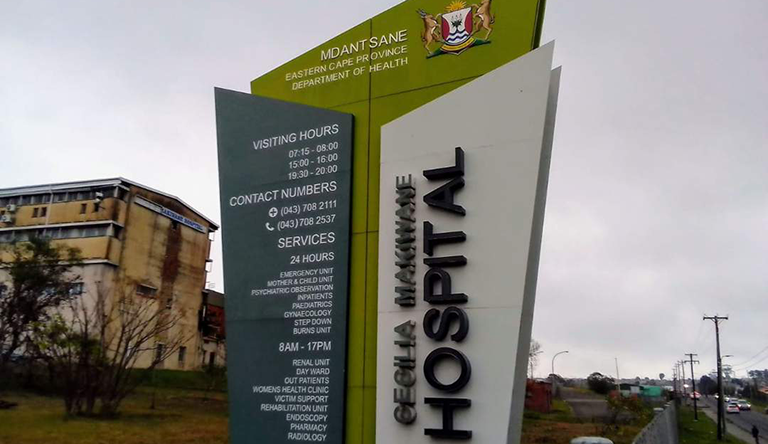
Mdantsane’s Cecilia Makiwane Hospital was found to be responsible and ordered to make a lump sum pay-out to the mother of a cerebral palsy child. Picture: Sithandiwe Velaphi/News24

An Eastern Cape mother has won her fight in the Supreme Court of Appeal (SCA) to force the provincial health department to pay her lump-sum damages for the Mdantsane’s Cecilia Makiwane Hospital’s (CMH) negligence, which resulted in her son being born with cerebral palsy.

The SCA ruling against Health MEC Ntandokazi Capa is a significant victory for all victims of labour and delivery negligence by healthcare workers, who seek lump-sum damages payouts.

The judgment will stand unless it is overturned on further appeal to the Constitutional Court, or if Parliament passes new laws regulating medico-legal negligence claims.

National Health Minister Aaron Motsoaledi and the eight other provincial health MECs joined Capa’s defence in the SCA as friends of the court to push the government’s strategy to curb payouts for negligence liability for cerebral palsy births, which ostensibly threaten the public health system’s sustainability.

The mother, identified only as TN in court papers, sought up to R23 million in lump-sum damages in the Bhisho High Court for herself and her son, identified as BN, for general and special damages, loss of earnings, and future medical care and services from private providers.

Due to the brain injury he suffered during birth, BN has spastic quadriplegic cerebral palsy, microcephaly (underdeveloped head and brain), intellectual impairment and epilepsy.

He is hearing and visually impaired and cannot speak, has a tube in his stomach for feeding, and is incontinent and will remain so for life. He has poor head control and is unable to sit, roll, crawl, stand or walk. He requires assistance with mobility (a hydraulic hoist, car safety chair and shower chair) and general daily living, such as bathing, dressing, general hygiene, eating and drinking, and he needs full-time caregivers.

Capa conceded in the High Court that the hospital’s healthcare workers had been negligent during TN’s labour.

But, pleading a “public healthcare defence” in lieu of paying lump-sum damages, she committed to treating BN in EC government health facilities, the same system responsible for his condition.

Capa also undertook to pay for medical services or supplies in the private sector if the department was unable to provide those in its own facilities.

In what was regarded as a key test case, the High Court developed the common law to allow Capa’s alternative compensation options, with Judge Rob Griffiths heeding government officials’ concerns that medical negligence compensation would cripple the public health sector, impeding the government’s constitutional obligation to provide basic healthcare services to all citizens who require them. 

The SCA has now set aside the “superficially attractive but unsound” order, finding that Griffiths had not considered the underlying reasons for the common law rule. Neither had he considered the wider consequences of a radical development of the law of damages and the creation of new remedies for damages, it found.

South African courts currently adjudicate personal injury claims similarly to other civil claims, under the common law, which relies on legal precedents established in prior court judgments.

This includes the common law rule of “once and for all”, which prohibits a multiplicity of lawsuits and requires a claimant to calculate and submit their damages, including their essential future medical expenses, in a single legal action.

The SCA noted in its judgment on Thursday that the common law practice ensured finality and fairness to both parties by protecting them against multiple, piecemeal actions for damages.

A litigant was neither subjected to “potentially endless, intermittent and indeterminate claims, which are difficult to plan for”, nor required to bring claims every time they sought to obtain part of the relief already granted by a court. 

Yet, the SCA said, that was precisely the effect the High Court’s order would have. If implemented, the public healthcare remedy would lead to disputes.

The MEC had been ordered to provide the child for the duration of his life, with all services, consultations, therapies, surgeries, supplies, supplements, medicines, devices and equipment at CMH or Frere hospital, or a public hospital nominated following consultations between the case managers. 

“A court will have to resolve on each occasion that a service, treatment, medication, device, or equipment becomes unavailable – for whatever reason – and a dispute arises”. 

The court would be called upon to decide whether the injury being treated or the medical supply sought resulted from the initial harm the child suffered; whether the medical service or supply was of a reasonable standard; whether the MEC failed to deliver the required service, medication or equipment; and whether that failure was wilful or negligent.

Similarly, in her undertaking to pay, the MEC was ordered to procure medical services and supplies in the private healthcare sector, to be provided timeously whenever it was required, in relation to daycare and permanent residential facilities, caregivers, washing machines and a private case manager. 

“Undoubtedly”, there would be disputes about whether the MEC had acted fairly, lawfully or reasonably, and whether medical services or supplies were required or rendered timeously. 

“What all of this shows is that open-ended remedies undermine finality, and repeated disputes increase legal costs. The result is continuous litigation and an increased burden on the parties and the court system. And courts could become long-term administrators of public healthcare, rather than adjudicators.”

The common law rule was “designed precisely to prevent these issues from ever arising”.

The SCA found that the common law rule – “a fundamental principle of the law of damages” – should not be changed by a court, but only by a legislature.

“So drastic a reform, in my view, should not be made by judges,” Judge Ashton Schippers wrote for the five-judge SCA Bench.

The SCA referred the case back to the High Court to determine the revised value of BN’s claim, which the Eastern Cape health department must pay.

BN’s future treatment includes consultations with neurologists, dentists, psychologists, physiotherapists, occupational therapists, orthopaedic specialists, dieticians, and speech therapists. Unsurprisingly, he will be unemployable.

While TN’s fight for justice in the SCA initially was an appeal against the Eastern Cape Health MEC, she found herself ranged against the national Minister of Health and all Health MECs, who had been admitted as friends of the court.

Her East London attorney, Siyabonga Booi, said: “We were against the whole South Africa”.

He added that the judgment had vindicated the work of negligence lawyers throughout the country who faced an uphill battle to assert their clients’ rights after the Bhisho judgment.

Eastern Cape health department head Rolene Wagner said officials had met with senior counsel about the SCA outcome and would issue a statement.

This story will be updated once the statement is received.

  • This article was produced with the support of the Henry Nxumalo Foundation.

The hidden impacts of AI data centres on water, climate and futurepower costs (Part 3/5)

The hidden impacts of AI data centres on water, climate and future power costs

Data centres have a gargantuan appetite for electrical power. But many also consume large volumes of water and generate substantial carbon emissions. Are the full environmental and financial costs being adequately measured or controlled?

To protect computer chips and other sensitive equipment from overheating, large volumes of water and cold air are pumped through data centres across the world.

But the water used for cooling purposes is just one part of a bigger story.

Unless they are powered by low-carbon or renewable energy sources, data centres indirectly use even larger volumes of water during the process of coal mining and burning fossil fuels to generate power.

Yet, at both a global and South African level, there is still relatively little information available about the full impacts of the data centre explosion on the world’s diminishing freshwater resources or human-driven climate change.

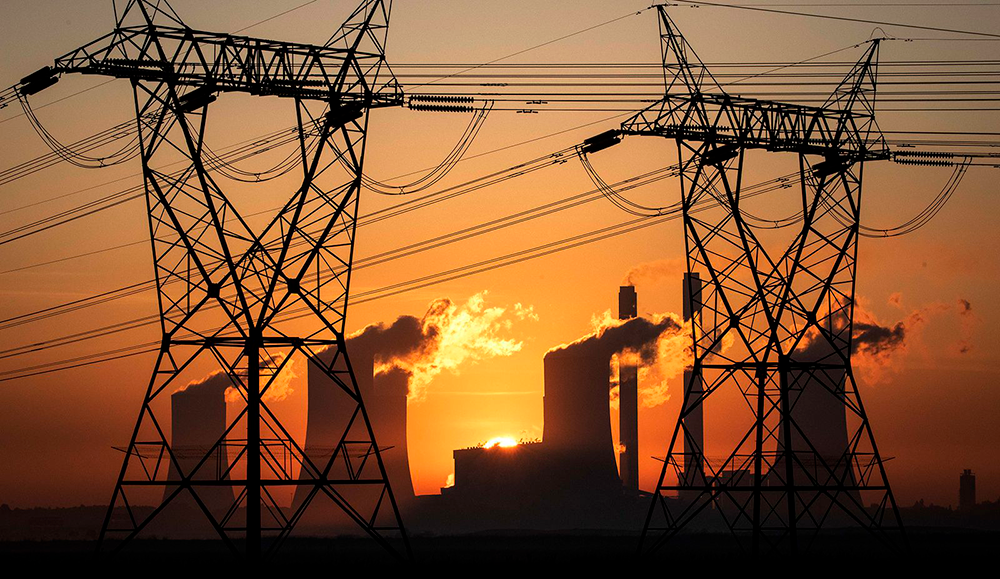
Powerlines lead from Eskom’s Lethabo coal-fired power station in the Free State on 13 April 2023. (Photo: EPA / Kim Ludbrook) 

Former Imperial College London researcher David Mytton reported in 2021 that data centres used relatively little water in the US compared with farming, power generation and other uses. However, less than a third of data centre operators were even measuring water consumption at that time, and the sector has since expanded rapidly.

More crucially, says Mytton, it is essential to measure and monitor the full water demand on a location-specific scale – especially with hyperscale projects such as the xAI “Colossus” data centre in Memphis.

A more recent report by the US-based Environmental and Energy Study Institute notes that the water consumption of about 5,426 data centres in the US is already affecting local communities.

Northern Virginia, considered the world capital for data centres, has more than 300 operational data centres, collectively consuming nearly 7.5 billion litres of water in 2023, a 63% increase from 2019.

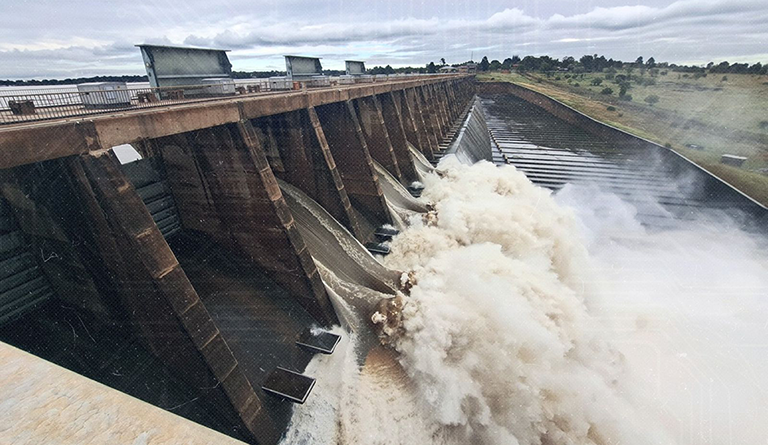
Water pours from the Vaal Dam in Gauteng during a controlled release in April 2025. Concern is growing about the impact of data centres on water security. (Image: Department of Water and Sanitation) 

The institute suggests that some of the larger data centres can consume up to 19 million litres per day, equivalent to the water use of a town of 10,000 to 50,000 people.

One example comes from the town of Bessemer in Alabama, site of a proposed hyperscale data centre. Inside Climate News reported last year that it could consume more than seven million litres of water per day – equivalent to a third of the available water supplied by the local water utility company.

Water use by a Google data centre in The Dalles, Oregon, has nearly tripled in the past five years, and the company’s data centres are now reported to consume more than a quarter of all the water used in this city.

Read more: Growth spurt of data centres could threaten SA’s electricity and water supply

Research by Dutch data scientist Alex de Vries-Gao suggests that global AI systems could have a carbon footprint comparable to a major city such as New York and consume as much water as all bottled water drunk worldwide in a year.

Officials at the International Monetary Fund believe electricity use by the global data centre sector already equals that of Germany or France (see graph), suggesting that indirect water use by the sector is even more substantial.

Electricity consumption by data centres in the United States is climbing rapidly. (Source: 2024 United States Data Center Energy Usage Report) 

Where does the water go?

The International Energy Agency (IEA) estimates that the total water consumption of data centres in 2023 was about 560 billion litres. Of this, roughly two-thirds (373 billion litres) was due to indirect water consumption (energy generation) and only a quarter (140 billion litres) from direct consumption (mainly for cooling data centres). The remainder of the water (about 8%) was used in the manufacture of computer chips and other hardware.

In his study – based on sustainability reports from major tech companies, scientific data on carbon emissions and water use per kilowatt-hour of electricity – De Vries-Gao concluded that previous water consumption estimates by the IEA significantly underestimate indirect water use by data centres and is probably a factor of three to four higher than the official estimate.

He also says that several major tech companies currently do not publish AI-specific figures on the energy and water use of their systems. Therefore, stricter reporting requirements are needed to ensure full transparency.

Similar concerns over transparency have been raised by Alyse Coakley, a policy research assistant at Tulane University in Louisiana. This was partly because water consumption within data centres is often reported using the Water Use Effectiveness metric, often excluding the much larger volumes from electricity generation.

Part of the extensive network of water- and air-cooling pipes on the roof of the Teraco JB4 data centre campus in Isando, Johannesburg. (Image: Teraco) 

Yet sections of the AI and data sector industry have sought to play down such impacts and also resist moves towards tougher monitoring and regulation.

Last year, OpenAI chief Sam Altman asserted that the average ChatGPT query uses the equivalent of one-fifteenth of a teaspoon of water – in sharp contrast to research cited in a Washington Post investigation that generating a 100-word email with GPT-4 required water equivalent to “a little more than one bottle”.

Responding to pressure from European Commission regulators to tighten control on data centres, a major industry group has also criticised plans for new minimum performance standards to conserve energy and water.

The Climate Neutral Data Centre Pact argues that the new standards would focus mainly on the largest operators, excluding smaller facilities. Another industry body, Cloud Infrastructure Service Providers in Europe, recently warned the commission that “burdensome” water use regulations might push operators into other regions.

Closer to home, several South African based data centres are also facing closer scrutiny over their increasing consumption of both water and electricity.

Read more: Major SA data centre expansion plans emerge, set to more than double current power demand

While coal mining and power generation consumed about 7% of water at a national level in 2013, the impacts are more pronounced at a local level. In 2018, power accounted for up to 37% of water use in the Upper Olifants catchment and the largest share of water in the coal-rich Waterberg region.

More nukes, price hikes and ‘beautiful’ coal

An International Monetary Fund working paper last year suggests that electricity prices in the US alone could rise by 8.6% if companies do not adopt renewable sources to power their data centres. Carbon emissions from AI-driven data centre growth could also lead to a 5.5% rise in US carbon emissions over the next five years.

However, any significant switch to renewable energy – in the US at any rate – seems unlikely given that President Donald Trump has signed an executive order titled “Reinvigorating America’s Beautiful Clean Coal Industry” and a second order to “streamline” permit approvals for big data centres.

When it comes to powering data centres, coal-burning is ‘beautiful’, according to Donald Trump. (Source: The White House) 

These pressures from corporate America and other developed nations are likely to ripple outwards into the Global South, according to Lydia Powell and Akhilesh Sati, researchers at the Observer Research Foundation in New Delhi.

Powell and Sati doubt that AI will create a utopian world that is wealthy, environmentally sustainable and equal – nor a converse scenario of a mostly poor, dirty and unequal world

However, they caution that developing nations should be cautious about passively consuming optimistic narratives about the data economy generated by the Global North.

“Companies, rather than countries, have a greater influence on locating data centres, as control of the data economy is almost entirely in private hands.”

Due to increasing pressure to reduce carbon emissions, they suggest data centre expansion could lead to a new form of “climatalogical imperialism” in which developing countries provide the Global North with more land, energy and greenhouse gas emission space to support the data economy.

Researchers from the International Monetary Fund and other groups project that electricity consumption by data centres could equal the current power use of large countries such as Russia by 2030. (Source: IMF) 

They note that the Paris Treaty climate goals require halving data centre emissions by 2030, implying a more aggressive shift to low-emission power.

But renewable energy supplies from wind and solar were intermittent and could not always match real-time peak demand of data centres. As a result, the growth of data centres could lead to a lock-in of fossil fuels – or the re-emergence of nuclear energy as a “clean” power source.

They further note that nearly 60% of the electricity supply in Virginia – home to the largest concentration of data centres in the world – is derived from natural gas, and 30% from nuclear power.

“The development of data centres and AI services is shifting influence on critical decision-making on issues such as the choice of energy source from countries to corporations,” they caution, noting that nuclear energy is emerging as a more dependable energy source for some data centres in the US.

“In the US alone, big tech companies have signed new contracts for more than 10GW of possible new nuclear capacity in 2024, and Goldman Sachs sees potential for three plants to be brought online by 2030.” DM

Next: Clouds of secrecy. Why such silence and evasion over the water and electricity impacts of SA data centre growth?

This article was made possible in part through support from the Henry Nxumalo Foundation.

Major data centre expansion plans set to more than double powerdemand (Part 2/5)

Major SA data centre expansion plans emerge, set to more than double current power demand

South Africa is on the cusp of a hyperscale data-centre boom that could add another 1,000 MW to national electricity demand, driven by massive expansion plans from Teraco and newcomer Cavaleros, alongside Microsoft’s growing cloud and AI footprint.

Just over the past few months, plans for significant “hyperscale” expansion projects in South Africa have emerged that would push current IT power load to well over 1,200 MW – which is equivalent to just over one stage of Eskom load shedding (1,000 MW).

The two biggest expansion projects on the cards involve the Teraco Group (currently the largest data centre provider in SA with an IT load of nearly 190 MW) and the Johannesburg newcomer, the Cavaleros Group.

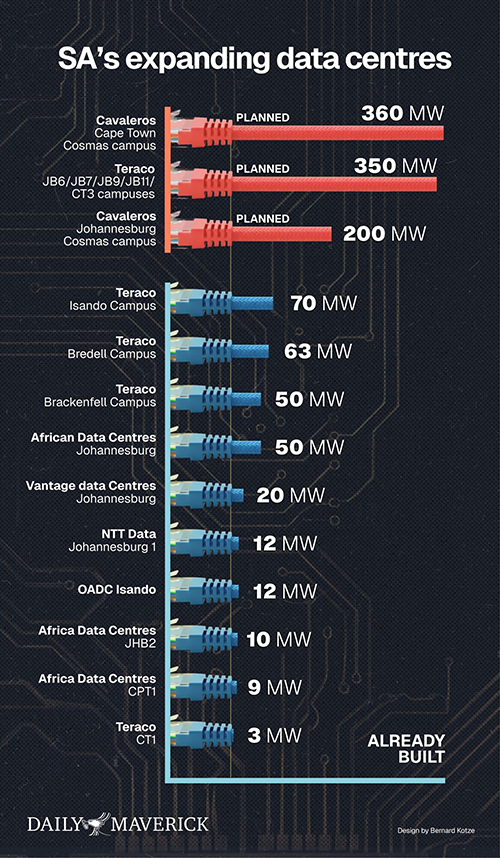
Shortly before Christmas, Cavaleros announced plans to build two new local data centres – a whopping 360 MW campus on a 100 hectare site in Cape Town and a 200 MW campus on a 40 hectare site in the Kosmosdal/Samrand area north of Johannesburg.

Whereas Teraco is a colocation operator (renting out data centre space to about 670 customers), the new Cosmas Data City project by Cavaleros is believed to be linked mainly to the Microsoft Corporation, which recently announced a multibillion-rand investment to expand its cloud and AI infrastructure in SA.

In a joint announcement by President Cyril Ramaphosa and Microsoft President Brad Smith, the US multinational confirmed a further investment of R5.4-billion (in addition to its previous investment of R20.4-billion over the past three years) to establish SA’s first “enterprise- grade” data centres in Johannesburg and Cape Town.

President Cyril Ramaphosa and Microsoft President Brad Smith announce a multi-billion investment AI and cloud expansion project in SA in March 2025. (Image: Microsoft) 

However, neither Cavaleros or Microsoft would confirm (or deny) whether they had entered a business relationship to develop the two Cosmas Data City developments – by far the biggest data centres in SA and Africa.

A spokesperson for Cavaleros said: “All information relating to occupiers or users is subject to strict non-disclosure agreements,” while Microsoft’s local PR consultants said: “Microsoft does not typically share details about its data centre suppliers and vendors and does not have any new updates to share at this stage.”

Cavaleros said the two new centres would be built in phases, but did not provide any timelines on commencement or completion schedules.

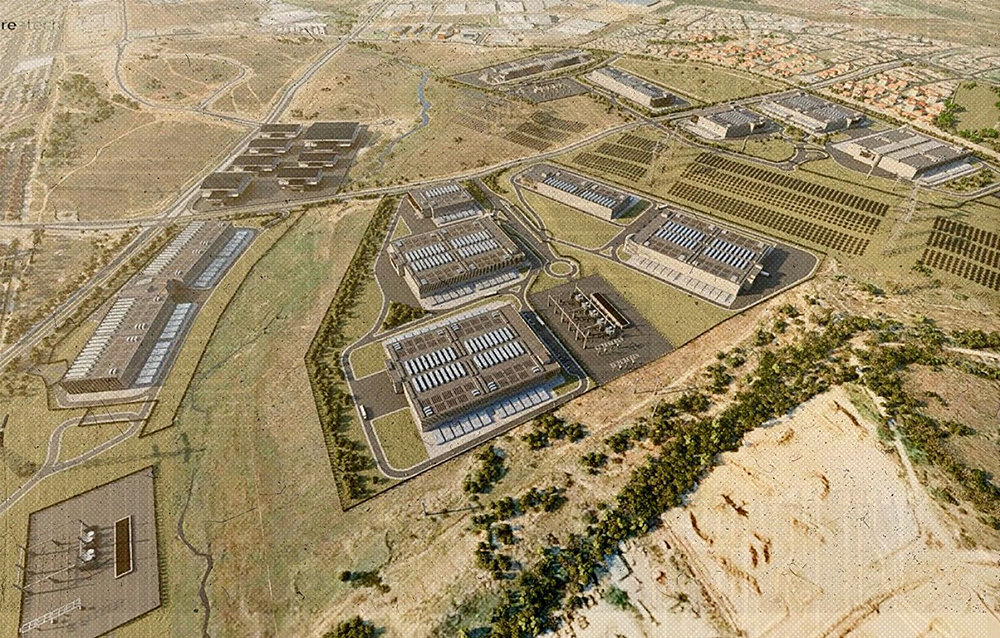
An artistic impression of the giant 200 MW Cosmas Data City project proposed to be built in the Samrand area north of Johannesburg by the Cavaleros property group. (Image: Cavaleros Group) 

Meanwhile, a Teraco document listing current capacities and future expansion plans suggests that the company is targeting 500 MW in total data centre capacity. This would include 290 MW of new capacity in Johannesburg and a further 60 MW in Cape Town, but no timelines have been given.

Other players hoping to expand include Vantage Data Centres, which aim to provide a 100 MW load at two data campuses in Johannesburg.

Whereas the current and future expansion plans in SA may seem like small beer when compared with mega projects like Elon Musk’s 2 000 MW “Colossus” AI data centre in Tennessee, US, local energy analyst Chris Yelland points out that they are “not insignificant” – given the risk of possible supply constraints outlined in a recent Eskom energy outlook report.

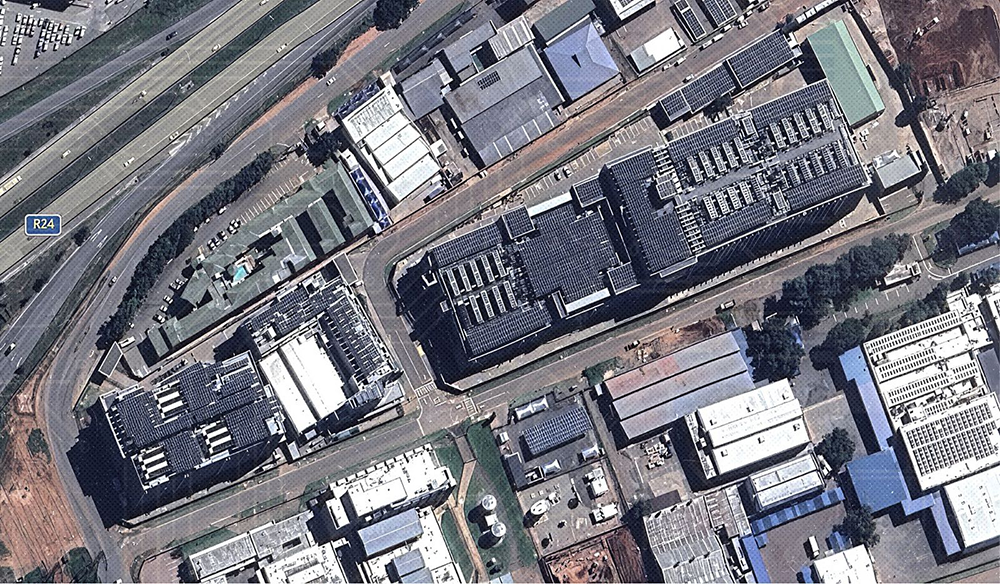
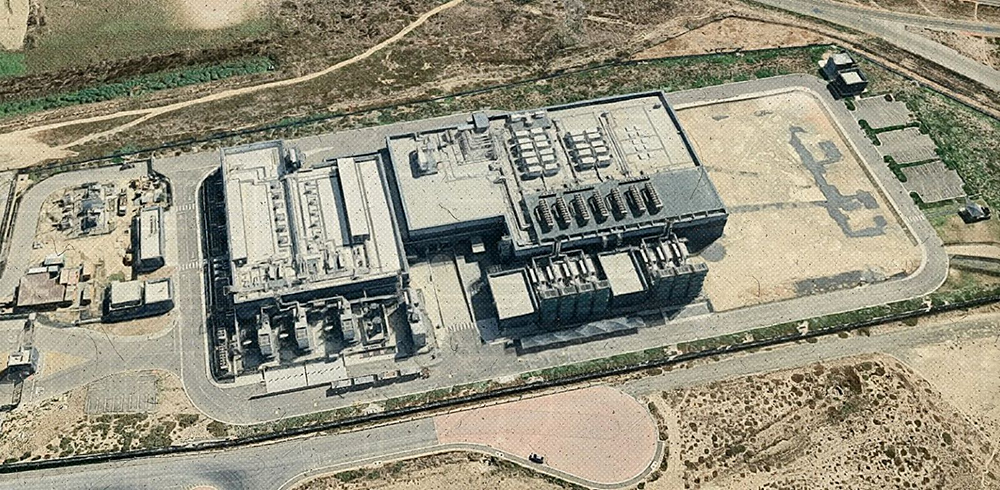
A satellite image of Teraco’s data centre campus near the OR Tambo Airport in Johannesburg, currently the largest cluster in South Africa. (Image: Google Earth) 

Yelland, managing director of EE Business Intelligence, told Daily Maverick that – based on Eskom’s latest risk analysis report – increasing power demand from new large data centres (combined with a possible rollout of electric vehicle charging stations and government subsidies for mothballed metal smelters) would probably lead to constrained electricity supplies by 2029 unless substantial generation capacity was added rapidly.

Read more: Growth spurt of data centres could threaten SA’s electricity and water supply

In a separate analysis piece in Daily Maverick late last year, Yelland said Eskom had also cautioned about a “looming base supply cliff” due to the retirement of certain coal-fired power stations and the expiry of power imports from the Cahora Bassa Scheme. The Eskom power fleet’s energy availability factor (EAF) also remained critical.

Daily Maverick has asked Eskom to provide statistics on current and projected data centre power consumption, without success.

So, in the absence of transparent Eskom statistics and other government sources, the IT peak loads advertised by some data centres gives some indication of their local power use.

A data centre in Ashburn, Virginia, US, where housing developments will soon be walled in by data centres, exemplify the tensions over their unfettered growth. (Photo: Charles A Fazio / Bloomberg via Getty Images) 

However, IT loads may not be an accurate yardstick to measure actual electricity consumption by data centres. Researchers at the Lawrence Berkeley National Laboratory in the US note that data centre servers rarely draw the full wattage for which they are rated on specification sheets.

In a report on US Data Center Energy Usage in 2024, Berkeley Lab scientist Dr Arman Shehabi and fellow laboratory researcher called for much greater transparency around data centres.

“Very few companies report actual data centre electricity use and virtually none report it in context of IT characteristics such as compute capacities, average system configurations and workload types. These details are often considered proprietary …”

The IT loads reported by some local data centres also do not appear to take into account the electricity consumed for cooling and other uses. Depending on cooling mechanisms used, this additional electricity use can eclipse the apparent IT load.

How are centres managing growing power and water demand?

In response to questions from Daily Maverick, Cavaleros marketing manager Mikaela Potgieter said electricity supply and detailed power procurement structures were “commercially sensitive and therefore cannot be publicly disclosed”.

On whether it would draw power from Eskom alone or generate its own power (including renewable energy) Potgieter said: “Any planned additional supply will be regulated, and detailed configurations are not publicly disclosed.”

On whether carbon emissions from the two new Cosmas data sites had been estimated, Cavaleros said: “Environmental considerations are addressed through standard regulatory approval processes.”

Regarding direct and indirect water consumption of the two new centres, the company said water systems would be “designed in line with applicable industry standards and regulatory requirements. Further details are subject to strict non-disclosure agreements.”

Teraco, currently the largest data centre operator in SA, appears to have adopted a much more transparent approach.

Teraco, currently the largest data centre operator in South Africa, has several campuses in Johannesburg, Cape Town and Durban. (Source: Teraco) 

For example, in its latest sustainability report, Teraco provides detailed statistics on total energy consumption over the past four years, along with estimated greenhouse gas emissions and the percentage of renewable or “clean” energy used to offset carbon emissions and power consumption from the national grid.

The company has begun construction of a 120 MW solar PV project in the Free State and also signed a power purchase agreement to source additional renewable wind energy supplies.

Teraco asserts that it is using “zero water” and closed loop cooling systems to reduce water consumption, but nevertheless reports using more than 34,000 kl during the 2025 reporting period (88% of which came from municipal supplies and the remainder from boreholes and rainwater).

“We are firmly on track to supply 50% of our total energy consumption from clean sources by 2027 and achieve 100% clean energy usage by 2035.

“By monitoring and tracking our water usage, our data centres maintain a low water usage effectiveness (WUE) ratio, using only 0.10 L/kWh in 2023, which is less than half a cup of water per IT kWh.

The company adds that: “We are investing massively to reach our targeted goal of 100% renewable energy by 2035 (considering that SA has a national utility that is largely 85% fossil-fuel-based).”

A satellite image of the Amazon Web Services (AWS) data centre in Atlantic Drive, near Dunoon, Cape Town. (Source: Google Maps) 

African Data Centres (which has centres in Johannesburg, Cape Town, Lagos and Nairobi) says it is “committed to achieving carbon neutrality/net zero by 2030 and maximising renewable energy for our pan-African data centre network”.

It has also signed a 12MW power purchase agreement that would increase renewable (wind) energy to over 33% of its South African energy mix through wheeling electricity to three of its local data centres. DM

*Additional reporting by Julia Evans.

Growth spurt of data centres could threaten SA’s electricity and watersupply (Part 1/5)

Growth spurt of data centres could threaten SA’s electricity and water supply

Hype and hope are running high with the spread of artificial intelligence. But is South Africa paying sufficient attention to the risk of a potentially explosive demand for electricity and water by the multitude of data centres at the heart of the AI behemoth?

There are roughly 12,000 data centres scattered around the world, quietly hoovering up huge volumes of electricity, water and mineral resources.

These data centres are the engine rooms of the global IT revolution — cavernous warehouses that house powerful computer servers and networking equipment that store and process the digital data torrent flowing through a multitude of banks, company offices, websites, email and social media platforms.

So far, they only consume around 1.5% of electricity at a global level. But the demand is growing rapidly across the world — an issue that has special relevance for a country still in recovery mode from the social and economic nightmare of load shedding (as well as frequent municipal water supply failures in Johannesburg, Durban and other areas).

Staff monitor data operations from a control room in the massive Citadel data centre in Reno, Nevada. (Image: Switch) 

In a recent report titled Energy and AI, the International Energy Agency (IEA) forecasts that data centres are likely to consume more than 4.4% of global electricity supply within the next decade.

That may not sound like a big deal — but viewing global-scale statistics in isolation dilutes the true impacts at a country, city or local dorpie level.

Look at Ireland, for example, where data centres already suck up 21% of that country’s metered electricity supplies (a five-fold increase over just eight years).

There are also six states in the US where data centres use more than 10% of the electricity supply, with Virginia leading at 25%. In Singapore, more than 7% of national electricity supplies are consumed by data centres.

A chart of global data centre distribution emphasises the dominance of the US. (Source: Visual Capitalist / World Economic Forum) 

One of the main reasons for this rapid increase in data centre power and water consumption is the global deployment of AI, which includes applications such as ChatGPT. The IEA says AI-focused data centres are getting much bigger to accommodate increasingly larger models and the growing public demand for AI services.

Whereas the power drawn from a conventional data centre may be around 10-25 megawatts (MW), the larger AI-focused data centres can draw 100MW or more. One example is The Citadel, a hyperscale facility in Nevada, US, that has been designed to draw up to 650MW of power — equivalent to more than 40% of Durban’s current electricity demand.

This Amazon Web Services data centre is one of more than 300 operational data centres in Virginia, US, that collectively consumed nearly 7.5 billion litres of water in 2023, a 63% increase from 2019. (Photo: Lexi Critchett / Bloomberg via Getty Images) 

An even bigger 2,000MW centre (aptly named Colossus) is under construction in Memphis, Tennessee, by Elon Musk’s xAI group.

The IEA notes that large data centres can consume as much electricity as 100,000 households.

“The largest currently under construction could consume as much as two million households,” says the IEA.

Little surprise then that some very senior power utility executives in the US and elsewhere are worried about meeting surging demand.

In December 2025, Exelon Corporation chief executive Calvin Butler warned that the US energy system warning lights were flashing and could no longer be ignored.

“It’s like you’re driving your car, the ‘check engine’ light is on, and you just don’t want to take it into the shop,” he told Fortune magazine. “I’m telling you on that hottest day or that coldest day, you might have a supply crunch, and people are going to suffer. I’m telling you, you have to fix it now.”

Currently, the largest data centres are in the US, Europe and China, but demand is also rising fast in the developing world. India’s total installed data centre capacity has doubled in only four years, now consuming electricity volumes equivalent to 6.5 million Indian households.

While the US state of Virginia is the global hub for data centres, these energy-hungry facilities are spreading fast across the world. (Source: IEA 2025) 

What about South Africa?

Though power consumption from South African-based data centres appears to be relatively low in comparison to the developed world, Eskom and several municipalities have refused to provide Daily Maverick with electricity consumption statistics by local data centres, asserting that the disclosure of such information is prohibited in terms of the Protection of Personal Information Act or that statistics are not available.

Nevertheless, five Teraco data centres in Johannesburg alone have a combined IT power load of more than 130MW (greater than the municipal power demand of a small city such as Mbombela or Kimberley).

Similar concerns about a potential South African resource crunch were raised in a recent opinion piece published by the National Science and Technology Forum. In the opinion piece, Legal Resources Centre attorney Saadiyah Kadwa and candidate attorney Aaron Tifflin note that the latest digital revolution may come with hidden costs.

“All the personal data we generate — every click, message and photo — is stored not in some abstract cloud, but in physical facilities. Despite its fluffy-sounding name, the cloud is not floating somewhere in the sky. It refers to a network of remote servers and infrastructure, maintained by tech giants, that allows data to be accessed over the internet.

“These cloud services are underpinned by physical data centres, which are massive facilities that house the servers, chips and networking equipment required to store and process digital information.”

A typical interior view of a data centre. Because electrical heat generation is so high, further large volumes of electricity and water are needed to keep them cool. (Image: Switch) 

And as data centres expand, the electrical demand and other environmental trade-offs remain ill-explored, say Kadwa and Tifflin.

“As the country positions itself as a player in the global AI economy, we must ask: at what cost? Technological advancement must go hand-in-hand with transparency, accountability, and responsible stewardship of our natural resources.” DM

Eskom begins solar panel rollout in schools

Eskom, in conjunction with the department of basic education (DBE) and the department of electricity & energy (DEE), has made good on its promise to install solar panels in special schools across the country.
The move comes after the Sunday Times revealed how these schools were receiving huge, erratic electricity bills.


Following the report, the three entities undertook to review the accounts, ensure schools were on the appropriate tariffs and install solar panels.
Eskom said it would broaden the project by including ordinary schools. The first initiative started on November 26, when Eskom handed over rooftop solar systems to five ordinary schools in Orange Farm: Radipabi Primary School, Aha-Thuto Secondary School, Laus Deo Primary School, Moyisela Primary
School and Mphethi Mahlatsi Secondary School. The electricity utility said the programme would continue nationally with support from the DBE, other corporate partners and its customers.


Eskom national spokesperson Daphne Mokwena said that through funding from its foundation, which has dedicated R146m to social programmes for the 2025 financial year, the utility installed “2 × 15kW inverters, 12 × 60kWh batteries and 40 × 620W solar panels” at each school.


Mokwena said the solar installation would result in the schools redirecting their government funds “towards educational resources, maintenance and other essential school needs, further enhancing the teaching and learning environment”.


She said this would “enable Eskom to deliver reliable and sustainable power to schools most affected by electricity interruptions caused by infrastructure theft and vandalism”.


“Orange Farm was identified as a community in urgent need due to the high prevalence of electricity infrastructure damage, which frequently disrupts learning and other essential services. The rooftop solar systems will ensure that the schools remain operational during supply interruptions, allowing teaching and learning to continue uninterrupted.”


On September 7, the Sunday Times published a story on high electricity bills charged to special schools in Limpopo, North West, Free State, Eastern Cape, Northern Cape, Western Cape and Mpumalanga. The eight-month investigation included a sample of 188 electricity bills from 66 special schools, which showed that many schools’ high electricity bills were forcing them to cut back on essentials such as textbooks, laptops, Braille and other resources for deaf, blind pupils and others with special needs. Laptops are indispensable for deaf pupils, as they are used for recording sign-language videos for lessons and exam answers.


The average monthly charge was R60,000, with some as high as R170,000. The charges did not drop during school holidays, when usage should be minimal.


Eskom later confirmed that one of the primary causes for large bills, even during times of low usage, was high notified maximum demand (NMD) charges. NMD relates to the highest amount of electricity a customer is allowed to draw from the grid at any time without incurring penalties and is measured in kilovolt-amperes (kVa).


Ntokozo Abraham is an economic and data journalist, and Vicky Abraham is an investigative journalist for Diary Series of Deaf People (www.thedeafdiary.com). Adam Oxford is a data journalist and founder of
Area of Effect (areaofeffect.tv).

>