

Stock records and insider testimony from Eswatini’s main pharmaceutical supplier have exposed how a simple and avoidable administrative error by the government in 2023 likely resulted in the stock out of several critical medicines for a period of months.
The error in question saw the Ministry of Health suspend Fortunate Bhembe, Eswatini Deputy Director for Pharmaceutical Services and the only official authorised to sign import permits for controlled medicines into the country. The Ministry did not mitigate against the impact that this would have on the medicine supply chain.
High-schedule stock cards, for the period July 2023 to December 2024, were leaked by Swazi Pharm employees. Swazi Pharm is the largest supplier of medicines to the Eswatini government.
The stock cards showed that for a ten month period – between February 2024 and November 2024 – drugs critical for the management of pain, epilepsy and psychiatric conditions remained at zero stock levels. The drugs affected included morphine, fentanyl, pethidine, phenobarbital, haloperidol, codeine and dyhydrocodeine. The Swazi Pharm employees highlighted an eight month period, wherein they said the company could not obtain a signature from anyone within the Ministry for import permits.
They explained that this was because Bhembe had been suspended. She was not immediately replaced and her signing powers were not transferred to any other officials. The Swazi Pharm employees attributed the stock outs to this fact.
The certain consequence was that Eswatini’s ongoing medicines stockout crisis was aggravated. It is likely that many patients in need of pain, epilepsy and psychiatric drugs could not be medicated as a result.
Stockouts in context
Since at least the mid-2010s, Eswatini’s public health sector has battled with repeated drug shortages. In recent years this has seen civil society protests erupt periodically throughout the country.
In late 2022, government commissioned Funduzi Forensic Services to conduct an audit into the country’s acquisition and distribution of medicines to public health facilities.
Historically, drug stock outs in the country have been attributable to non-payment of suppliers, weak procurement systems, and poor inventory control. The Funduzi report further highlighted procurement irregularities, evidence of possible fraud, as well as weak or ineffective internal controls across the supply chain.
Yet the report was not without controversy. For instance, the company was accused of having misled the government about its corporate identity and credentials. Some of the report’s findings have also been disputed by the World Health Organisation.
Still, many of the findings and recommendations were accepted by government.
A hidden consequence
Our investigation now points to a previously unknown negative impact of the Funduzi report’s conclusions and recommendations. The report fingered several officials, including Bhembe, for “causing government to incur fruitless and wasteful expenditure” by unnecessarily ordering medicines that were not in demand.
Acting on the report the Eswatini government suspended Bhembe on 7 November 2023. At the time she was the only government official authorised to sign import permits for companies such as Swazi Pharm to bring controlled medicines into the country.
Shaun Morgan, Swazi Pharm’s spokesperson, explained during an interview the effect that the suspension of Bhembe’s signing powers had on the company’s ability to import controlled medicines into the country.
In the aftermath of the Funduzi report, Swazi Pharm donated its reserve stocks of several medicines – including morphine, fentanyl, pethidine, phenobarbital, haloperidol – to the government.
“We were dealing with the fallout from the leaked report, but with patients already suffering, we chose to act in the public interest,” Morgan said, explaining the decision to donate these medicines to government. The donations meant that the stock levels for several medicines fell to zero in February 2024, as reflected in stock records.
“Under normal conditions, closing stock never reaches (or stays at) zero because new deliveries continuously replace what is issued,” he said.
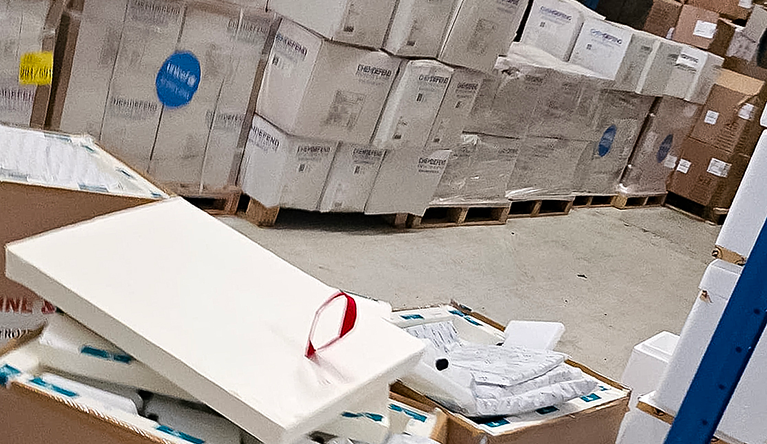
Medicines stocked at the Central Medical Stores before distribution to public health facilities in Matsapha, Eswatini. The facility is the main hub for the storage and dispatch of pharmaceuticals nationwide. Pic: Sibusiso Dlamini/SAAJP
“In a functioning system, stock cleared in January would be replaced through new imports. That did not happen and that gap coincides with the suspension of Fortunate Bhembe.”
Bhembe’s position as Deputy Director for Pharmaceutical Services was only again filled in September 2024, with the appointment of Nomsa Shongwe. This means that no one in government was able to sign for imports for a period of ten months.
Another director of a medicines supplier confirmed that there was no government signatory for the import of medicines during the ten month period of Bhembe’s suspension. She spoke on condition of anonymity to safeguard her relationship with government.
Doctor testimony
Drug stock-outs in Eswatini have a long and complicated history. But, the suspension of Bhembe – and government’s apparent failure to mitigate against the dire impact that the removal of her signing power had on the country’s medicines supply chain – shows that sometimes easily avoidable administrative mistakes can deepen the crisis.
The impact is felt most by patients, often those from very poor backgrounds, who are unable to access the medicines they need to overcome debilitating pain and ailments.
Accounts from within the health sector point to the consequences of stock outs of medicines, such as those reflected on Swazi Pharm’s leaked stock records.
During a recent interview, a doctor at a major government hospital described this impact.
He spoke specifically about not having access to fentanyl and morphine injections, used to control severe pain after surgery, trauma and advanced cancer.
“There were times when patients who should have received proper injectable pain relief could not get it. We relied on weaker alternatives or asked families to source medicines privately,” the doctor said.
The result, he said, was prolonged pain and slower recovery.
Stock outs of phenobarbital, another of the medicines impacted by Bhembe’s suspension, can have dire consequences for seizure patients.
“In seizure cases, delays (in administering medication to the patient) matter. Seizures can last longer or recur, increasing the risk of complications and longer admissions,” the doctor said.
Psychiatric care can be similarly strained by the absence of the correct medicines. Haloperidol, used to stabilise patients in acute psychosis, was often not available to this doctor and his patients, he said.
“When it is not there, patients remain unstable for longer, which affects both their safety and that of staff,” he stated.
Ministry’s right of reply
The stock records and testimony from suppliers suggest that the Ministry of Health made a grave error when it suspended Bhembe in 2023, without mitigating the impact that it would have on Eswatini’s medicine supply chain.
Confronted with this conclusion in an email, which also requested the Ministry of Health’s response to Swazi Pharm and other suppliers’ allegations, spokesperson Nsindiso Tsabedze was dismissive and denied that government was to blame.
But, suppliers remain unequivocal in blaming the ministry for medicines not entering Eswatini for those critical ten months.
“You cannot remove a signatory without ensuring that the function continues,” said one.
“That is a basic systems failure.”
- This story first appeared in The Eswatini Observer