Plastic regulations flouted as Zimbabwe’s crisis deepens

Volunteer of the Environmental Management Agency in a clean-up exercise in Harare's central business district. Photograph Aaron Ufumeli / SA I AJP

Volunteer of the Environmental Management Agency in a clean-up exercise in Harare’s central business district. Photograph Aaron Ufumeli / SA I AJP

In 2010 Zimbabwe’s plastic waste stood at 297,000 tonnes annually, according to a joint University of Zimbabwe and United Nations study. Today it stands at 342,000 tonnes. Of the estimated 1.6-billion plastic containers placed on Zimbabwe’s market every year, only 7.1% is formally recovered, according to Petrecozim, an industry-led post-consumer producer recovery initiative.

This crisis did not emerge overnight. A rapidly urbanising population, swelled by climate-induced migration from rural areas where livelihoods are collapsing, a consumer economy that has embedded plastic into the fabric of daily life, and local authorities too financially strained to sustain basic refuse collection have combined to produce a waste burden that has outpaced every regulatory intervention.

Against that backdrop, the laws were supposed to intervene. They have not. This investigation found two distinct regulatory failures: the non-enforcement of bans on thin plastics and polystyrene that have been law since 2010, and the absence of any legally binding framework compelling producers to recover the plastic waste they generate. At the centre of both failures sits the Environmental Management Agency, the country’s environmental regulatory body.

What the law says

Zimbabwe’s plastic regulatory framework rests on two statutory instruments, a form of secondary legislation used to bring an Act of Parliament into force or alter existing laws.

Statutory Instrument 98 of 2010 prohibited the manufacture, importation and distribution of plastic packaging with a wall thickness of less than 30 micrometres unless it was biodegradable.

To understand what that threshold means in practice: a standard supermarket carrier bag – the thin, crinkly kind that tears easily and goes translucent when held to light — typically measures between 20 and 25 micrometres. A heavier reusable bag or bin liner sits above 30 micrometres. If you can see your hand through a bag when you hold it to the light, it is almost certainly banned.

Statutory Instrument 84 of 2012 strengthened the framework. Section 3(1) re-asserted the ban on thin plastics. Section 3(2) prohibited polystyrene packaging outright — the white foam material used in takeaway containers, meat trays and disposable cups. Section 3(3) required polystyrene users to take responsibility for recycling the material they manufacture and sell.

Most significantly, Section 6 introduced a provision titled “Responsibility of Producers”. It states that any establishment producing, distributing, importing, transporting, recovering or generating plastic waste “must” take all available measures for prevention, reuse, recycling, recovery and disposal at EMA-registered facilities. Any responsible party who wilfully neglects those duties is guilty of an offence liable to a fine, imprisonment for up to one year, or both.

On paper, the regulations are robust. On the ground, they have been dead letters for 15 years.

Failure one: the ban that is not enforced

During visits to markets across Zimbabwe, this reporter found thin plastic bags and polystyrene food containers openly and commercially available despite their prohibition under Zimbabwean law.

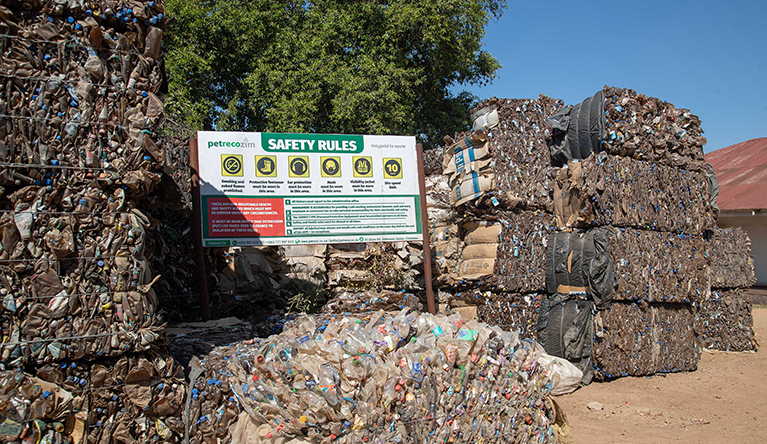
Stacks of used plastic bottles ready for recycling at a plant in Harare. Photograph Aaron Ufumeli / SA I AJP

Stacks of used plastic bottles ready for recycling at a plant in Harare. Photograph Aaron Ufumeli / SA I AJP

The Environmental Management Agency is the designated enforcement authority. Under Section 37 of the Environmental Management Act, inspectors may enter premises without a warrant, seize prohibited materials, issue compliance orders and refer offenders for prosecution. Premises may be closed for up to three weeks for non-compliance.

When asked why banned products remain on sale, EMA’s environmental education and publicity manager Amkela Sidange did not address the question.

This reporter asked specifically: “EMA has powers under Section 37 to seize prohibited products and refer violations for prosecution. Why have there been zero manufacturer prosecutions for producing or distributing plastic packaging banned under SI 84 of 2012 or its predecessor?”

Sidange spoke instead about Extended Producer Responsibility — a post-consumer recovery framework entirely separate from the manufacturing ban. “Extended Producer Responsibility is currently a voluntary best practice rather than a statutory requirement,” she said.

Pressed specifically on prosecutions for banned thin plastics and polystyrene, she responded: “Zero prosecutions or fines have been executed specifically for PET recovery non-compliance, as post-consumer PET recovery targets are not yet codified into mandatory regulations.”

The ban on manufacturing and selling thin plastics and polystyrene has been law since 2010. Neither response addressed it.

EMA said seizures and fines had been conducted over the past 24 months, but provided no names, dates, locations, quantities or fine values. The agency also failed to confirm whether any producer has ever filed the waste prevention targets required under Section 6 of SI 84 of 2012 — a mandatory legal obligation. Follow-up questions submitted to the agency on June 15 2026 went unanswered.

The enforcement gap is sharpened by a direct contradiction in EMA’s own public record. In March 2021, EMA Director of Environmental Protection Christopher Mushava told an international meeting convened by the United Nations Environment Programme – attended by the Basel Convention secretariat and the Norwegian Retailers’ Environment Fund — that the plastic ban had achieved a reduction in thin plastic and polystyrene use of more than 95%. 

Five years later, EMA confirmed in writing that zero manufacturers had been prosecuted. Markets across Zimbabwe carry the banned products openly. EMA did not reply when asked to reconcile these two figures.

Failure two: a recovery system the law never required

The second failure is distinct in nature but connected in cause. Unlike thin carrier bags and polystyrene, PET plastic is not the target of an outright ban. PET — polyethylene terephthalate — is the clear, rigid material used in water bottles, soft drink bottles and cooking oil containers. It is one of the most recyclable plastics in commercial use. It is also one of the most visibly accumulated in Zimbabwe’s waterways, roadsides and open dumpsites.

According to PetrecoZim — the industry-led producer responsibility organisation whose members include Delta Beverages, Dairibord Zimbabwe, Varun Beverages, Schweppes Zimbabwe and Coca-Cola Central Africa — approximately 5,500 tonnes of PET enter Zimbabwe’s market every quarter. Only 393 tonnes are recovered. That is 7.1%.

Both SI 98 of 2010 and SI 84 of 2012 carry the words “Plastic Bottles” in their formal titles. The body of those instruments tell a different story. The core prohibition applies a 30-micrometre thickness threshold to packaging. A standard PET bottle is rigid plastic typically between 200 and 500 micrometres thick — physically outside the scope of that threshold. Neither instrument contains any provision governing what happens to a bottle after a consumer finishes using it.

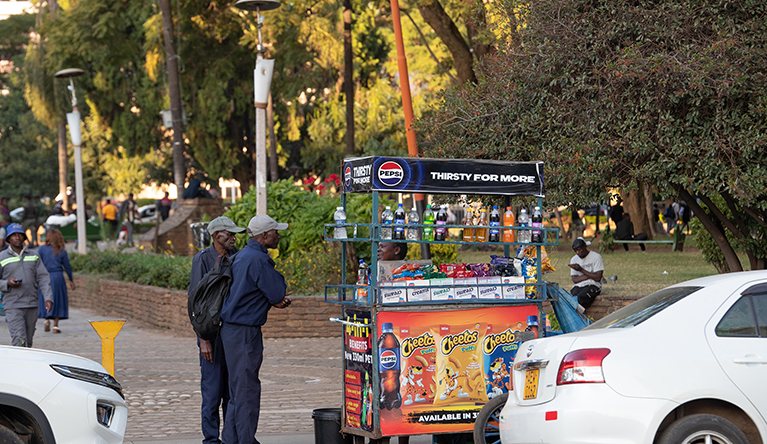
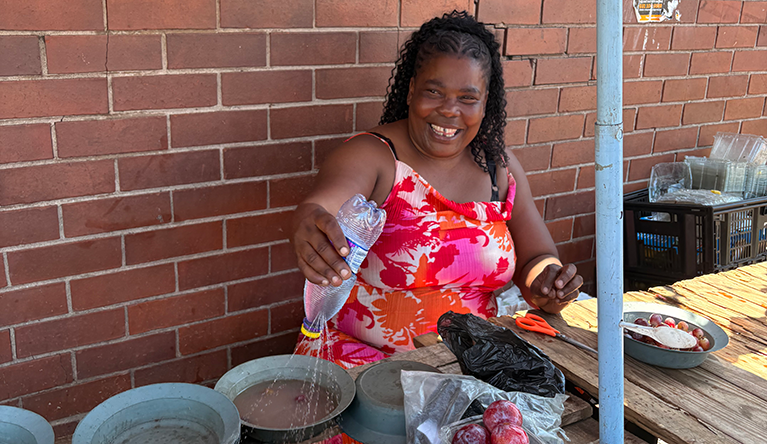
A soft drinks vendor in Harare’s central business district. Photograph Aaron Ufumeli / SA I AJP

“The title of a statutory instrument signals legislative intent,” said Emerge Masiya, an environmental law lecturer at Great Zimbabwe University. “But if the operative provisions do not reach PET bottles, the title cannot create an obligation the body of the law does not establish. The bottles are named. They are not regulated.”

This explains, with legal precision, why the recovery rate is 7.1%. There was never a law requiring anything different.

The voluntary trap

PetrecoZim acting general manager Tendai Nyawiri said the voluntary system has reached its structural limits.

“Benchmarking with regional peers and international systems, EPR cannot work if not legislated,” Nyawiri said. “Members are not obligated to provide reverse logistics. It’s a pro bono service subject to withdrawal and without contractual implications.”

EMA’s own written response confirmed the legal position plainly: “Operating outside of a voluntary EPR network does not make a company an illegal operator under current Zimbabwean law.” A producer placing millions of PET bottles on to the market and recovering none of them has broken no regulation.

Delta Beverages, one of Zimbabwe’s largest beverage producers and a founding member of PetrecoZim, illustrates the structural gap most starkly. On its website, Delta states it has taken “deliberate measures to maintain returnable packaging as the core of its offerings”, and that its approach is based on four principles: reducing packaging material, increasing recycled content, promoting recovery and reuse, and rethinking packaging models.

Yet Delta’s own data shows that more than 70% of its lager beer volume is in returnable packs — a positive step for glass and can formats. For PET bottles, the picture is different. 

This reporter submitted written questions to Delta asking it to confirm its annual PET volume placed on the market, its financial contribution to recovery systems, and whether it had ever filed the waste prevention and recovery targets required under Section 6 of SI 84 of 2012. Delta did not respond by time of publication.

EMA confirmed it has never audited whether any producer has filed those targets. The provision has been law since 2012. Thirteen years, no confirmed compliance, no confirmed enforcement.

The law says ‘must’. EMA says ‘voluntary’.

This is where EMA’s shortfall becomes hardest to defend.

Section 6 of SI 84 of 2012 uses the word “must” and attaches criminal penalties for wilful neglect or failure to recover plastic. Yet EMA has consistently characterised producer responsibility as voluntary best practice throughout this investigation.

Masiya said that characterisation is not legally reconcilable with the statute: “The use of ‘must’ combined with criminal sanctions makes this a mandatory obligation, not a voluntary one,” she said. “Punitive measures are usually linked to mandatory obligations. EMA’s position that producer responsibility is voluntary best practice is inconsistent with the plain language of Section 6.”

She grounded her analysis in the plain meaning rule applied by Zimbabwean courts: where words are unambiguous, courts apply their ordinary meaning. There is nothing ambiguous about “must”.

Masiya added that 15 years without a single referral to the National Prosecuting Authority raises questions under the Administrative Justice Act, which requires authorities to act lawfully, reasonably and in good faith.

“Fifteen years of non-prosecution is not the same as choosing which cases to prioritise,” she said. “That is a blanket non-enforcement — and that is a completely different thing.”

A further problem sits inside the law itself. SI 84 of 2012 amended the core thickness prohibition to read “not less than 30 micrometres” — which as written permits packaging below the threshold and prohibits packaging above it: the precise opposite of the intended ban. This drafting error has stood uncorrected for 13 years.

Masiya said courts would apply purposive interpretation and read the provision as originally intended — but the uncorrected error, she said, “affects the credibility of the agency. If enforcement was really mandatory, why didn’t they fix it?” EMA did not respond to questions on this discrepancy.

Political urgency elsewhere, paralysis here

Against the documented failure of plastic regulation, Zimbabwe’s government has projected environmental urgency in other arenas.

President Emmerson Mnangagwa’s monthly national clean-up campaign — running since 2018 — has mobilised citizens to clear plastic waste from streets and rivers on the first Friday of every month. Cabinet approved the Environmental Management Amendment Bill of 2026, introducing tougher environmental penalties. In May 2026, government fast-tracked Statutory Instruments 91 and 92 of 2026, operationalising the polluter-pays principle for river and wetland protection — moving from Cabinet approval to gazetted law within days.

The political will, where rivers are concerned, is demonstrably real.

The Ministry drew a distinction in its formal response: plastic packaging waste, it said, “does not pose the same immediate, life-threatening risk” as alluvial mining pollution, allowing for “a more consultative, economically measured policy approach”.

That distinction is difficult to sustain against EMA’s own evidence. The same agency told international partners in 2021 that plastic waste kills 5,000 animals annually, including elephants, donkeys and cattle; blocks stormwater drains causing urban flash flooding; and releases toxic gases, including dioxins and furans through dumpsite burning. 

National clean-up campaigns remove plastic from the environment. They do not stop it being produced or compel its recovery. The structural fault — a law that does not require producers to recover what they generate — remains unaddressed.

The government’s own admission

On June 19 2026, Secretary for Environment, Climate and Wildlife Simon Masanga signed a formal written response to questions submitted by this reporter — the most significant official document this investigation produced.

On the enforcement gap, it noted: “The Ministry acknowledges, without reservation, that the absence of a gazetted, comprehensive EPR framework creates an enforcement gap within Zimbabwe’s plastic packaging regulatory architecture. Statutory Instrument 98 of 2010 established a foundational, high-level obligation for producers to manage the end-of-life lifecycle of their packaging. However, it lacked the specific, mandatory mechanisms required to make that obligation strictly enforceable in practice.”

On EMA’s constraints, it said the Ministry “accepts the assessment that current enforcement actions are legally constrained by the narrow scope of outdated instruments, rather than an institutional lack of enforcement capacity at EMA, and is actively working to resolve this statutory limitation.”

On the reason for the three-year gazetting delay, it stated: “While the draft regulations have been finalised for some time, their formal gazetting is currently deferred pending the evaluation of critical macroeconomic and policy concerns. Specifically, the Government of Zimbabwe is executing an Ease of Doing Business initiative. Introducing a new regulatory levy on business owners introduces a high risk of cascading costs, as businesses are likely to pass these compliance expenditures onto consumers, thereby impacting inflation.”

Masanga also confirmed that standing executive directives currently freeze any pending legislation introducing new levies, taxes or regulatory fees, and that the draft EPR regulations must still clear the Attorney-General’s Office and the Cabinet Committee on Legislation before the Minister can gazette them.

South Africa gazetted mandatory EPR regulations in 2021. Kenya and Rwanda have binding producer responsibility frameworks. Zimbabwe has discussed EPR for more than a decade. The regulations are written, approved in draft, confirmed by the government to exist — and sitting on hold.

A familiar pattern

This is not the first time EMA’s enforcement record has attracted scrutiny. A 2022 Auditor General’s report found that EMA issued 109 wetland enforcement orders between 2014 and 2019 and enforced none of them. The National Environmental Council had not met since 2013. The Auditor General concluded that EMA was not adequately carrying out its statutory environmental protection mandate.

A 2022 peer-reviewed study by University of Johannesburg researchers, drawing in part on interviews with EMA officials, concluded that Zimbabwe’s plastic regulations “have not achieved their intended objectives” and face a systemic threat from “insufficient resources or political will to enforce legislation”.

The Ministry pointed to the Environmental Management Amendment Bill and tightened EIA compliance as evidence of reform. Those measures address development approvals and wetlands. They do not address plastic packaging enforcement.

Fifteen years, one question

This is not about one company. It is about whether Zimbabwe’s environmental laws are actually enforced.

The powers exist. The bans are clear. The mandatory language of Section 6 is unambiguous. The draft EPR regulations are finished and waiting. Banned products are everywhere. Recovery is stuck at 7.1%. The regulations that could change everything are being withheld by executive directive.

When asked why violations continue despite EMA’s extensive powers, Sidange said: “Our current enforcement is not limited by our capacity, but by the scope of the existing regulations.”

The Ministry has now confirmed, without reservation, that the scope of those regulations is insufficient.

What it has not explained is why the fix — finalised, confirmed, ready — continues to gather dust while Zimbabwe’s plastic burden grows, its cities fill with waste, and the question of who bears responsibility for the crisis remains, 15 years on, unanswered.

This report has been produced by the Southern Africa Accountability Journalism Project (SA | AJP), an initiative of the Henry Nxumalo Foundation, with the financial assistance of the European Union. It can under no circumstances be regarded as reflecting the position of the European Union

The numbers at a glance

297,000 tonnes: plastic waste generated annually in 2010  —  University of Zimbabwe, 2011

342,000 tonnes: plastic waste generated annually today  —  EMA, 2021 — up 15% under regulation

1.6 billion: plastic containers placed on market annually  —  EMA published materials

5,500 tonnes: PET plastic entering market every quarter  —  PETRECOZIM Q2 2025

393 tonnes: PET recovered every quarter  —  PETRECOZIM Q2 2025

7.1%: national PET recovery rate  —  PETRECOZIM Q2 2025

Zero: manufacturer prosecutions in 15 years of plastic packaging regulation  —  EMA written response, 2026

Zero: companies confirmed to have filed waste prevention targets under Section 6, SI 84 of 2012  —  EMA non-response, June 2026

13 years: since SI 84 of 2012 was gazetted without meaningful amendment

3+ years: draft EPR regulations finalised but withheld from gazetting  —  Ministry of Environment, June 2026

$1.9 billion: declared profit of Zimbabwe’s leading beverage manufacturer  —  ZSE filings

5,000: animals killed annually by plastic waste as of 2010  —  EMA, UNEP presentation 2021

109: wetland enforcement orders issued by EMA 2014–2019 — none enforced  —  Auditor General, 2022

Cooked: the life of informal traders in a heating world 

If Sizeni Dlamini makes R300 from a day’s trade in second hand clothing and shoes, she’ll dip into it to buy basic groceries A bit more, and she’ll add a few more things to the food basket on her way home. More still, and she’ll replenish her business's stock. Picture: Leonie Joubert

If Sizeni Dlamini makes R300 from a day’s trade in second hand clothing and shoes, she’ll dip into it to buy basic groceries A bit more, and she’ll add a few more things to the food basket on her way home. More still, and she’ll replenish her business’s stock. Picture: Leonie Joubert

No work, no pay. 

No one knows this better than Sizeni Dlamini. She’s been selling second-hand clothes and shoes from her patch at Warwick Junction, beneath an overpass in Durban’s inner city, for 16 years. If it rains, passers-by dash through the usually bustling market. Who’s going to stop to browse soggy clothing, and likely get soaked through? 

Same in the heat. 

“People just pass by,” the 55-year-old says. “They don’t have time to stand in the sun and choose clothes. It would be much better if we had shelter.”

Call her what you will — micro-business operator, entrepreneur, street trader — but Dlamini’s isn’t the kind where she can close the shop door when it’s a scorcher, even if trade is down.

The recent summer was pretty grim, even for someone like her, whose body is acclimatised to the notoriously muggy East Coast weather where the warm Indian Ocean puts plenty of water vapour into the air, pushing up the discomfort levels and health risks on hotter days.

“It was really bad,” she recalls.

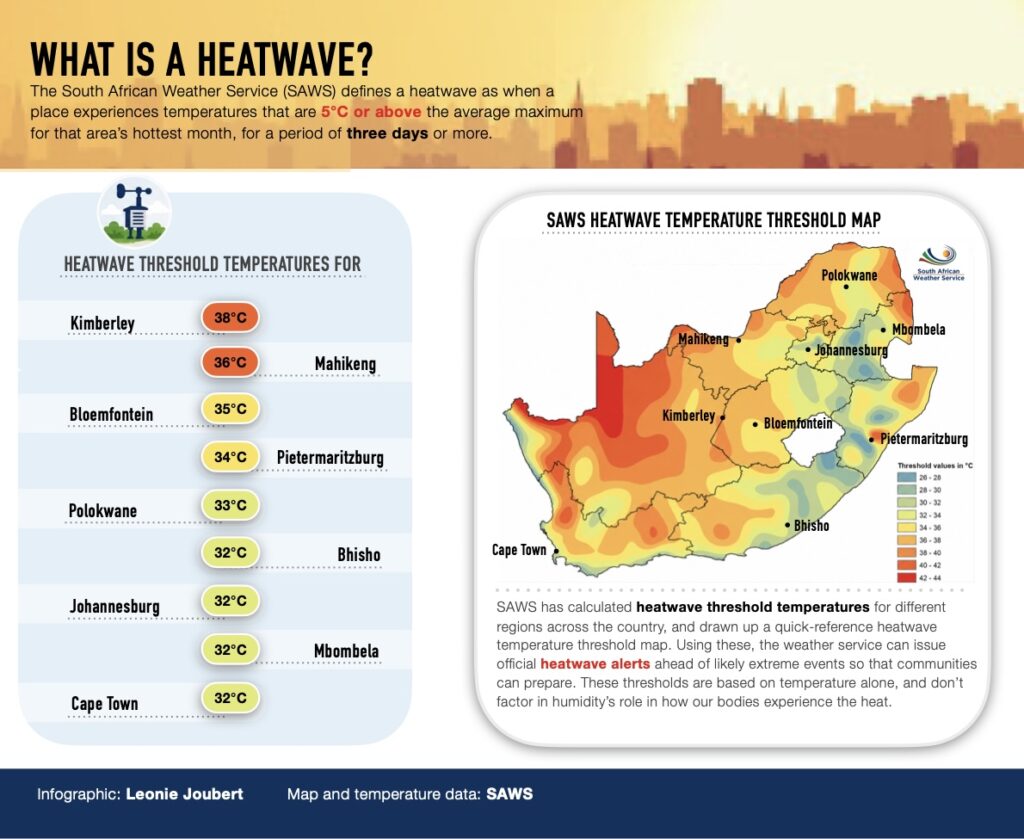
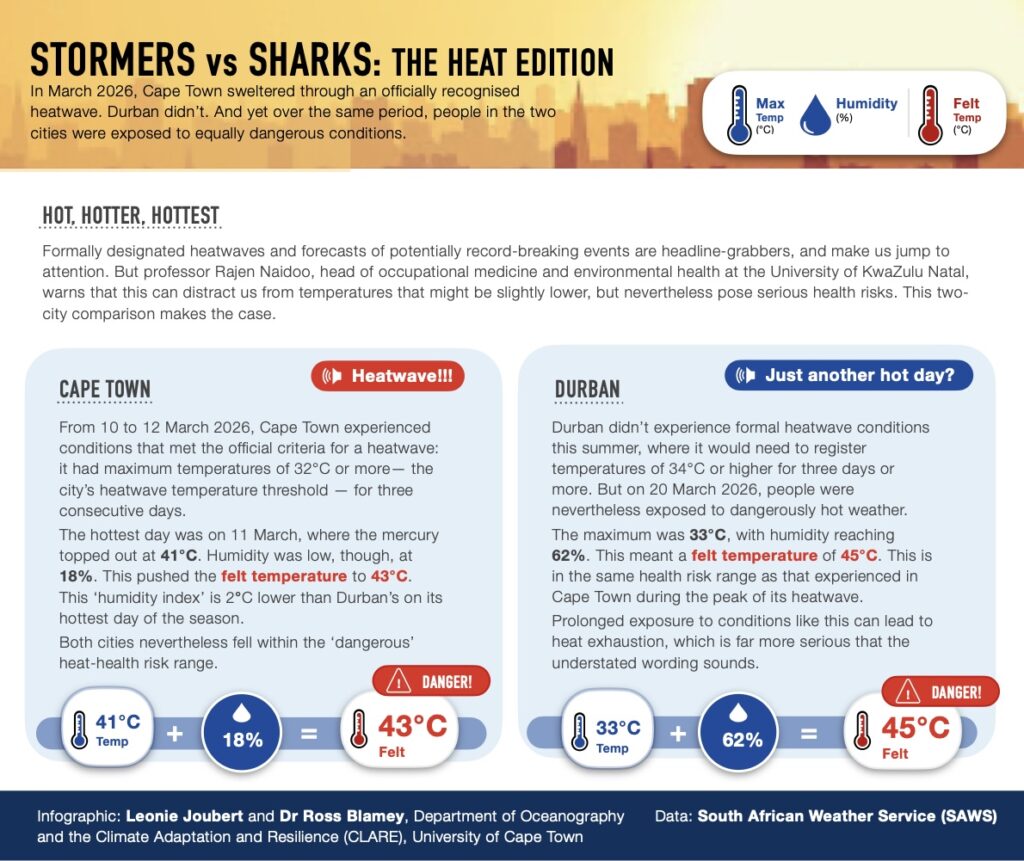
Durban didn’t experience any formal heatwave conditions this summer, according to climatologists — for that, the city would need to register temperatures of 34°C or higher for three days or more — but people were nevertheless exposed to dangerously hot weather at times. The most sweltering day came in early autumn: the Ballito weather station, about 50km north of the inner city, registered a maximum of 33°C on 20 March. With the humidity reaching 62%, the felt temperature  would have been 45°C, well into the range for developing symptoms of heat exhaustion for those not able to find ways to shelter from the heat.


But densely built-up inner city areas like Warwick Junction are heavily tarred, paved and concreted over. Surfaces like this trap heat, making conditions in these heat islands 5°C to 10°C hotter than a city’s leafier outskirts. 

Women feel the heat more acutely than men, and are more likely to be hurt by income loss because of it. It’s partly their body’s make-up — women don’t shed heat through sweating as efficiently as men do, so will experience health impacts at a lower threshold than men — but also because many work in lower-paying and informal heat-exposed jobs, such as farming, street trading, garment making, or care work, according to the US-based non-profit HERA. The organisation recognises the greater risk that lower-income and self-employed women face because of extreme heat, both to their health, and their income, and works in various Global South countries to help them become more heat-resilient.

The first line of defence for traders who are exposed to the elements in this way, local occupational health expert from the University of KwaZulu Natal professor Rajen Naidoo says, is to put in heat-buffering solutions — think in terms of shelter, water, and rest — with the city responsible for most of the necessary infrastructure. 

Once that’s in place, though, a novel form of income protection insurance might be something that could encourage women to shut up shop during the worst of a heat event, without fear of her family going hungry.

Bathroom breaks 

“This is the piss wall,” says Patrick Ndlovu, cheeks dimpling with humour as he points out the face-brick wall with its makeshift urinal along a stretch of pavement not far from the stall holders. 

Hand-sprayed lettering barks a command to passers-by in isiZulu. The sentence is poetic and gritty: two layers of paint, florid green over black; some ee cummings flare to the grammar, which doesn’t bother with capital letters. 

There’s no polite way to tell the urinal’s users that this is no place for solids. 

“If you defecate here,” Ndlovu translates delicately, “if caught, you will be compelled to take it away.”

The wall is topped with coils of barbed wire and some medieval-looking spikes overlooking a riot of off-duty minibus taxis getting soaped down on the pavement. 

At first glance, these facilities look pretty grim. The air is thick with the smell of urine being alchemised into vapour in the mid-morning heat. The two 25-litre water containers — each with a shoulder cut away to create a pee bucket — are working overtime. One’s overflowing, the other’s getting there. But it’s much better than it used to be, according to Ndlovu, who is the co-founder of the urban renewal non-profit Asiye eTafuleni. The organisation has been working here for nearly two decades, supporting informal traders to know their rights and legitimise their place in the city’s economy. 

At a most practical level, that means sorting out the lavatory situation. 

Warwick Junction’s broken-down municipal toilet block has been barred and bolted for six years, with the city giving no indication of why it hasn’t been repaired, or if it will be. For the many thousands of people who pass through this rabbit warren daily, or ply their trade in and around the market, this means that when their bladders call, they have little option but to go al fresco

This is easier said than done if you’re a woman, which matters during summer. Many women traders say they hold back on drinking water during the day because they don’t want to have to deal with the inevitable consequences. 

Between beach brollies and a makeshift sprinkler, fruit trader Nomusa Luthuli protects herself and her stock from the sun which can pummel the delicate plums she’s selling today. Picture: Leonie Joubert

This will lead to dehydration. When the body’s heat-stressed, it puts extra strain on the kidneys, leaving the body’s clean-up system overloaded with salts and toxins but with too little water to do the job. The upshot: higher risk of urinary tract infection, but also longer-term kidney damage. 

In principle, a key solution to a heat-resilient trading community here is simple: get clean drinking water coming in, and black water flushing out. In a sentence: restore the municipal ablution block. 

The eThekwini municipality did not respond to a request for clarity on why the public amenities at Warwick Junction aren’t working, why they haven’t been repaired, or if there are plans to do so.

Until such a time, Ndlovu and his team have been experimenting with low-cost outdoor urinals, knocked together from materials you can pick up at a local hardware store — PVC piping, wooden planks, buckets, shade cloth. Men, at least, have a discrete nook to relieve themselves. They’re asked to pay R2 for the convenience, but no sweat if they can’t, says Ndlovu. 

But what about the women? 

There’s a nondescript plywood walk-in booth near Dlamini’s clothing stall. It’s the size of an average wardrobe, and the only thing telling a passer-by that it’s the women’s facility is the universal sign on the door: a stick-figure illustration of a person in a dress. 

There’s no comfortable sit-down loo with flushing water inside, or even a dry-toilet system. But it’s a private, dignified place for a woman to relieve herself over a small bucket, the contents of which she’ll toss down the nearest storm water drain. 

The next step is to recruit what the Asiye eTafuleni team calls urine entrepreneurs — most likely people living rough in the neighbourhood who are keen to make a bit of cash — to empty the urinal buckets into nearby stormwater drains for a small fee. 

It’s one small part of the shade-water-rest triage that’s necessary to make these traders more heat-resilient in an ever hotter world. 

“Back in five minutes” 

Besides drinking plenty of water during hot weather, traders like Dlamini should do one more thing that they’re not likely to: take a break.  

Because: no work, no pay.

But what if they have income protection insurance that paid out if conditions get hot enough — dangerous enough— that they need to close their stalls for a few hours? Allowing them to stay safe without foregoing the food they need to put on the table that night.  

HERA is piloting something like this in India, Sierra Leone, Pakistan, Thailand and the USA, using philanthropic money, buy-in from local insurance companies, and small premiums paid by traders. Founder and CEO Kathy Baughman McLeod reckons it could work for Warwick Junction traders, too.

“Women in a market in Freetown, Sierra Leone, lose 60% of their income to heat,” says Baughman McLeod. “Whether that’s their own illness, if foot traffic is down, or (when their stock) has gone bad.” 

For the price of roughly one day’s takings — in Sierra Leone, that’s around R130; for Dlamini, it might be R200 — the woman will get paid out the equivalent of a day’s earnings for every day that conditions are hot enough to be recognised as dangerous. It’s an index-based insurance, meaning they’re guaranteed to get a paid out purely on the basis of a heat event occurring. No site-visits or assessments to verify the impact of the heat event. 

The threshold temperature that triggers a heat-event payout is site-specific.  

For traders like those in Durban, this could be calculated based on the city’s own weather station data — it has several — and satellite imagery. Given the Warwick traders operate in an urban heat island, the trigger temperature would need to be calculated to accommodate that, too. Ideally an on-site weather station would give the most accurate measurements of temperature and humidity in the market complex. Some of the HERA pilot initiatives are also drawing on biometric data from traders themselves, using digital fitness trackers which allow a correlation between weather data and the physical markers of women’s heat stress. 

The current insurance structure is event-based. Once a triangulation of different weather data registers that the trigger temperature has been reached, the insurance company partners will guarantee the payout, usually within 10 days or less.  

“But we want to go to forecast-based payouts,” says Baughman McLeod. “If we know it’s going to be hot and humid, and the trigger (conditions) are predicted for, say, five days from now, then half or all of the payout (will be made) in advance. The trigger is the forecast, not the actual event.”

A forecast-based approach would also give women early warning of an approaching extreme event so they can plan stock purchases, make alternate childcare arrangements, and change their operating hours.

Making a plan 

The income insurance isn’t a silver bullet, says Baughman McLeod. The heat resilience triage needs to start with heat-buffering solutions — think in terms of shelter, water, and rest — with the city responsible for most of the necessary infrastructure and various social protections.

The eThekwini municipality says it recognises heat stress as a pressing issue. It has various climate-focused plans, strategies and working groups in place, and has a range of partnerships such as with the World Resources Institute and the C40 Cool Cities network which aim to coordinate climate responses. Although it’s unclear what the timelines are for these solutions materialising in this part of the inner city. 

Until such a time as the city brings the shelter, water, and resting options, the old South African maxim — ’n boer maak ’n plan — is alive and well amongst these stallholders. Thandazile Nyathi sells beef and chicken braaied over open coals at her stand not far from Dlamini’s clothing stall. BBQ sauce, shisanyama spice, plain salt, curry. Loads of sides — rice, phuthu (a stiff porridge from maize meal), beans, spinach, samp, cabbage.  

She trades from a makeshift shelter on a pavement where taxis roar past nearby. Her work-around for not having a fridge?

“You buy your food in the morning, and sell it all in one day,” she says. 

Nomusa Luthuli has some beach brollies that she puts up over her fruit stand when the sun gets hot and high. Soft fruits, like today’s plums, go pap quickly in the heat. Her solution: a repurposed 500ml cool drink bottle, with a few holes punctured on one side, makes a sprinkler system. A few squirts every now and then to cool things down, and her stock will likely have of a longer life. 

This article is from Story Ark – tales from southern Africa’s climate tipping points, an award-winning collaboration with the Stellenbosch University School for Climate Studies, Henry Nxumalo Foundation, and the Pulitzer Center

What Remains of South Africa’s Industrial Dream

Streetview of Vanderbijl Park. Pic: Nathalie Bertrams

Built on steel and state planning, the Vaal Triangle once symbolized South Africa’s economic future. Today, its residents are living through the long aftermath of deindustrialization.

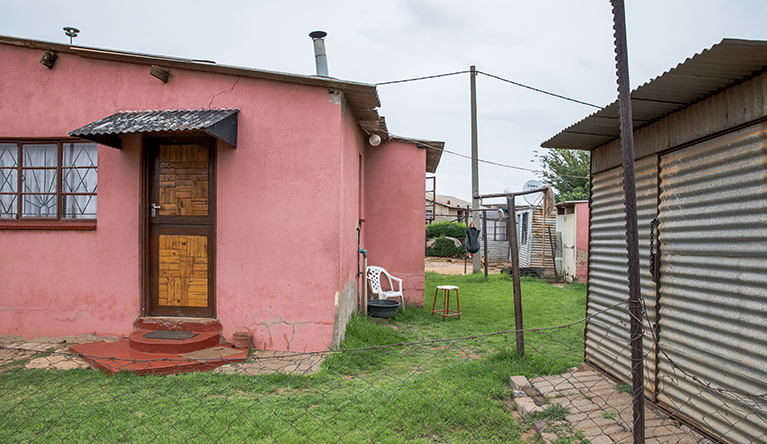
Cold November rain turns Toto Street in Sebokeng township into mud. The road, like most here, is unpaved. Diluted sewage seeps between the small houses behind brick walls and sagging fences, past a general dealer under a corrugated roof, through scattered rocks and loose rubble. Children kick a soccer ball while cars carefully pick their way past.

Inside a backyard house (an informal dwelling built on an existing property), Maselo Lemphane sits wrapped in a red bathrobe. The room is dark — electricity is expensive. A pot of pap, a thick maize porridge that is a staple in South African homes, simmers on the stove. Her baby daughter stares from the doorway of a small bedroom.

“Can’t say it was a nice job,” Lemphane says, remembering her work as a valet at a panel-beating company. “You’re working with water 8-to-5. It doesn’t matter which season it is. You see the weather conditions, it’s raining. But if the clients want the car, they’re like, ‘Gou, gou. Kom, kom! Roer julle gat!’” (“Hurry up, come on! Move your ass!”)

In 2024, the company went bankrupt, and Lemphane was laid off. “Everything changed,” she says. “The food, the insurance. My policies lapsed. Then my mother died. Afterwards, we even struggled to give her a simple dignified funeral. Like, yoh, it strained a lot. Everything changed. Everything.”

At almost 30, Lemphane now raises two children and three siblings while searching for work in South Africa’s rusting industrial heartland, the Vaal Triangle, which consists of three cities — Vereeniging, Vanderbijlpark and Sasolburg — an hour south of Johannesburg.

Her struggle reflects a broader transformation of South Africa’s postapartheid economy. After 1994, the country dismantled the industrial model that had built places like the Vaal. Under three decades of rule by the African National Congress (ANC) party, liberalization and privatization were not matched by the investment and institutional discipline required to sustain heavy industry. Since 2008, more than 560,000 manufacturing jobs have disappeared nationwide.

The Vaal epitomizes that trend. Built around factories that once sustained entire communities, it now faces the compounded effects of industrial decline and a weakened state. In 2011, unemployment in Emfuleni stood at 35%. Today, it is 56% — with youth unemployment far higher — reflecting a decade of deepening labor market collapse. Nearly 28 million South Africans now receive some form of social assistance, including millions who survive on the Social Relief of Distress grant of 370 rands (equivalent to $23) per month.

On Toto Street in Sebokeng. Pic: Nathalie Bertrams

“It assists,” Lemphane says. “But it can only afford a portion of food. That cannot even take up to the whole month till we wait for another payment.” She looks around the small room. “Yoh, there’s a lot of social problems here,” she says. “People are struggling, especially here in Sebokeng. There’s a lot of struggles behind closed doors.”

Lemphane was born after apartheid ended. Her generation came of age with promises of opportunity — just as the industrial economy that had shaped the Vaal for decades was beginning to unravel.

The region’s industrial rise began in the early 20th century, centered on steel production in Vanderbijlpark and Vereeniging — the triangle’s two main cities in Gauteng province — and petrochemicals in Sasolburg, just across the border in the Free State. Behind much of this was the engineer Hendrik van der Bijl, who helped establish key state institutions such as the electricity utility Eskom in 1922 and the South African Iron and Steel Corporation (ISCOR) in 1925, laying the foundations for an economy driven by cheap electricity and heavy industry.

Under apartheid, that system served political power as much as economic growth. Protective tariffs and subsidies consolidated white — particularly Afrikaner — wealth, while Black workers supplied labor without access to political rights. Townships like Sebokeng, where Lemphane lives, housed workers close to factories, preserving inequality and solidifying it in a new geography.

For those employed in steel and petrochemicals, the system did offer stable and unionized jobs, though those would later prove fragile. The exclusion of Black workers from skilled labor was structural and profound. But the industries themselves were strong, and for decades underpinned the local economy.

The ambition of that era survives in remnants, in unexpected places. At the end of a tree-lined driveway off Beethoven Street in Vereeniging stands the Vaal Teknorama museum. Rusting artillery pieces, an ancient tank and a steam engine from 1938 sit on the massive front lawn. Opened in 1990 by apartheid President F. W. de Klerk, the museum was meant to celebrate South Africa’s industry. Today, it is in shambles — dim lights, a photo archive in disarray and abandoned, dusty displays.

In the years after apartheid, the foundations of the model altered. Trade liberalization accelerated. Privatization reshaped ownership. Factories faced new competition as technology changed and global steel markets shifted. ISCOR was absorbed into the global steel giant ArcelorMittal in 2004, and the industry increasingly answered to market logic rather than state mandates.

The consequences filtered through the region. Electricity became less reliable and more expensive. Rail infrastructure deteriorated. Imported steel — particularly from China — intensified pressure on local producers, even as export markets grew more volatile. South Africa once benefited from preferential access to the United States under the African Growth and Opportunity Act. But successive rounds of U.S. trade measures — including steel tariffs imposed in 2018 and new 30% reciprocal tariffs announced in 2025 — narrowed that advantage, adding uncertainty for manufacturers reliant on overseas markets.

The strain extends beyond steel. Sasol’s operations in nearby Sasolburg — once a pillar of industrial expansion — now face strategic uncertainty as the company restructures debt and scales back investment. The state-owned PetroSA refinery has closed. A proposed deal involving Gazprombank fell through amid political and financial turbulence. In Durban, Shell and BP sold their refinery to the government for a nominal sum, but it remains shut. Three decades after liberation, much of the industrial energy infrastructure built in the 20th century is shrinking, stalled or for sale.

A former local mayor recalls warning the national government about rising unemployment in the early 2000s, but large-scale investment never followed.

“The firms are closing down. The companies are liquidated,” says Lemphane. “There’s always retrenchments in the firms, in the companies. So, we’re going to struggle more. This unemployment thing that we’re crying about now, it is definitely going to get worse.”

Vincent Ndemande, born in 1981, also lives on Toto Street with his granddaughter and wife. A black-and-white photograph of his father hangs on the wall of his small living room. He works as a chef, but the job is precarious — his employer recently lost a major client. Around him, people work fewer days or shorter shifts. Salaries no longer stretch to the end of the month, and debt piles up quickly.

“We are asking ourselves,” he says, “when we wake up in the morning and go to work — what will happen?” He shifts in his chair. “I want to tell you straight up. You see all of this. This is torment, guys. I don’t want to look like someone who’s just going to work … and ends up with nothing. There’s never been enough.” He pauses, then adds: “But there’s enough in our government. They told themselves there’s never been enough in their pockets.”

Seven miles away, the cooling towers of the Lethabo coal-fired power station rise above Vereeniging, visible long before you reach the city itself. For decades, electricity from Lethabo fed the steelworks that shaped life across the Vaal. ArcelorMittal’s mill was set to close at the end of December 2025, losing around 3,500 jobs. The Samancor manganese alloy smelter, used in steelmaking, shut down in 2020.

A few blocks from the city’s crumbling main drag stands Delta Marine. Inside, recreational fishing boats loom out of the shadows. A generator throbs in the workshop; the municipality cut the electricity after a dispute over meter readings.

Sonja Theron, 68, stands behind the counter with paperwork spread before her. She has spiky black hair, nail art and a tattoo around her wrist. Her hands cut through the air as she speaks. “I’ve come to a point,” she says, “where I want to say to the municipality, you know what, stick your stuff up your, wherever. … I feel they are still stealing. … I just think that the corruption is sky, sky, sky high. Sky high, the corruption.”

She and her husband bought Delta Marine in 1996, when orders flowed. Their son now designs the boats. Business has been slowing for years. She frequently has panic attacks. “We are,” she says, “literally living from hand to mouth.”

The decline began in the 2000s, when sewage spills into the Vaal drove recreational boaters away. COVID-19 made things worse. Before the pandemic, the company employed 25 people. Today, it’s 15.

“If we make it, I don’t know,” she says. “We’ve sold our caravan, we’ve done this, we’ve done that, to try and just keep going for our son’s sake. But we are going to come to a point where we haven’t got much more to sell.”

She pauses. “I say my knees have got patches on already from praying and asking God, please just give us an outcome. Give us an outcome on this whole situation that we are in. It’s gone down to ground level.”

The generator hum continues behind her, mocking the dream of cheap electricity. Rolling blackouts — known as loadshedding — began in 2007 after years of underinvestment in electricity generation. The state utility Eskom had been earmarked for partial privatization in the early 2000s, and expansion plans stalled just as demand rose.

Later, corruption and state capture hollowed out the utility further. Supply declined while prices rose sharply. Industry groups say the average tariff jumped from about 20 South African cents per kilowatt-hour in 2008 to more than 165 cents in 2024 — another cost absorbed by businesses already fighting to stay open.

Beyond the factory gates, the crisis spreads. On Union Street in Vereeniging, the effects are visible at street level. Potholes scar the road, dirt obscures what remains of the tarmac. Once-thriving shops now struggle to survive.

Inside Taxido Chemist, Faatema Patel, 44, a pharmacist and mother of three boys, works behind the counter, often chatting with regulars. Many once worked in steel or in the industries that depended on it. “January used to be busy,” she says, because that was the month when medical aid benefits reset and people collected prescriptions. “Now we worry.”

Job losses often mean treatment is delayed. Chronic illnesses go unmanaged. Patel says many former industrial workers will end up relying on the public health system, which she describes as already overstretched. “We see patients coming to us looking for medication that just isn’t available there,” she says.

Some antiretroviral medicines are among those facing shortages. A month’s supply in the private sector can cost roughly $22 — almost the same as the 370-rand Social Relief of Distress grants on which many unemployed South Africans depend.

Some arrive with prescriptions they cannot afford to fill all at once. Others ask for smaller quantities, hoping money will stretch a little further. “When socioeconomic circumstances worsen,” she says, “it shows here.”

The pharmacy has ceased selling codeine-based medication to stop a constant stream of teenagers looking to get high: another sign, Patel says, of strain spilling into everyday life. “You already have children seeping through the cracks,” she says. “That’s where your drugs come in.”

Patel lives in Roshnee, a suburb on the edge of the Vaal developed under apartheid as a segregated area for Indian South Africans. The community fixes potholes and looks after its own security and education. Within its boundaries, Roshnee has zero crime.

“I always tell my husband that living in Roshnee sometimes feels like you’re living in The Truman Show,” she says. “You’ve got cameras in every street, access control, and the kids can ride around. But it’s utopian. It’s utopian because the moment you drive out, that’s where the real world begins.”

From township to suburb, residents talk about drugs and how they are tearing apart the social fabric — especially nyaope, a cheap street drug widely smoked in South Africa, containing low-grade heroin mixed with cannabis and often cut with a variety of household chemicals such as pool cleaner and rat poison.

On Toto Street, Selina Marilitsi has watched the change up close. She has lived in the same small house for all her 44 years. She has not had steady work since the Samancor smelter closed in 2020, and has survived on government grants and by selling snacks outside her home.

Like many former industrial workers, she speaks less about factories now than about what happens after they close: long stretches without work, young people with too much time, alcoholism and families stretched thin. Her greatest concern is her two sons, both still at school.

“We don’t want drugs,” she says as damp seeps through the roof. “Drugs are killing our kids. We want our kids to go to school and get education and work for their parents.”

A few blocks away, Kgokare Secondary School stands behind a concrete slat fence topped with broken razor wire. The buildings are worn. Some classrooms have digital teaching aids, but the walls and corridors show years of neglect.

Jeanette Vis is part of the Community Policing Forum, a volunteer patrol group formed by residents in Sebokeng’s Zone 7. She has two children and receives a monthly stipend of $90 for her work at the CPF. In addition to night patrols, she helps guard the school. Crime reaches here too. Some break in to steal copper piping. Others come for food from the storeroom.

“First thing we do every morning, we search to make sure that children are not carrying weapons and drugs in their school bags,” Vis says. “If there was no CPF, these kids would carry the knives to school to stab each other or teachers. It would be really bad.”

Once, unions organized political life here, much as community patrols do now in places such as Roshnee and Sebokeng.

At the regional office of the National Union of Metalworkers of South Africa (NUMSA) in Vanderbijlpark, Kabelo Ramkgathadi traces the arc of the industry through his own career. He started as a general worker 25 years ago after completing high school, later becoming a drill operator and shop steward at MacSteel before moving into local organizing. Since 2019, he has served as NUMSA’s regional secretary.

“When I joined the industry in 2001,” he says, “the rate of unemployment was very low. You would resign or be dismissed from one company and get a job next door.” Back then, factories competed for workers. Union membership was strong because the industry felt permanent.

Now, Ramkgathadi spends much of his time managing retrenchments. ArcelorMittal has cut operations, coking ovens are shutting down and workers have been pushed into working shorter shifts. NUMSA’s regional membership, he says, has fallen from about 25,000 before COVID-19 to roughly 17,500.

“ArcelorMittal now, their main objective is to maximize profit,” Ramkgathadi says. “So they have moved away from that objective of ISCOR.” He says that the company had been expected to stabilize the industry and support surrounding communities, but privatization has created a new reality. “ArcelorMittal does not care about if the community is going to benefit.”

For him, the argument is no longer only about wages or working conditions. It is about whether South Africa still has an industrial strategy at all. “Because while they are wasting time,” Ramkgathadi says of the government, “the moment they wake up, there will be no ArcelorMittal. Because the speed that ArcelorMittal is moving is actually more than 100 kilometers per hour, while the government is moving at 10 kilometers per hour.”

“The problem,” he says, “is that decisions are made far away from here — but the consequences land here.”

Six miles away, the trade union Solidarity describes the same problem in different words. This union — historically aligned with white workers — has also watched its membership collapse as mills downsized. Organizers now help long-time steelworkers write their first CVs and, in some cases, provide food support.

“If I do my part and government does not do theirs, then I feel betrayed,” says deputy general secretary Willie Venter. “People paid their taxes. They trusted government to find solutions.”

The two unions may not agree politically, but they do when it comes to the future of steel. Politicians still speak about reindustrialization, local manufacturing and renewal. Municipal plans tout a new international airport as a “gateway to global markets.” In the Vaal, these promises sound all too familiar, especially around election time.

Pizzo Rapudungwane, 68, spent much of his life involved in ANC politics. He joined protests against racial segregation in education in the 1970s and took part in stayaways and boycotts in the 1980s. His last job was with a garden services company, which maintained the grounds of the steel manufacturer Cape Gate.

He believed in the promise of “jobs, jobs, jobs” in 1994. “Yes, I did believe that they can make jobs. But when time goes on, I see that, no, these people, they are playing with people. There are no jobs. In terms of jobs, we get this thing of retrenchment, company of retrenchment,” he says.

Many older residents still vote ANC, he says — out of loyalty, for grants, for housing, for what the party once represented. “I tell them those things are supposed to be there,” he says. “They are not gifts.”

In 2010, he left the ANC. Rapudungwane explains that he was “talking too much,” being too vocal in his criticisms. “I was an activist who was making strikes at the company, then I saw them killing people inside. But it was an internal thing that they didn’t want people to see. So I said, no, let me get out from this.”

Now he votes for the Democratic Alliance, a party historically associated with white and middle-class voters. Asked what it feels like to leave the movement he once fought for, he pauses. “I feel lonely,” he says.

Lemphane leans forward when politics comes up. She once served as deputy secretary for the Economic Freedom Fighters in her ward, but stepped away after deciding that activism was not changing her circumstances. “I saw myself running for nothing,” she says. “There’s no better change at all.”

She says young people follow politics closely through social media. They see corruption scandals. They watch leaders attack one another. Many no longer take elections seriously. “Whenever a person goes and votes,” she says, “we only vote for a better future. Is it happening? No.”

Asked whether she will still vote, Lemphane nods. “I haven’t given up on voting. What I gave up [was] being an active member of politics. But I’m always practising my right, which is to vote.” Her voice firms. “That one I will never, never let go.”

Lemphane’s insistence on voting comes less from optimism than from resilience. In the Vaal, industry is shrinking and political loyalties are shifting, yet people still turn out to vote. Whether that faith can withstand prolonged economic decline is an open question — not just for this industrial heartland, but for South Africa itself.

This story was supported by the Henry Nxumalo Foundation and the Pulitzer Center.

Tristen Taylor is a South African investigative journalist covering politics and the environment, and a research fellow in philosophy at Stellenbosch University.

Nathalie Bertrams is a documentary photographer and journalist reporting on environmental conflict and social justice.

>