

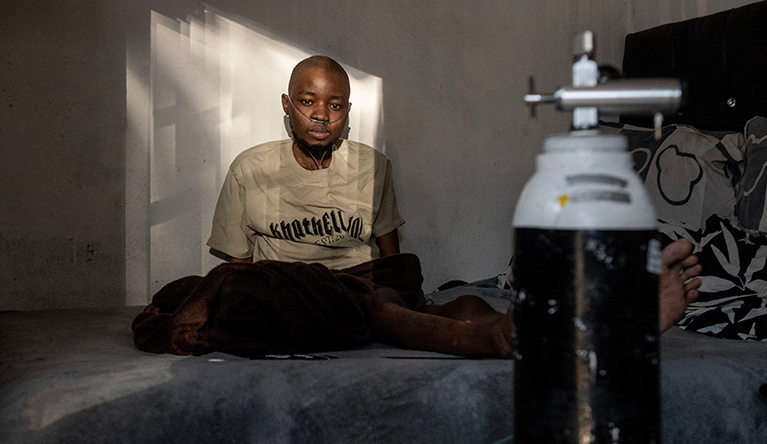
When the electricity goes off at John Gahle’s Johannesburg home, he does not simply wait for the lights to come back on. He starts calculating how long his oxygen will last.
Gahle relies on an electrically powered oxygen concentrator and keeps cylinders as backup. He has spent more than R20,000 on backup arrangements. A 10-litre cylinder lasts about four hours.. “That’s when I start to get panics … because I don’t know,” he said of outages whose duration is uncertain.
For medically vulnerable residents, that uncertainty turns a municipal service failure into something more immediate. Electricity may be needed for oxygen concentrators, nebulisers, CPAP machines or refrigeration. Water is necessary for wound care, continence care and basic hygiene.
Asked what municipalities should do differently, Gahle said they should provide some form of backup support for medically vulnerable people who depend on electricity-powered equipment.
The question his experience raises is what happens to people who cannot afford their own backup when an outage lasts longer than the equipment or supplies keeping them safe.
Jones Majoni, Social Work Manager at the Gauteng Provincial Association for Persons with Disabilities (GPAPD), said water interruptions create particular difficulties for people who rely on caregivers for continence care and washing. Caregivers may have to find water elsewhere, wait for tankers and transport containers home while still dealing with bedding and personal hygiene.
Majoni pointed out that in some households people depend on refrigerated medication, prepared food or powered medical support. When electricity fails, “the food will definitely go off,” he said.
He said the practical and financial burden can shift to families and caregivers, who may have to arrange transport, find water or rely on community assistance when ordinary support systems fail.
A registered nurse who asked to be identified by professional role only said prolonged outages can create serious risks for people who depend on electrically powered medical equipment.
“Prolonged electricity outages can significantly affect patients who are dependent on home CPAP ventilation,” she wrote. “These machines do have batteries, but can only run for a certain period before needing to be charged.” She also identified patients who require home suctioning and nebulisation.
She said water interruptions can have equally serious consequences for people at medical risk, particularly where hygiene and wound care are involved.
“With hygiene and wound care, infection prevention will be compromised as we require thorough hand hygiene before touching or changing dressings,” she wrote.
The nurse also recommended a vulnerability register for priority response by service providers.
“Municipalities should keep an updated register of medically vulnerable households, and prioritize restoration in those areas,” she wrote, adding that alternatives should also be provided during planned or unplanned outages.
Service failures do not only affect the homebound. Mark Rundle, National President of the South African Association of Homes for the Aged (SAAHA), described similar problems in frail-care settings.
Rundle described bedbound or chairbound residents who depend on staff for continence care and personal hygiene. “If you don’t have water for a couple of hours and days, it’s a serious situation,” he said.
Care-home residents who rely on oxygen machines are also at risk during power outages.
Rundle said that those with chronic respiratory conditions who depend on electrically powered oxygen equipment need to be given bottled oxygen or may have to be transferred to hospital if the electricity remains off for too long.
Better-resourced facilities may have water tanks, generators and solar systems, while poorer homes may have none. At the lower end of the sector, Rundle said, “you have no solar power, you have no diesel generators, you have no big tanks with pumps to keep water flowing.”
The same outage can therefore have very different consequences depending on how much money the facility has.
In communities where care organisations already operate with limited resources, service delivery failures mean drastic improvisation.
In Tshepisong, volunteers at the Power of Women and Children and Ithemba Labantwana Children’s Home must find firewood or paraffin to cook outside when there is no electricity. Children do homework by candlelight.
Water shortages also affect the vulnerable. For those with disabilities, carrying containers or walking long distances to collect water is not possible. Volunteers must assist.
Irene Molefe, founder and house mother at Power of Women and Children in Tshepisong, described the pressure on the children’s home when both services fail. “We have to cook, we have to start now going to the garage … looking for water. We can’t survive without water,” she said.
Money gives people more options. A generator gives a household more time if there is fuel. Solar and batteries can keep essential appliances running. Water tanks can help during a temporary water interruption. Private transport can move someone to another place. Backup oxygen can keep someone going when the power is off. But all these things cost money.
Those who can afford it are increasingly buying their own systems because they no longer trust municipal power to be reliable.
Prince Jonah Jordan, owner of Lesiah Electrical Services, said his company saw a 35% to 45% increase in backup-power and solar enquiries from 2024 to 2025.
“Customers are also asking for larger hybrid systems with solar instead of small backup-only systems,” he said.
According to Jordan, typical installed prices in Johannesburg and Pretoria can range from about R28,000 to R45,000 for smaller backup systems, R50,000 to R80,000 for mid-range systems and around R95,000 to R160,000 for fuller hybrid solar systems.
These figures show what it can cost to reduce dependence on municipal electricity, meaning anyone without these large sums at hand is left behind.
A power interruption may affect a whole street, but not everyone on that street experiences it in the same way. One household may switch automatically to batteries. Another may be trying to decide whether there is enough power left to keep a medical device working. One facility may have a generator and water tanks. Another may be sending volunteers to collect water or buy paraffin.
That is where the service-delivery problem becomes a health care issue, and it needs to be addressed.
Responding to questions on this matter, Isaac Mangena, City Power’s General Manager for Public Relations and Communication, said medically vulnerable households must use the normal fault-reporting channels and that City Power does not maintain household medical-condition records.
“City Power is not mandated to maintain records of individual customers’ or households’ medical conditions,” Mangena said. City Power also said it “does not provide specialised or preferential assistance to individual medically vulnerable residents or households”. The utility said generators cannot be deployed to individual households, while identified medical facilities may receive alternative supply where operationally feasible and resources are available.
If City Power does not know that a household contains someone who depends on electrically powered medical equipment, that information is not part of the response when there is a prolonged outage. While the ordinary fault-reporting system may tell the utility that the electricity is off, it does not tell them what the outage means inside any particular home.
Johannesburg Water spokesperson Nombuso Shabalala said the entity’s mandate is to provide water and sanitation services and to deploy alternative water supplies during qualifying interruptions. She said the identification and coordination of broader social or medical support for vulnerable residents falls within the mandates of the relevant municipal and provincial health or social-service structures.
No municipality can prevent every substation fire, burst pipe, cable fault, theft incident or infrastructure failure. The question is what happens when the failure continues and the people affected cannot simply wait. Those who can afford alternatives have more choices. Those who cannot are left relying on ordinary response systems even when the consequences inside the home are anything but ordinary.
This story also appeared in Daily Maverick.