

When Thabo* left Lesotho last year, he thought he was finally travelling to a good job in South Africa. After all, an old school friend working in Rustenburg recruited him, promising decent pay.
He was sent R1000 and picked up in a fancy car from his home at Motete in Butha-Buthe district. Little did he know there was a higher price to pay.
“The man who drove us was so nice; he even stopped with us at the mall and bought us clothes and nice food,” Thabo recalls.
“It all felt like a dream. Until we woke up to a nightmare.”
The driver had taken Thabo to Mandleni informal settlement – a notorious base for illegal mining on the East Rand outside of Johannesburg. He was handed over to a miner whom he knows only as Victor.
His passport was immediately taken for “safekeeping” and told that he owed R6,000 for his journey, his work clothes, to pay for accommodation, and the equipment he would use to work as a miner.
Months later, Thabo still worked tireless shifts underground breaking rocks for Victor and his other handlers. He agreed to be interviewed at a dirt floored shack in Mandleni, where he sleeps on the floor sharing with four other miners, in August this year.
A few weeks after his arrival, he realised that he was trapped in a cycle of debt bondage and forced labour. Thabo tried to escape. He was caught and raped by a crew of zama zamas under his boss Victor’s orders, he says.
A year later, Thabo is still in Mandleni. He lives in constant fear.
“I asked if I could go home. My team leader told me I have to finish off my debts before I can make a new one,” Thabo says.
“He beat me to a pulp a month ago after my shift, and did not pay me for three weeks.”
Debt bondage
Mandleni is an informal settlement situated along the Heidelberg Road near Wattville township in Benoni. Here residents have grown to accept the crews of illegal miners as part of the community. Many, however, remain ignorant to the extent to which these crews rely on the labour of young men and women who are trapped in various forms of “debt bondage”.
Debt bondage is when someone is forced to work to repay a debt, but the debt is structured in a way so that they cannot realistically settle it and escape. It is the most common form of forced labour around the world, according to the International Labour Organisation (ILO).
Thabo’s is not an isolated case. The Southern Africa Accountability Journalism Project (SA AJP) spoke to several young people – men and women – who reported being trapped in a cycle of debt and backbreaking work. This report highlights three interviews from those conversations.
Joaquim* said he was lured by similar promises of work and decent pay from his home village of Inhambane on the southern coast of Mozambique.
He was just seventeen years old when he travelled to Johannesburg two years ago, believing he was going to be employed as a bricklayer for a construction contractor. At the time, he was the only breadwinner for his siblings, who had been orphaned after Joaquim’s parents died in a boat accident while travelling to sell fish to tourists at the city market in Maputo.
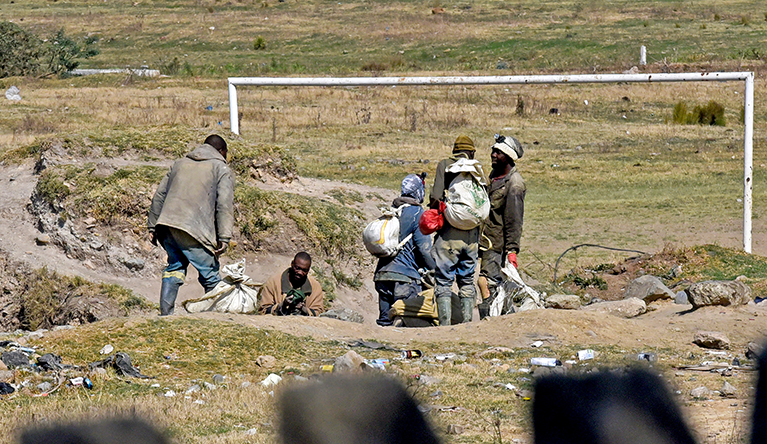
The area is part of an illicit mining network where dozens of young people are reportedly deceived and coerced with promises of decent jobs before being drawn into illegal mining by mining kingpins and gang leaders. Photograph: Tebogo Letsie/SA|AJP
“Our parents’ deaths meant no more income for the family. We were left to fend for ourselves,” he said during an interview in Mandleni.
While looking for a way to make a living, a friend referred him to what he believed to be a construction recruiter who was looking for workers. Unbeknownst to him, he was falling into a trap.
“I called the number, and the recruiter sent me instant money via the M-Pesa money-sending app,” he said.
“I left Maputo after the recruiter based in South Africa sent me a bus fare from my village to Mozambique’s border.”
From there, he was received by a different man who helped him cross the border.
“We drove about seven hours, in a Nissan Double Cab bakkie with two others whom we met at Komatipoort “.
When Joaquim got to Mandleni, there was no construction job, no contract. The introduction was just verbal. He became a zama zama working underground, inhaling dust and praying to make it back safely to the surface each day.
“I asked to leave once and my leader got angry and told me, I can’t leave until my debt is fully paid. I have not tried to escape yet because I have seen and heard stories of what happens to guys who have tried running,” he said.
“Here if you cooperate, you have few problems if you don’t you get punished. I will eventually leave, when the time comes. For now I’m scared.”
How debt controls
The debt is not simply a recruitment cost. It becomes a mechanism for keeping workers trapped.
“The debt does not end because we are also charged protection fees, generator fees, and fuel fees,” said Joaquim.
“Fuel is gold for illegal miners because we use it to generate electricity and light underground. We also use it to operate machinery and drilling equipment underground, so we pay R250 weekly. It is for everyone and if you don’t pay it’s written down and it accumulates.”
After speaking to the illegal miners during our two-month investigation it was clear that this modus operandi was a system designed to trap young adults and teenagers from Lesotho, Mozambique, and Zimbabwe at illegal mining operations in Mandleni. By paying for their transportation and housing, these young migrants were in effect bonded to the illegal mining operation and its owners.
Protection fees, fuel fees, and food are part of the mechanism used by the leaders to control these workers.
The system extends to sexual exploitation
Mpho*, 22 -years-of age, left Lesotho for Johannesburg after a woman in her church WhatsApp group said there were jobs for cooking and cleaning for miners in Carletonville. Transport was paid. Accommodation was to be included.
But, the transport did not take her to Carletonville at all. Instead she was taken to Mandleni informal settlement. There were no formal jobs. She found the settlement was controlled by a network of men who ran the illegal shafts. The woman who recruited her handed her over and disappeared.
“I was sexually abused by the team leader the first month. He came into my shack every day and told me I was his wife. At first I consented to the sex. But one day I refused because I was on my period, and he got angry and sent four men to come and forcefully sleep with me all at once,” Mpho recalled sobbing.
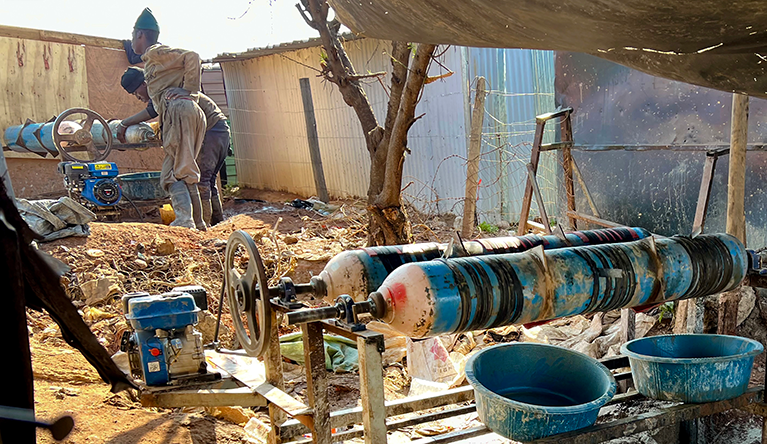
Mpho said she was warned that if she left without paying off her debt, she would be beaten or handed over to police because she had no documents.
According to Mpho, the team leader told her the only way to settle the debt was to “entertain” miners returning from underground.
During the interview, it was evident that Mpho was rolling and smoking marijuana and drinking a Black Label quart. She said this was to numb the pain. She now regrets accepting the offer that turned her life upside down.
“Anyone who wants to sleep with me just pays the boss. I get only R450 a week,” she said.
Mpho said the experience had left her feeling “betrayed, broken, and worthless”.
She said she had previously approached a police officer who frequents the informal settlement for help. Instead, she alleged, the officer reported her to one of the kingpins.
“I told him I needed help to get out of this place because I had been deceived into thinking I was coming to be a cleaner. Now I’m turning into a sex worker.”
When she tried again to report her plight to this police officer, he made light of it. He then asked what she wanted to do.
Mpho said she told him she wanted to leave and report the matter at a police station. But, “he just kept quiet and walked away,” she recalls.
Allegations of police collusion
Throughout this investigation, various interviewees alleged that police officers were working hand-in-glove with the bosses of the illegal mining operations in Mandleni.
These allegations were supported by a shaft guard employed by the same illegal mining syndicate, who agreed to be interviewed on condition of anonymity. The guard said he had been recruited while homeless by a Benoni SAPS officer, whom he named, and was responsible for guarding the entrance to a shaft at Watville Dam, monitoring who entered and left and watching for rival gangs.
He alleged that police were part of the syndicate, providing transport and escorts to miners, while higher-ranking police also benefited. He further alleged that police officers collected regular “tax” or protection fees from miners and regional buyers in return for allowing them to operate undisturbed.
This journalist observed vans carrying police officers, both branded and unbranded, entering Mandleni repeatedly during weeks of reporting, often staying for 30 minutes to an hour or longer. The purpose of the visits could not be established, nor could the allegations of collusion be independently verified.
Hawks asked to comment
SA AJP submitted a query to the Directorate for Priority Crime Investigation (DPCI) spokesperson Colonel Katlego Mogale. The DPCI is the premier law enforcement agency in South Africa concerned with organised crime, including issues of police collusion with illegal mining syndicates and corruption.
Drawing on the accounts of people interviewed for this story, the query highlighted allegations of forced labour and trafficking in illegal mining operations at Mandleni. It also highlighted allegations against the police. The query asked what the Hawks were doing to address these allegations.
Mogale issued a response.
“With regard to allegations of forced labour, human trafficking or exploitation of children, the DPCI is not in a position to confirm or refute such allegations in the absence of evidence establishing the relevant offences. At this stage, the DPCI does not have cases in which alleged victims have come forward and formally reported trafficking or labour exploitation,” she said.
The DPCI further supports a multi-disciplinary approach to illegal mining, recognising that effective intervention requires not only law-enforcement action but also coordinated measures addressing the socio-economic vulnerabilities that contribute to the exploitation of persons within illegal mining environments.”
*The names of interviewees have been changed as they are still in Mandleni and under the control of the illegal mining syndicate.