

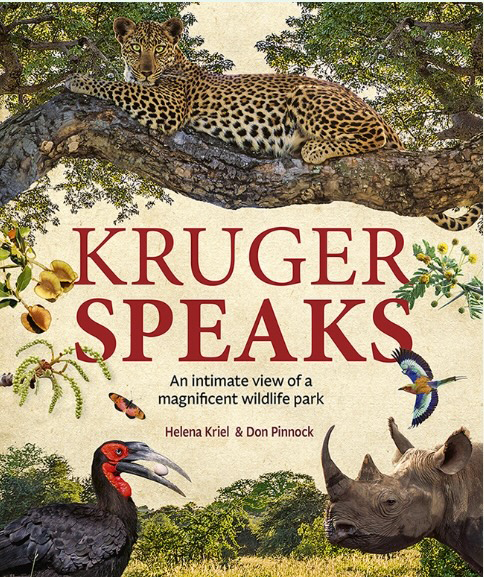
Across nearly 20,000 square kilometres of ancient land, Kruger National Park reveals itself not as a destination, but as a living, breathing presence. In this extraordinary book, the park speaks through a chorus of voices: rangers, scientists, workers, travellers and the wildlife and landscape itself.
From the slow rhythm of a dawn drive to the magnetic silence of a riverbank, each page invites you deeper into a world where elephants shape landscapes, antelope sustain entire ecosystems and birds carry echoes of deep time.
An extract from Let Kruger Speak by Helena Kriel and Don Pinnock (Struik, 2026)
Introduction
There is a place where time slows, not because it’s behind but because it’s deeper. A place where heat hangs over the land and life – vivid, muscular, invisible, immense – pulses just beyond the visible. Kruger National Park is not a destination. It’s a presence. And this book, Kruger Speaks, is our attempt to let it speak for itself – through the voices of the people who live it, guard it, walk it and breathe it, as well as through the creatures, seen and unseen, that define its breath.
Kruger is one of the greatest wildlife sanctuaries on Earth, spanning nearly 20,000 square kilometres across South Africa’s eastern border. But even those who’ve driven its roads or sat silently at its hides have only touched the surface. What lies beneath the tourist map is what this book hopes to illuminate.
Kruger Speaks has three intertwined currents.
The first: the human stories – an astonishing range of voices from inside the park. A cleaner at Satara Rest Camp who rises at 3 a.m. and talks gently about humility and lions. A conservation manager who sees the constellations as old friends. A ranger mauled by a buffalo and bureaucracy and another who considers the dung beetle one of Earth’s greatest engineers. These are the people who keep Kruger alive – quietly, steadfastly, often unnoticed. Their stories are sacred offerings, giving us an intimacy that tourists never see.
The second: the biodiversity of Kruger – its shimmering intricacies, its age-old rhythms, its evolutionary marvels. Here, antelope are not just prey species but architects of the ecosystem. Rhinos are not merely threatened icons but climate warriors, Earth shapers, survivors of deep time. Birds become time travellers, singing threads connecting us to prehistoric forests. Termites aerate the land, hippos breathe in unison and dung beetles roll eternity into spheres of survival. To look closely at Kruger is to discover a biosphere in balance, however fragile – a system of relations so rich it makes the human world look like a stripped-down sketch.
The third: the journey – the slow, ruminative, absorbing experience of driving into Kruger and surrendering to its pace. These lyrical vignettes, sometimes meditative, sometimes electric, run alongside maps showing the very roads and moments they describe. A giraffe alone in the morning haze. A pod of hippos pulsing like one great aquatic being. An elephant standing still in a river, teaching us that nothing is left undone when you have nowhere else to be.
And running through all these stories, like an underground river, is the park’s deep contradiction: it is both wild and wounded. The threat of poaching is real and persistent, and the interviews with those on the front lines of the rhino war – men and women who track, intervene, arrest, grieve and occasionally lose – are raw, fierce and unforgettable. There’s a rhythm to their work, tied to moon cycles and rainy seasons. A strategy board might be covered in scrawls and maps, but the real terrain is human – hunger, corruption, courage, trauma. And tracker dogs. Still, what stands out most is not despair but devotion.
Again and again, the voices in this book return to a central theme: reverence. Reverence for the mopane woodlands of the north. Reverence for birdcalls at dawn. Reverence for the shadow of a lion just out of sight. Reverence for the feel of dust, the taste of air, the way rain smells on hot soil. To experience Kruger fully, you must receive it, say the rangers. Like you would receive rain. Like you would walk into a temple. That’s how this book invites you in – not as a spectator, but as a participant in something ancient, resonant and astonishingly alive.
This is a book to read slowly. A book to pause within. A book to return to, after your visit to the park, when you can’t explain to your friends why it moved you so. It is for those who think they know Kruger and for those who have only heard its name. It is a polyphonic love letter to the land, its people, its animals – and to the complicated, beautiful, threatened miracle of connection.
Because in the end, that is what Kruger teaches most: that life is relational. That wildness is not a spectacle but a system. That humility is not weakness but wisdom. And that wonder, when it comes, is quiet and complete.
Let Kruger speak.
To read the rest of the book, buy it here..